

What if the hours you spend reconciling NDIS portal claims could be reclaimed for participant care? For many Australian providers, the xero accounting cost is often viewed as a simple monthly fee, yet the hidden price of manual data entry can cost a small business upwards of 15 hours every single week. You likely feel the pressure of maintaining strict compliance while trying to scale your services. It’s a common struggle to balance the books when you’re worried about selecting a plan that might lack essential GST or payroll features needed for a 2026 audit.
We’ve simplified the process. This guide reveals the real xero accounting cost for the upcoming year and helps you identify the specific plan that ensures your NDIS business remains audit-ready and financially clear. You’ll discover how to automate your invoicing, eliminate the fear of hidden integration fees, and set a precise monthly budget in A$. We break down the tiers from Ignite to Ultimate so you can stop guessing and start growing your impact with confidence.
Key Takeaways
- Navigate the 2026 Xero tiers to identify the specific plan that matches your NDIS business scale and budget.
- Secure your compliance by discovering why the “Grow” plan is the essential baseline for NDIS providers with employees.
- Calculate the real xero accounting cost by identifying hidden “manual entry taxes” that drain your team’s productivity.
- Organise your financials for success by setting up tracking categories and a Chart of Accounts tailored for NDIS audits.
- Automate your workflow using dock’d to bridge the gap between rosters and Xero for instant, seamless NDIS invoicing.
Xero Accounting Cost 2026: Understanding Australia’s Pricing Plans
Managing an NDIS business requires precision. You need tools that move as fast as your team. The xero accounting cost you pay is an investment in your operational freedom. As of 2026, Xero has streamlined its Australian offerings into four distinct tiers. Each level is built to scale with your provider journey. Review Xero’s history and background to see how they’ve evolved into a global powerhouse for small businesses.
The 2026 Xero Subscription Tiers
Selecting the right plan ensures you don’t overpay for unused features.
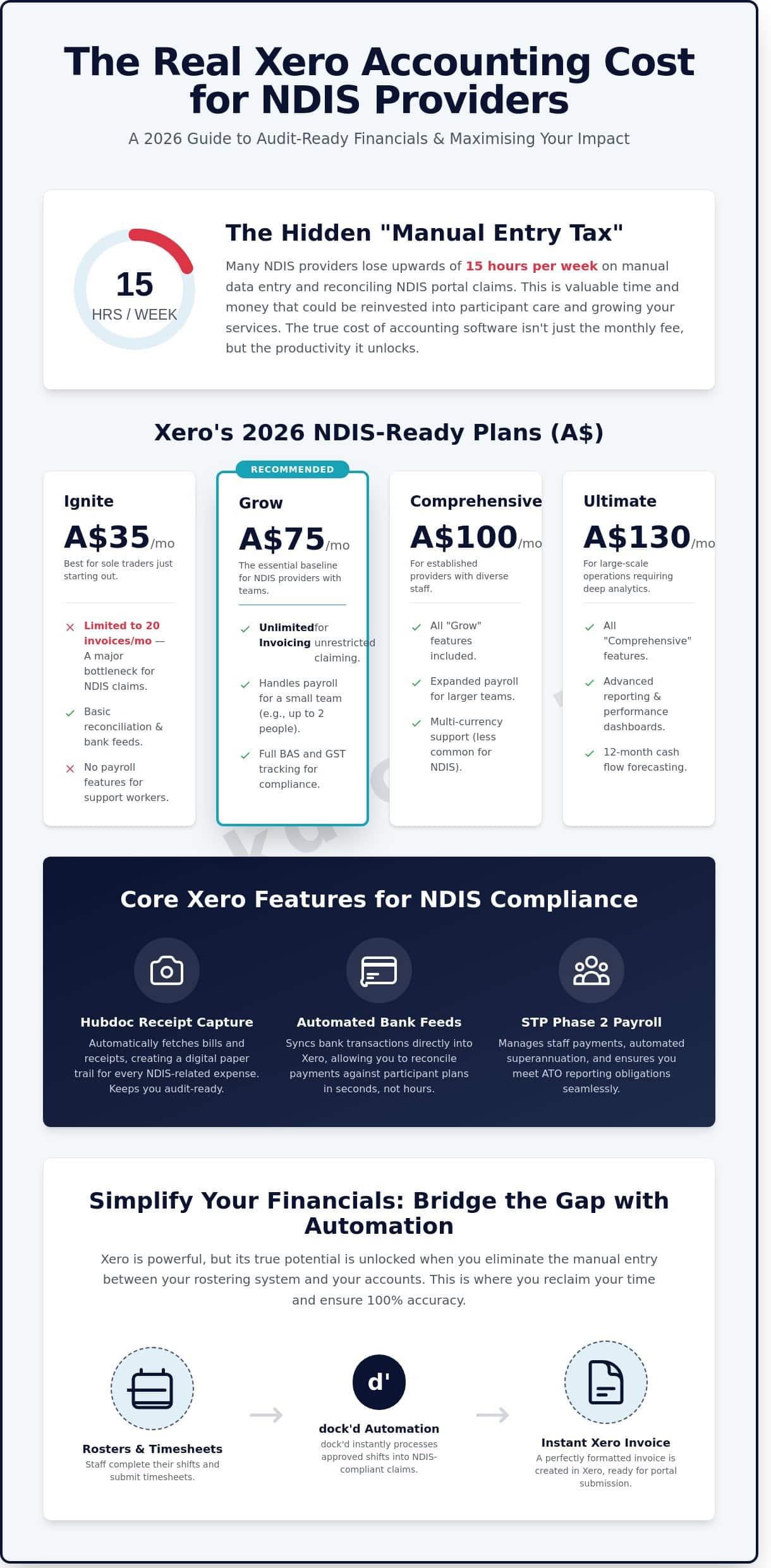
- Ignite (A$35/mo): This entry level suits sole trader NDIS providers. It handles basic needs but has strict limits on invoice volumes.
- Grow (A$75/mo): Most small NDIS teams land here. It offers unlimited invoicing. This is vital when you’re billing multiple participants weekly.
- Comprehensive (A$100/mo): This tier adds multi-currency and advanced payroll features. It’s built for established providers managing diverse staff.
- Ultimate (A$130/mo): The top-tier choice. It includes advanced reporting and expenses for large-scale operations.
Standard Features for NDIS Compliance
Every plan includes core tools to keep you audit-ready. Hubdoc is the standout feature here. It fetches your bills and receipts automatically. This creates a digital paperless trail for every NDIS expense. You won’t lose a receipt again. Automated bank feeds are another essential. They sync your bank transactions directly into the software. You can reconcile payments against NDIS plans in seconds.
Real-time financial reporting keeps you ahead of the tax office. You can track your BAS and GST obligations as they happen. This visibility prevents end-of-quarter stress. You see exactly what you owe and what you’ve earned. This transparency is crucial for maintaining your NDIS registration status.
Why NDIS Providers Must Look Beyond Ignite
Don’t let a low price tag stall your growth. The Ignite tier often restricts the number of invoices you can send. In the NDIS world, volume is common. You might serve 15 participants but send 40 invoices a month. Ignite will block your progress. Moving to the Grow tier unlocks unlimited invoicing. It allows your business to breathe. It simplifies your billing cycle.
Choose the plan that fits your future, not just your current size. High-performing providers prioritise scalability over the lowest monthly xero accounting cost. It’s about finding the flow that keeps your business moving forward. Fast, secure, and reliable software is the backbone of a modern disability service.
Choosing the Right Xero Plan for Your NDIS Business
Select a plan that matches your operational tempo. Your xero accounting cost is an investment in your back-office efficiency. Don’t settle for the entry-level Ignite plan if you manage more than two participants. It caps your invoicing at 20 per month. That’s a bottleneck you don’t need when you’re trying to scale a support business. Most providers find the Grow plan is the absolute baseline. It removes those restrictive caps and allows for the high-volume transaction environment common in the disability sector.
The Grow plan is the standard for NDIS providers with a small team. It handles the heavy lifting of daily admin while keeping your data secure. Higher tiers like the Comprehensive plan add multi-currency features. These are largely irrelevant for local NDIS work, but the real value lies in the advanced performance dashboards. These tools offer 12-month cash flow forecasting. They help you stay ahead of your labour costs and tax obligations. Use these insights to unlock better decision-making for your next equipment purchase or office lease. Align your plan choice with the latest NDIS Pricing Arrangements and Price Limits to ensure your margins remain healthy as government rates shift.
Payroll and Superannuation Requirements
Managing a team of support workers requires precision. Xero’s payroll tiers are strict. You must match your staff count to the right limit. The Grow plan usually supports payroll for two people, while higher tiers expand this to five or unlimited users. Automation is your best friend here. Xero handles Single Touch Payroll (STP) Phase 2 reporting requirements seamlessly. It ensures you meet your Australian legal obligations without manual data entry. Set up automatic superannuation payments to keep your business compliant. It’s a simple way to build trust with your team and avoid ATO penalties.
Invoicing Volumes and NDIS Claiming
NDIS providers live and die by their cash flow. If you’re restricted by invoice limits, your growth stalls. The Grow plan provides unlimited invoicing. This is essential for managing bulk claims through the PRODA portal. You can’t afford to wait until next month to bill for services rendered today. Use Xero tracking categories to tag every invoice to a specific participant or service type. This data shows your profitability per participant instantly. It makes your financial management as streamlined as a well-maintained vessel. You get clear visibility on your business health. Focus on providing quality care rather than fighting with spreadsheets.
Beyond the Monthly Fee: Hidden Costs of NDIS Accounting
Don’t just look at the subscription price. The true xero accounting cost includes the “Manual Entry Tax.” This is the invisible drain on your budget. If your team spends 10 hours a week re-keying data from NDIS service agreements into Xero, you’re losing A$450 weekly at an average admin rate of A$45 per hour. That totals A$23,400 per year. It’s a heavy price for inefficiency. Stop draining resources on manual tasks. Use automation to reclaim your time and focus on participant care.
The Labour Cost of Disconnected Systems
Disconnected systems create friction. Moving data manually from NDIS service agreements to Xero increases human error. A single typo in a line item leads to payment rejection in PRODA. Statistics show that 15% of NDIS claims fail due to data entry errors. This forces your team to repeat the work. Integration reduces the need for expensive external bookkeeping hours. Check out this guide for business owners to understand how to structure your financial team effectively. High-tech systems ensure your cash flow stays steady and your records remain pristine.
Optional Xero Add-ons for Providers
Customise your setup with targeted add-ons. Xero Expenses costs A$5 per user monthly. It’s vital for support workers claiming travel or supplies while in the field. Xero Projects allows for precise job costing. Use it to track SIL (Supported Independent Living) margins and ensure your accommodation services remain profitable. You might also need NDIS rostering and invoicing software integrations like CareVision or ShiftCare. These often range from A$100 to A$500 per month depending on your participant count. Factor these into your 2026 budget to avoid surprises. Seamless integration is the key to a scalable operation.
Cheap software often costs more during an NDIS audit. Non-compliance can result in fines or suspended registrations. A 2024 NDIS Commission report highlighted that 12% of providers faced sanctions due to poor record-keeping. Proper implementation is an investment. Expect to pay A$2,000 to A$5,000 for a professional setup and team training. This ensures your bookkeeping team operates with nautical precision. Secure your future by building a solid foundation now. Unlock your growth potential by investing in the right tools and training from day one. It simplifies your journey and protects your reputation. Before committing to any platform, review a detailed dock’d vs Brevity comparison for NDIS software in 2026 to ensure you’re selecting a solution that eliminates manual PRODA claims and reduces your administrative overhead.
How to Organise Your Xero Setup for NDIS Success
Efficiency is the engine of a successful NDIS business. If your backend is a mess, your front-line care will suffer. Managing your xero accounting cost in 2026 starts with a clean architecture. You need a system that tracks every cent from the NDIS portal to your support workers’ bank accounts without manual friction. Stop treating your accounting software like a digital shoebox. Start treating it like a high-performance dashboard that unlocks growth and ensures compliance with Australian tax laws.
Tracking Categories are the key to NDIS profit analysis. By assigning categories to every transaction, you can see exactly which service lines are profitable and which are draining your resources. This level of detail is vital for the 2026 NDIS landscape where margins are tighter and audit requirements are stricter. Set up categories for support types like Core, Capacity Building, and Capital to keep your reporting sharp.
Strategic Chart of Accounts Setup
Your Chart of Accounts (COA) is the foundation of your financial house. Don’t dump all your income into a single “Sales” account. Separate your NDIS revenue from private-pay income and other streams like My Aged Care. For example, use account codes like 4-1000 for NDIS Plan Managed income and 4-1100 for NDIS Self-Managed income. This clarity makes it easy to reconcile the bulk payments you receive from the PRODA portal.
- Map support worker wages directly to specific service delivery costs in your COA.
- Create separate expense accounts for NDIS-specific costs like audit fees and software subscriptions.
- Use specific codes for GST-free NDIS supplies to ensure your Business Activity Statements are accurate.
Problem: Reconciliation takes too long. Solution: Bank rules. Action: Configure Xero to recognise the “NDIS PAYMENTS” description from your bank feed. Automating this step can reduce your weekly admin time by up to 5 hours, effectively lowering your internal xero accounting cost by freeing up staff for billable tasks.
Automating the Invoicing Workflow
Manual invoicing is a relic of the past. For regular support schedules, set up recurring invoices in Xero. This ensures your claims are ready the moment the service is delivered. If you handle private-pay clients, enable Xero’s online payment options like Stripe or GoCardless. Data from 2025 shows that providers using online payment gateways get paid 14 days faster than those relying on traditional bank transfers.
The real magic happens when you connect Xero to your operations. Integrating your finance system with The Ultimate Guide to NDIS Software allows for end-to-end automation. This connection pushes timesheet data directly into Xero payroll and generates invoices based on verified service bookings. It creates a seamless flow that eliminates double data entry and reduces human error to near zero.
Ready to scale your operations without the administrative headache? You can optimise your NDIS business operations today by choosing the right digital tools to support your journey.
Simplifying Your NDIS Financials with dock’d and Xero
Managing NDIS financials shouldn’t feel like navigating a storm without a compass. You have already calculated the xero accounting cost for the 2026 financial year; now it’s time to ensure that investment delivers a high return. dock’d acts as your digital navigator, bridging the gap between complex NDIS rosters and your Xero ledger. By connecting these two powerhouses, you transform a fragmented admin process into a high-performance engine. This integration ensures that your focus stays on participant care rather than being anchored down by paperwork.
The ROI of automation is clear. Providers using integrated systems report saving upwards of 12 hours during every NDIS claim cycle. This efficiency comes from a “Single Source of Truth” approach. When your roster, NDIS service agreement management, and accounting data live in a unified ecosystem, compliance becomes a natural byproduct of your daily operations. You no longer need to cross-reference three different spreadsheets to prove a service was delivered. Every dollar is tracked, every hour is accounted for, and your tax obligations remain crystal clear.
The dock’d + Xero Integration Advantage
- Eliminate manual entry: Push NDIS invoices directly to Xero with a single click to remove the 15% error rate typical of manual data entry.
- Sync timesheets instantly: Move staff hours straight into Xero payroll to ensure your team is paid accurately without double-handling data.
- Track service agreements: Monitor real-world spending against participant budgets in real-time to prevent over-servicing or budget blowouts.
Future-Proofing Your Provider Business
Scaling from a sole trader to a team of 40 or more shouldn’t lead to a total admin meltdown. Integrated systems allow you to increase your participant load without hiring additional office staff just to manage the books. This scalability turns the xero accounting cost from a simple overhead into a strategic asset. When mid-term NDIS audits or registration renewals arrive, you won’t be scrambling for records. Your digital trail is already organised, secure, and ready for review.
Your NDIS financials, simplified. By removing the friction from your maritime of mandates, you gain the freedom to explore new growth opportunities for your business. If you are ready to move beyond basic bookkeeping and build a robust care enterprise, explore our comprehensive guide on NDIS Software for Providers. It is the roadmap you need to scale effectively in the 2026 market. Set up your seamless financial ecosystem today and leave the manual data entry behind.
Take Control of Your NDIS Financial Future
Master your cash flow and keep your NDIS business moving forward. By 2026, the xero accounting cost for Australian providers will reflect a more specialised landscape, requiring you to choose between plans that often start from A$60 to A$115 per month. Hidden fees for additional payroll seats or third-party reporting tools can add A$10 to A$30 to your monthly bill if you don’t plan your budget early. Success in the NDIS space depends on accuracy and speed; you need systems that talk to each other without manual data entry. Our Australian-owned and operated platform bridges the gap between your daily operations and your financial records. We provide NDIS-compliant invoicing and a seamless Xero integration to ensure your claims are processed without friction. Stop wasting hours on administrative paperwork and focus on delivering high-quality care to your participants. Your business deserves a clear path to growth and financial clarity.
Simplify your NDIS accounting; see how dock’d integrates with Xero today.
Your journey toward a more efficient NDIS business starts now. We’re here to help you navigate every step with confidence.
Frequently Asked Questions
Is Xero Ignite enough for a new NDIS sole trader?
Xero Ignite works for very low-volume NDIS sole traders, but its limit of 20 invoices per month is a major bottleneck. Most providers outgrow this plan within 90 days as they take on more participants. Upgrade to the Grow or Comprehensive plan to handle unlimited invoicing and automated bank feeds. It’s about finding your rhythm without hitting administrative ceilings early on.
Does Xero accounting cost include NDIS PRODA claiming?
Your Xero accounting cost doesn’t include direct NDIS PRODA or PACE claiming functionality. Xero manages your general ledger and tax compliance, while PRODA handles the actual claim processing. To bridge this gap, most providers integrate Xero with a dedicated NDIS platform like dock’d. This connection automates the flow from service delivery to payment reconciliation instantly.
Can I track NDIS participant budgets directly in Xero?
Xero doesn’t offer native NDIS participant budget tracking as a standard feature. You can use Tracking Categories for basic monitoring, but this becomes difficult to manage once you have more than 5 participants. For precise budget management, integrate your accounting software with a specialist NDIS tool. It keeps your finances clear and ensures your participants’ funding remains secure and visible.
How much does Xero Payroll cost for a team of 10 support workers?
For a team of 10 support workers, expect to pay approximately A$100 to A$120 per month depending on your base plan and specific add-ons. The Xero Ultimate plan includes payroll for 10 people in its standard pricing, which simplifies your monthly overheads. This setup ensures your Single Touch Payroll (STP) compliance is automated. It’s a small price for keeping your crew paid and your tax obligations met.
Is the cost of Xero tax-deductible for NDIS providers?
Yes, the total xero accounting cost is 100% tax-deductible for NDIS providers as a legitimate business expense. Since the software is used exclusively for income production and ATO compliance, you can claim the monthly subscription fees on your annual tax return. This reduces your taxable income while keeping your digital office running smoothly. Consult your accountant to ensure you’re claiming all eligible software expenses.
What happens to my Xero cost if I integrate it with dock’d?
Integrating with dock’d doesn’t change your base Xero subscription price, but it significantly reduces your administrative labour costs. You’ll pay your standard Xero monthly fee plus the dock’d service fee. This combination eliminates manual data entry errors and saves roughly 10 hours of admin per week. It’s the most efficient way to navigate the complex NDIS billing landscape without hiring extra staff.
Does Xero handle NDIS GST-free invoicing correctly?
Xero handles NDIS GST-free invoicing perfectly once you configure your chart of accounts correctly. Most NDIS services are GST-free under Section 38-38 of the GST Act, and you simply select the GST Free Income tax rate when creating invoices. This ensures your BAS lodgments are accurate and your pricing stays compliant with NDIS guidelines. It removes the guesswork from your quarterly reporting.
Can I use a Xero trial to set up my NDIS business?
You can use a 30-day Xero free trial to build your NDIS business foundation without any upfront investment. This trial period allows you to import your chart of accounts and test the payroll features before your first NDIS audit. It’s a great way to explore the interface and ensure the software fits your workflow. Start your journey today and see how easy managing your NDIS business can be.