

Hiring the biggest NDIS plan manager in Australia might actually be the reason your cash flow is currently stalled. While a large firm suggests security, it often results in your invoices getting lost in a manual processing queue for 10 business days or more. You didn’t start a support service to become a full-time data entry clerk, yet you’re likely spending 15 hours a week wrestling with manual portal uploads and complex service agreements. It’s frustrating when administrative friction keeps you anchored to a desk instead of growing your business.
We’re here to change that. This guide helps you choose an NDIS plan manager that accelerates your payments and secures your compliance for the 2026 regulatory shift. You’ll discover how to streamline your operations to ensure every invoice is audit-proof and paid on time. We’ll compare the latest management styles and show you how to integrate your claims directly with Xero for a seamless, tech-forward workflow that sets your business free. Your provider operations, simplified.
Key Takeaways
- Understand how a modern ndis plan manager acts as a digital concierge to bridge the gap between participants, providers, and the NDIA.
- Compare fund management styles and discover how to secure faster payment cycles compared to traditional Agency-managed delays.
- Identify the workflow bottlenecks that cause lost invoices and learn to move beyond the high-risk “email and pray” manual method.
- Evaluate potential partners using a tech-forward checklist that prioritises real-time tracking and NDIS-compliant portals.
- Unlock seamless operations by integrating shift scheduling with automated invoicing to simplify your NDIS management journey.
Understanding the NDIS Plan Manager Role in 2026
Unlock the full potential of your funding with a dedicated financial partner. An ndis plan manager is a registered provider responsible for the financial administration of your plan. They act as a digital concierge, bridging the gap between participants, service providers, and the NDIA. By handling the complex paperwork, they ensure your supports remain uninterrupted. This role is strictly financial; they don’t provide clinical support coordination or therapy. They manage the money so you can focus on your life goals.
The 2026 regulatory environment has introduced tighter service standards to protect your budget. As of July 2026, updated fee caps and mandatory real-time reporting protocols ensure higher transparency across the sector. These shifts mean your manager must provide instant data access through secure platforms. They simplify the National Disability Insurance Scheme (NDIS) experience by removing the friction of manual claims. It’s about efficiency, security, and giving you back your time.
The Core Responsibilities of a Plan Manager
Efficiency drives every task in the plan management process. Your manager handles the technical logistics so you don’t have to. Key responsibilities include:
- Claiming funds: They pull money directly from the NDIS portal on your behalf.
- Paying invoices: They process provider payments within a standard 2 to 5 business day window.
- Budget tracking: They monitor your expenditure in real-time to prevent overspending or under-utilisation.
- Monthly reporting: You receive clear statements that break down every A$ spent.
These tasks maintain your Choice and Control. You decide which providers to hire, and your manager ensures they get paid accurately. It’s your journey; they just handle the financial logistics.
Why Plan Management is the Preferred Choice
Flexibility is the primary benefit of this model. Unlike Agency management, an ndis plan manager allows you to use non-registered providers. This opens access to local, specialised services that might not be registered with the NDIA, such as niche cleaners or community-based tutors. You get the freedom of self-management without the administrative headache of record-keeping for 5 years. An NDIS Plan Manager is the financial navigator of a participant’s journey. They remove the burden of tax invoices and employment records. You get a seamless experience that feels like a modern, tech-forward marketplace. Spend your time living, not processing paperwork. It’s the smartest way to organise your supports in 2026.
Comparing NDIS Fund Management: Plan Managed vs. Agency Managed
Choice and control aren’t just buzzwords. They’re the engine of the NDIS. In 2026, participants select from three distinct paths: NDIA-managed, Self-managed, or using an NDIS plan manager. Each choice impacts how quickly you get paid and how much paperwork you handle. Your decision determines whether you spend your time on care or on complex administration.
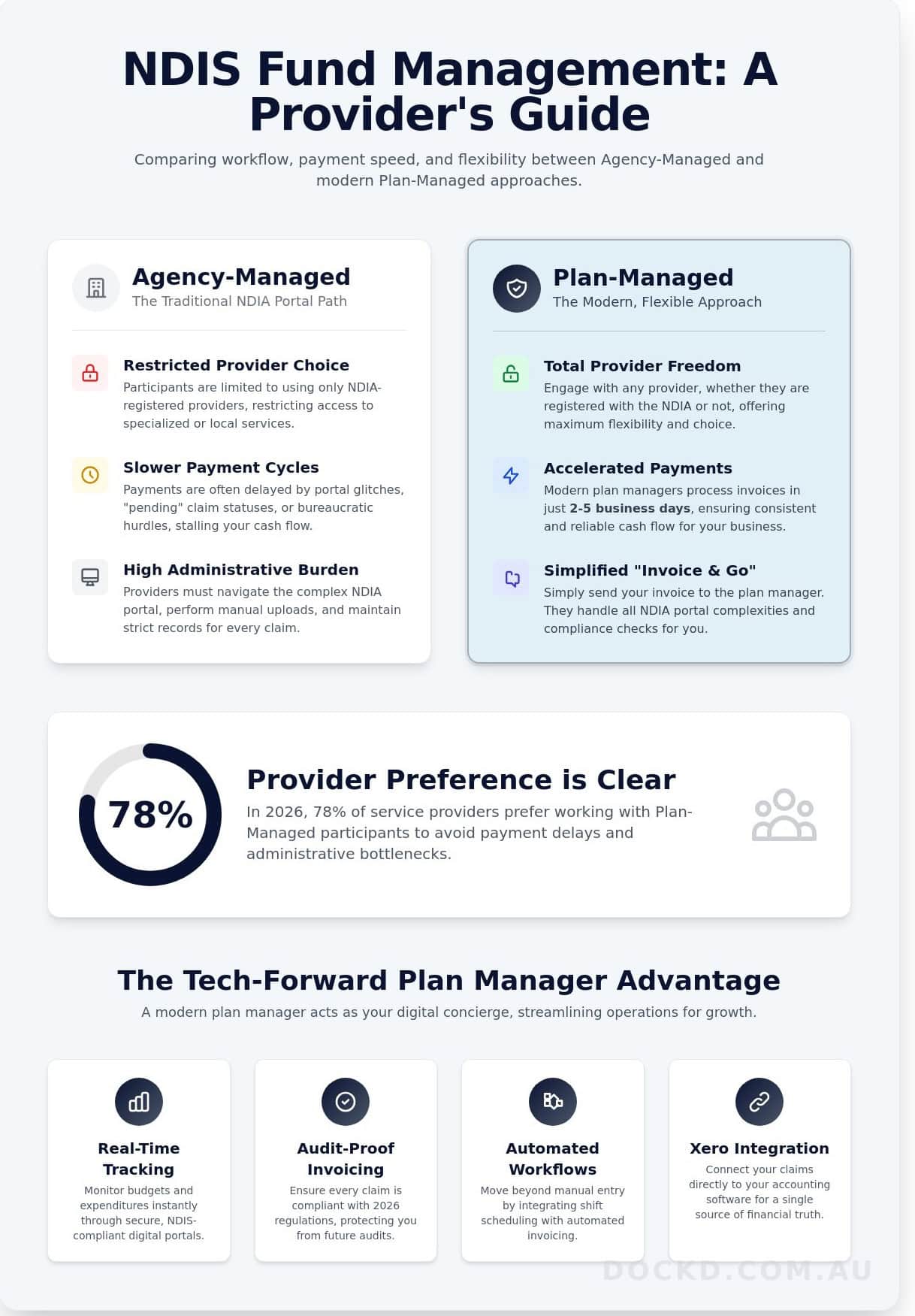
Agency management keeps funds locked within the NDIA portal. This limits participants to registered providers only. Self-management offers total freedom but places the administrative weight on the individual. Plan management provides the best of both worlds. It allows participants to use non-registered providers while a professional handles the books. For a deeper dive into these roles, the NDIS Guide to Plan Management details exactly how these responsibilities shift between parties.
Speed is the differentiator. Plan Managers typically process payments within 2 to 5 business days. Agency-managed claims often face “pending” statuses or portal glitches that stretch wait times. In 2026, 78 percent of providers prefer working with plan-managed participants to avoid these bureaucratic bottlenecks. Fast payments keep your business agile and your staff focused on delivery.
The Workflow Comparison for Service Providers
- Agency Managed: You must navigate the NDIA provider portal. This involves strict record-keeping and manual uploads. Funds are often “locked” to specific categories, reducing your ability to pivot services quickly.
- Plan Managed: Send your invoice directly to the NDIS plan manager. They handle the portal hurdles. You get higher flexibility and fewer administrative headaches, allowing for a more seamless service experience.
- Self-Managed: You deal directly with the participant. This requires robust internal debt collection processes. You’re relying on an individual to pay from their own bank account, which increases the administrative touchpoints for your team.
Financial Implications for Your Care Business
Cash flow is your business’s pulse. Your management style mix directly affects your Days Sales Outstanding (DSO). Agency delays can push DSO past 30 days, while plan management keeps it under 7 days. To scale effectively, you need NDIS software for providers to track these diverse payment streams in real-time. This ensures you aren’t flying blind when it comes to your revenue.
Risk management is equally vital. Budget overspends are common in self-managed plans. Plan Managers act as a safety net, ensuring funds exist before you provide the service. They reduce the risk of non-payment by roughly 15 percent compared to self-managed arrangements. A single coding error against the wrong NDIS categories of support can trigger an audit that stalls your cash flow for 90 days, making accurate categorisation just as important as choosing the right management style. If you want to simplify your operations, understanding these financial levers is the first step toward a secure and scalable care business.
The Workflow Challenge: Navigating Invoices with Plan Managers
Sending an invoice and hoping for the best is the fastest way to stall your cash flow. In the NDIS sector, the “Email and Pray” method remains the primary pain point for providers. You send a PDF to an ndis plan manager and wait. If that email hits a spam filter or sits at the bottom of a cluttered inbox, your support workers do not get paid on time. This delay creates a dangerous ripple effect. When staff feel their pay is at the mercy of administrative black holes, retention rates drop by 15% within the first six months. Reliable cash flow is the heartbeat of your business. Without it, you cannot maintain the high-quality care your participants deserve.
Many providers believe that working with multiple Plan Managers is too complex to scale. They fear the administrative burden of juggling different portals and payment cycles. This objection often keeps businesses smaller than they need to be. The solution is not to limit your reach, but to change your tech stack. You need “Digital Handshakes.” This concept refers to the direct API connection between your provider software and the systems used by an ndis plan manager. According to the Official NDIS Guide to Plan Management, these managers exist to help participants manage their funding, so aligning your tech with theirs is a logical step toward efficiency. It removes the middleman and ensures data flows without human error.
Automating the Invoice Lifecycle
Stop typing data twice. You can use automated invoicing to reduce manual data entry by up to 70%. When your booking system talks to your billing software, the risk of “lost” invoices disappears. Use Xero integration to ensure your books match your NDIS claims in real time. This creates a single source of truth for your finances. You will no longer waste hours on bank reconciliation every Friday afternoon. Automated invoicing is the secret sauce to scaling a disability support business in 2026. It turns a three-day administrative headache into a thirty-second background process that runs while you focus on participant outcomes.
Audit-Proofing Your Service Agreements
Every Plan Manager requires a valid service agreement before they release funds for an invoice. It is a non-negotiable compliance gate that protects the participant and the provider. For those delivering Early Intervention NDIS services, these agreements must be precise and reflect 2026 pricing standards. Use digital signatures to lock in these documents the moment a participant joins your service. This ensures you have a clear, timestamped audit trail. Proper version control prevents payment delays caused by outdated documents. Keep your agreements stored in a secure cloud environment where they can be retrieved instantly during an NDIS Commission audit. This proactive approach builds trust with Plan Managers and secures your revenue stream.
How to Evaluate and Partner with a High-Performing Plan Manager
Choosing an ndis plan manager shouldn’t feel like being lost at sea. It’s a strategic partnership that determines how quickly providers get paid and how easily participants access their supports. High-performing managers in 2026 prioritise speed, visibility, and automation. They act as a digital concierge, removing the friction between the NDIA and the support team. Start by verifying their credentials. Every manager must maintain active registration and demonstrate strict adherence to the NDIS Practice Standards to ensure safety and quality across all administrative functions.
Efficiency is the primary metric for success. A tech-forward manager uses NDIS-compliant portals to offer real-time tracking for every transaction. This allows you to see exactly where every dollar goes without waiting for monthly statements that arrive weeks too late. Communication must be rapid. Top-tier firms commit to responding to invoice queries within 24 hours. If a manager takes three days to reply to a simple email, they’ll likely struggle when complex budget issues arise or when a provider is chasing a missed payment.
Providers should look for partners who treat fund management as a high-performance system. Use this checklist when evaluating a potential partner:
- Real-time Data: Do they offer a live dashboard for budget tracking?
- Audit Readiness: Are all records stored in an NDIS-compliant, secure cloud environment?
- Responsiveness: Can they guarantee a 24-hour turnaround on urgent billing enquiries?
- Compliance: Do they provide regular updates on NDIS pricing guide changes?
Key Questions to Ask a Potential Plan Manager
Get specific during your initial consult. Ask about their average turnaround time for provider payments. In 2026, top-tier firms process claims in 2 to 3 business days. Confirm they provide a dedicated portal for participants to monitor their remaining budget 24/7. Finally, ask how they handle invoice errors or NDIA rejections. A proactive ndis plan manager fixes these issues before they impact your service delivery, rather than leaving the problem for the participant to solve. Aligning your financial administration with a strong commitment to person centred care ensures that budget decisions always reflect individual participant goals and preferences.
Red Flags to Avoid in 2026
Steer clear of managers who rely on outdated manual processes. If their payment cycles exceed 7 days, they’re a liability to your provider relationships. Lack of transparency is another major warning sign. You should have an instant view of your budget burn rates to avoid unexpected shortfalls at the end of a plan cycle. Poor integration with modern NDIS management software suggests a firm that’s falling behind the curve. Providers delivering high-demand services such as NDIS respite care are especially vulnerable to these delays, given the complexity of 24/7 rostering and short-stay claiming cycles. Choose a partner who embraces the future of digital fund management to keep your plan moving forward.
Unlocking Efficiency: Why dock’d is the Key to Seamless Plan Management
Stop drifting through endless paperwork. Your NDIS journey needs a steady hand and a clear course. dock’d simplifies the administrative nightmare by acting as your digital concierge. It transforms complex logistics into a smooth, manageable flow. You didn’t enter this industry to manage spreadsheets; you did it to support people. dock’d gives you that time back. Our platform acts as the bridge between traditional service and the modern, on-demand world.
Efficiency starts with scheduling. Our platform features integrated shift rostering that feeds directly into your invoicing system. This eliminates the 12% margin of error often found in manual data entry across Australian disability services. Support workers log their hours via a tech-forward mobile app. These entries generate instant, accurate records. Your NDIS plan manager receives clean data every time, ensuring payments move as fast as your operations. It’s about reliability and forward-thinking technology.
Managing diverse fund types is no longer a struggle. dock’d provides a centralised dashboard to handle Plan, Agency, and Self-managed funds simultaneously. You get a high-level view of every participant’s budget in one spot. This visibility prevents budget overspends and ensures every A$ is accounted for accurately. It is the knowledgeable local guide you need to navigate the complexities of the scheme. We’ve designed the interface to be as welcoming to a new provider as it is to a seasoned veteran.
The dock’d Advantage for Provider-Manager Relations
Compliance is your anchor. dock’d generates instant invoices that meet all 2026 NDIS requirements. We’ve built a seamless Xero integration to keep your accounting secure and adventurous. Your books stay balanced without the heavy lifting. Centralised documentation makes NDIS audits a breeze. When auditors request data, you’ll have every record ready in seconds. This transparency builds lasting trust with every NDIS plan manager you work with. For providers managing complex logistics like NDIS transport, our platform ensures every mileage claim and travel expense is automatically tracked and audit-ready.
Ready to Transform Your NDIS Operations?
Ditch the manual spreadsheets. The 2026 NDIS landscape demands a high-tech marketplace mindset. dock’d is the catalyst for a better, more connected experience. We remove the friction from your daily transactions so you can focus on growth. It’s time to chart a new course for your business. Unlock your potential with a system designed for the modern provider. Book your dock’d demo today and see how we simplify your world. Spend less time on paperwork and more time on the water.
Navigate Your NDIS Future with Confidence
Choosing a high-performing NDIS plan manager is the most effective way to secure your funding and reclaim your time. In 2026, the difference between a stalled plan and a successful one often comes down to the technology behind the scenes. You need a partner that understands the Australian market and provides the tools to handle invoice workflows with total precision. Don’t settle for manual processes that slow you down when modern solutions are within reach.
Since 2016, dock’d has provided NDIS-compliant software that removes the friction from disability service management. Our platform offers seamless Xero integration tailored for Australian providers, making financial tracking instant and organised. By leveraging cloud-based technology, we empower you to manage a remote workforce from anywhere, ensuring your operations stay agile. It’s time to unlock a more efficient way of working. Simplify your NDIS management with dock’d today. Your path to a smoother, more secure plan starts here.
Frequently Asked Questions
Is an NDIS Plan Manager the same as a Support Coordinator?
No, these roles serve completely different functions within your plan. Your NDIS Plan Manager acts as your financial administrator, paying invoices and tracking your budget spending. A Support Coordinator focuses on connecting you with specific providers and organising your schedule of supports. Think of the manager as your accountant and the coordinator as your navigator. Both work together to keep your plan on course.
Can I change my NDIS Plan Manager if I am unhappy with their service?
Yes, you have the total freedom to switch your provider at any time. Most service agreements include a standard notice period of 14 or 28 days. Simply notify your current manager in writing and sign a new agreement with your chosen partner. This transition is designed to be seamless, ensuring your providers continue to get paid without any interruption to your daily supports.
How much does an NDIS Plan Manager cost in 2026?
Plan management costs you nothing from your core or capacity building budgets. The NDIA adds specific funding to your plan under the Improved Life Choices category to cover these fees. As of the 2025-26 price limits, the agency pays A$232.35 for a one-off setup fee and A$104.45 for monthly management. These fixed rates ensure professional oversight without dipping into your personal support funds.
Do I need a separate NDIS Plan Manager for each state I operate in?
No, you only need one manager regardless of where you travel or live in Australia. Because the NDIS is a national scheme, your manager can process invoices from any provider across all eight states and territories. This national reach simplifies your logistics. It allows you to maintain a consistent financial point of contact even if you move house or access services while on holiday.
Can a Plan Manager help me determine if a support is “reasonable and necessary”?
Yes, your manager provides expert guidance on whether a purchase aligns with Section 34 of the NDIS Act 2013. They check if a support is related to your disability and represents value for money. While they can’t overrule the NDIA, they act as a vital filter. They help you avoid spending funds on items that the agency might later audit or reject during a review. Understanding NDIS impairment categories helps both managers and providers ensure supports align with functional needs rather than just medical diagnoses.
What happens if the NDIS budget runs out before the plan ends?
Payments to providers will cease immediately once your budget hits zero. Your ndis plan manager tracks your spending velocity and should alert you if you’re on track to exhaust funds early. If this happens, you must apply for an internal review under Section 100 of the NDIS Act. Proactive monitoring ensures you don’t face a gap in essential services during your current plan cycle. Providers offering time-sensitive supports such as NDIS respite care are particularly at risk when budgets run dry unexpectedly, making early alerts from your plan manager essential to continuity of care.
How do Plan Managers interact with the new “my NDIS” computer system?
Managers use secure digital portals to link directly with the NDIA’s PACE system. This tech-forward approach allows for real-time budget tracking and faster claims processing. Most invoices are now cleared within 48 hours of submission. This system replaces older, slower manual uploads with a streamlined interface that gives you instant visibility of your remaining funds through your ndis plan manager‘s custom dashboard.
Are Plan Managers required to be NDIS registered?
Yes, every plan management firm must be registered with the NDIS Quality and Safeguards Commission. This registration ensures they meet strict Australian auditing standards and comply with the NDIS Practice Standards updated in 2024. There are currently over 1,500 registered plan managers across Australia. Choosing a registered provider gives you a layer of security and professional accountability that protects your funding from mismanagement or fraud. Embedding person centred care principles into your administrative framework ensures that registration compliance translates into genuinely participant-focused service delivery.