

Statistics from 2024 indicate that manual administrative tasks consume up to 15 hours per week for the average Australian NDIS provider, often due to a poorly managed service agreement. You know the feeling of staring at a stack of paperwork while your real work waits. Manual data entry errors and the looming shadow of an audit can make your daily operations feel like navigating a storm without a compass. Tracking participant budgets and managing slow onboarding shouldn’t be your primary focus.
We’re here to help you find a better way. This guide reveals how to master the NDIS service agreement through practical digital management and streamlined compliance. You’ll discover how to secure faster contract execution and maintain 100% audit readiness without the stress. We’ll break down the steps to create a seamless connection between your contracts, billing, and rosters to unlock a more efficient future for your organisation. Your compliance, simplified.
Key Takeaways
- Unlock total transparency by building a functional roadmap that meets Commission standards and safeguards your participants.
- Identify non-negotiable compliance elements and use clear language to ensure your service agreement is accessible for every participant.
- Ditch the paper trail and navigate toward efficiency with cloud-based management that links data directly to your roster.
- Master a streamlined 5-step process to consult and execute agreements, ensuring your NDIS operations stay on course.
- Transform static documents into a live operational hub with Dockd, your digital concierge for simplified, tech-forward management.
Understanding the NDIS Service Agreement: More Than Just a Contract
Think of an service agreement as the functional roadmap for every support you deliver. It is not just a stack of paper; it is the chart that guides your professional relationship. While the National Disability Insurance Scheme provides the overarching framework for funding, the agreement defines the day-to-day reality of care. The NDIS Quality and Safeguards Commission prioritises written documents because they ensure transparency and protect participant choice. Without a clear document, you are sailing without a compass. It makes the complex feel manageable and keeps everyone on the same heading.
Distinguishing between an NDIS Plan and a provider-specific contract is vital for operational success. An NDIS Plan belongs to the participant, outlining their goals and total budget. Your service agreement is the specific contract between your organisation and that individual. It details exactly how you will help them reach those goals while securing your business interests. This is “Your compliance, simplified.” By removing the friction of vague expectations, you create a secure atmosphere where trust can grow. It is about making the logistics invisible so the focus stays on the participant.
Why Every Provider Needs a Written Agreement
Protect your business from the start. Written contracts prevent payment disputes and stop scope creep before it drains your resources. In 2024, reports from the NDIS Commission indicated that clear documentation reduced service delivery complaints by providing a verifiable point of truth. You must ensure participants understand their rights and responsibilities through clear language. This isn’t just a suggestion; it’s a requirement. Meeting the mandatory NDIS Practice Standards for registered providers requires a robust, written approach to service delivery and record-keeping.
Verbal vs. Written Agreements: The Risks
Relying on a verbal “handshake” deal is a gamble you can’t afford in a regulated sector. Handshakes don’t hold up during an NDIS audit. You need evidence. Written documentation serves as your primary shield when the Commission reviews your files. Transitioning long-term participants from legacy verbal arrangements to modern digital contracts is a smart move for 2026. Stop chasing lost paperwork and start using digital tools to lock in details instantly. It’s time to move from “we’ll figure it out” to “it’s all in the contract.” This shift secures your revenue and clarifies the participant’s journey from day one.
Core Components of a Compliant NDIS Service Agreement
Your service agreement is the anchor of every participant relationship. It’s more than a legal formality; it’s a tool for transparency and trust. To meet the NDIS Code of Conduct, your document must be accessible and easy to understand. Complexity creates friction. Clarity creates confidence. Use plain English to ensure every participant understands their rights and your obligations. This approach reduces the risk of disputes and builds a secure foundation for your business operations.
The Schedule of Supports and Pricing
Vague descriptions lead to billing disputes. Your Schedule of Supports must be precise. List every support item with its specific NDIS line number and unit cost in A$. This level of detail prevents confusion during the claiming process. Remember that most disability supports are GST-free under Section 38-38 of the GST Act. Always verify your tax status against current ATO guidelines to maintain compliance. Manual data entry is a common source of error. You can eliminate these mistakes by linking your NDIS software directly to your service agreement. This automation ensures your claiming is instant and accurate. It keeps your cash flow moving and your records audit-ready.
Cancellation Policies and Dispute Resolution
Protect your workforce and your bottom line with firm boundaries. Define “short notice cancellations” according to the latest NDIS pricing arrangements. Currently, providers can often claim 100% of the agreed fee if a participant cancels within 7 clear business days. State this rule clearly so there are no surprises. You also need a transparent pathway for feedback. Participants must know exactly how to raise a concern or lodge a formal complaint. A clear process shows you value their input and are committed to quality. Finally, define the notice period for ending the service agreement. A standard 14 or 28-day notice period is essential for effective workforce planning. It gives you the time to reallocate staff and manage your roster without losing momentum. Simplify your administrative load and unlock better provider management by standardising these clauses across all your contracts. This consistency makes your business more resilient and easier to scale.
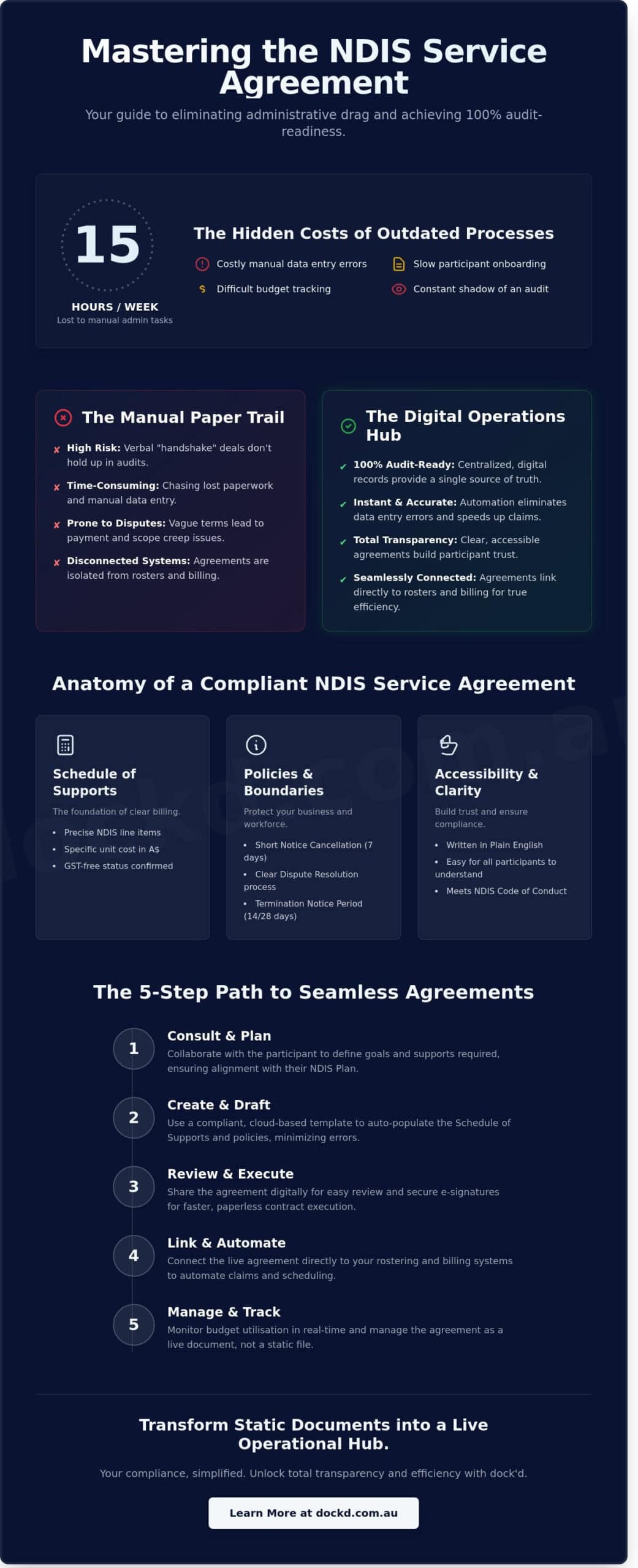
Manual vs. Digital Agreement Management: Finding Your Efficiency
Stop drowning in physical folders. The old way of managing paper files is a relic that slows your momentum and creates unnecessary friction. Modern NDIS providers are moving to cloud-based systems to keep their operations buoyant and responsive. This shift isn’t just about going green; it’s about speed. Transitioning data from a signed service agreement directly into your rostering software eliminates the lag between onboarding and care delivery. Digital signatures via tools like DocuSign or built-in portal features allow participants to sign from any device, anywhere. This removes the “wait and see” period of the traditional post. Your data stays secure with bank-grade encryption, replacing vulnerable physical cabinets with a fortified digital vault.
The Hidden Cost of Paper-Based Systems
Manual systems carry a heavy price tag that rarely appears on a balance sheet. Industry data from 2024 indicates that administrative staff lose an average of 4.5 hours every week to manual data entry, scanning, and filing. This is time that should be spent supporting participants. Beyond the clock, paper systems invite human error. Using an outdated version of a template can lead to immediate non-compliance during an audit. You must ensure your documents align with the latest NDIS service agreement guidelines to protect your registration. Physical paperwork creates a bottleneck, often delaying a participant’s journey to receiving essential support by up to 10 business days. Digital systems clear this path instantly.
Unlocking Real-Time Budget Tracking
Digital management transforms your service agreement from a static document into a live financial tool. Automated systems track every dollar spent against the agreed total, triggering alerts when funds reach a 20% remaining threshold. This proactive approach prevents the nightmare of over-servicing or “plan overspends” that result in unpaid invoices and awkward conversations with participants. To achieve a truly unified view of your business, integrate your agreement data with Xero accounting. This connection ensures your service delivery and financial reporting move in perfect sync. Your compliance, simplified.
- Automate: Sync agreement totals with your invoicing cycle to stop revenue leakage.
- Protect: Use encrypted cloud storage to prevent unauthorised access to sensitive participant data.
- Accelerate: Use digital templates to reduce the onboarding process from days to minutes.
How to Create and Execute Service Agreements: A 5-Step Process
Managing an NDIS service agreement shouldn’t feel like navigating a storm. It requires a clear map and reliable tools to ensure compliance and clarity. Follow this five-step process to streamline your operations and build trust with participants.
- Step 1: Consultation. Meet with the participant or their nominee to discuss goals. Listen first, then align your services with their specific NDIS plan objectives.
- Step 2: Drafting. Use a compliant, customisable template. Ensure it meets the 2026 NDIS Quality and Safeguards Commission requirements while remaining easy to read.
- Step 3: Review. Send the draft for approval. This stage ensures all parties understand the pricing, cancellation policies, and support schedules before anything is finalised.
- Step 4: Digital Execution. Use secure e-signature tools for instant signing. Store the completed document in a centralised digital vault for immediate access during audits.
- Step 5: Monitoring. Schedule regular check-ins. Track the funding burn rate and plan dates to ensure supports remain continuous and effective.
Gathering Accurate Participant Data
Precision starts at the beginning. Use the PRODA portal to verify NDIS numbers and plan dates with 100% accuracy. Mistyped numbers cause 15% of initial claim rejections in the disability sector. You must identify if the funding is ‘Plan Managed’, ‘Self Managed’, or ‘NDIA Managed’ immediately. Each type has different invoicing workflows. Centralise contact details for nominees and support coordinators in a secure digital environment to ensure communication never breaks down.
Managing Variations and Plan Renewals
Participants’ lives change, and their agreements must reflect that. When a goal shifts mid-year, don’t start from scratch. Create a variation addendum to the existing service agreement to document the change. Manual tracking often leads to lapsed supports. Set automated reminders 60 days before a plan expires. This proactive approach gives you enough time to renegotiate terms. Always archive old versions with timestamped logs. This creates a transparent audit trail that protects your business during NDIS Commission reviews. Choosing the right NDIS rostering and invoicing software ensures these monitoring tasks are automated, reducing the risk of missed renewals and billing errors.
Ready to simplify your administrative workflow and focus on what matters? Unlock a more efficient way to manage your agreements today.
Streamlining Your NDIS Operations with dock’d
Stop treating your service agreement as a static document sitting in a digital folder. It’s the engine room of your business. Dockd acts as your digital concierge, transforming every signed contract into a live operational hub. We built this platform for providers who want to spend less time behind a desk and more time delivering impact. It’s tech-forward, Australian-made, and designed to unlock your business potential by removing the friction of manual administration. You deserve a tool that works as hard as you do.
From Agreement to Invoice in One Click
Manual data entry is a silent killer of productivity. It leads to errors, delays, and administrative burnout. When a participant signs their service agreement on the Dockd platform, the data flows instantly into your billing system. This eliminates the manual middleman. For many Australian providers, this transition can reduce administrative fatigue by over 35% within the first three months of implementation. It ensures every claim matches the agreed support items perfectly.
- Instant Data Transfer: No more re-typing line items from a PDF into an invoice.
- Accuracy Guaranteed: Automated checks ensure your claims align with NDIS Price Guide updates.
- Faster Payments: Clean, compliant invoices mean fewer rejections and better cash flow for your team.
The system is built to handle the heavy lifting. You don’t have to guess if a support item is valid or if the price is current. Dockd manages the technical details so you can focus on your participants. It creates a smooth narrative where the paperwork supports the service, rather than hindering it.
Built for Australian Providers, by Local Experts
We understand the nuances of the local market because we’re part of it. Our software strictly follows Australian English standards and stays updated with the latest NDIS compliance requirements. We don’t just handle paperwork; we help you organise your entire operation. You can align your rosters and staff timesheets directly with your active agreements. This ensures you never over-service a participant or miss a billable hour due to a scheduling oversight. Providers looking to further optimise their workflows can explore the leading NDIS rostering and invoicing software options available in 2026 to find the right fit for their team.
The platform is energetic and helpful, acting as a bridge between complex government regulations and your daily workflow. It’s time to trade clunky spreadsheets for a system that moves at your speed. You can Find your spot with Dockd and simplify your paperwork today. Unlock a smoother way to work and get back to what matters most: supporting your community.
Navigate Your NDIS Compliance with Confidence
Navigating the complexities of a 2026 service agreement doesn’t have to feel like sailing through a storm. You’ve seen how moving from manual paperwork to digital systems is the fastest way to secure your revenue and protect your business. The NDIA increasingly demands 100% record accuracy to pass strict audits. By implementing a five-step execution process, you ensure every participant interaction is documented and every claim is valid. It’s time to drop the anchor on administrative chaos and reclaim your schedule.
dock’d simplifies your operations with NDIS-compliant agreement templates and a seamless Xero integration that keeps your finances on course. Our Australian-based support and training teams provide the local expertise you need to stay ahead of regulatory shifts. Don’t let manual data entry hold your vessel back from reaching its full potential. You can streamline your workflows and focus on delivering high-quality care instead of chasing signatures. Your NDIS management, simplified.
Unlock your business potential with dock’d NDIS management software
The water is open for providers who embrace modern efficiency. Take the helm and start your journey toward a more secure, tech-forward future today.
Frequently Asked Questions
Is a service agreement mandatory for all NDIS providers?
A service agreement isn’t mandatory for every provider, but the NDIS Commission strongly recommends them to protect your business interests. Registered providers must have them for Specialist Disability Accommodation under the SDA Rules 2020. They clarify expectations and prevent payment disputes before they start. Your service agreement, simplified: it sets the rules of the sea for your business and ensures a smooth voyage for every participant.
What happens if an NDIS participant refuses to sign a service agreement?
Document the refusal in your system immediately if a participant won’t sign your document. You can still provide supports, but you must keep detailed notes of the verbal agreement reached to remain compliant. Review the NDIS Practice Standards 2021 to ensure you’re meeting your duty of care. Clear communication keeps your partnership on course even without a physical signature, protecting both parties from future friction.
Can I charge a participant for the time spent creating a service agreement?
You cannot charge participants for the time spent creating or negotiating a service agreement. The NDIS Pricing Arrangements and Price Limits 2024-25 classify this as an administrative task. These costs are already built into the hourly rate for your supports. Focus on making the process seamless and efficient to save your business time. A tech-forward approach ensures you spend less time on paperwork and more time delivering quality care.
How often should an NDIS service agreement be reviewed or updated?
Review your service agreement at least once every 12 months or whenever a participant’s NDIS plan changes. Regular check-ins ensure your supports stay aligned with their evolving goals and funding levels. Update the document if the NDIS Price Guide changes on 1 July each year to reflect current rates. Keeping your paperwork current prevents billing delays and ensures your business remains secure and reliable for the long haul.
Does the NDIS provide a standard service agreement template?
The NDIS provides a simple service agreement template on their official website, but it’s often too basic for complex supports. Many providers customise these documents to include specific cancellation policies and travel terms. Your agreement should be a tool that simplifies your operations. Tailor your template to act as a reliable guide for your specific services, ensuring you’re unlocking the best possible experience for every boat owner or participant you serve.
What is the difference between a service agreement and a service booking?
A service agreement outlines the terms of your partnership, while a service booking allocates funds in the NDIS portal. Think of the agreement as your navigational chart and the booking as the fuel in the tank. You need both to ensure payments flow without delay. Secure your agreement first to define the scope before locking in the digital booking. This two-step process makes the financial side of your business feel effortless and secure.
Can digital signatures be used for NDIS service agreements?
Digital signatures are fully accepted for NDIS service agreements under the Electronic Transactions Act 1999. Use secure platforms like DocuSign or Adobe Sign to speed up the onboarding process for new participants. This tech-forward approach removes the hassle of paper and post. It makes unlocking your services instant and accessible for participants across Australia. Digital tools ensure your business stays modern, efficient, and ready for the 2026 landscape.
How long must I keep copies of signed NDIS service agreements?
You must keep copies of signed service agreements for at least 7 years according to the NDIS (Record Keeping) Rules 2018. This applies to both digital and physical records. Maintaining a secure archive protects your business during NDIS Commission audits or payment reviews. Stay organised to ensure your records are always ready for inspection. A secure digital filing system ensures your business remains grounded and compliant without the clutter of traditional maritime paperwork.