

What if the most complex part of your business became your smoothest operation by 2026? Managing ndis respite care often feels like navigating a vessel through a storm of 24/7 rosters and manual claiming errors. You likely agree that the administrative weight of tracking participant goals during short stays can sink your efficiency. It’s a common struggle; industry data suggests that administrative friction accounts for up to 30 percent of operational delays in the disability sector.
It’s time to unlock a more streamlined way to work. This guide provides the tools to master NDIS compliance and staffing while automating your financial management. You’ll learn how to build an error-free claiming system and maintain audit-ready documentation without the usual stress. We’ll break down the exact steps to transform your workflow into a high-tech, functional marketplace for care. From optimising your roster to securing instant payments, your path to a more professional and adventurous service delivery starts here. Your respite delivery, simplified.
Key Takeaways
- Navigate the 28-day annual limit and master STA definitions to align your services with NDIS requirements.
- Secure your operations by implementing mandatory risk assessments and NDIS Practice Standards for safer delivery.
- Optimise your 24/7 rostering and worker screening to maintain high-quality care without administrative friction.
- Unlock accurate invoicing by mastering the 1:1 to 1:3 staffing ratios and 2025-26 rates for NDIS respite care.
- Simplify your workflow and scale faster by centralising participant goals into a single source of truth—your respite management, simplified.
Understanding NDIS Respite Care: Short Term Accommodation (STA) for Providers
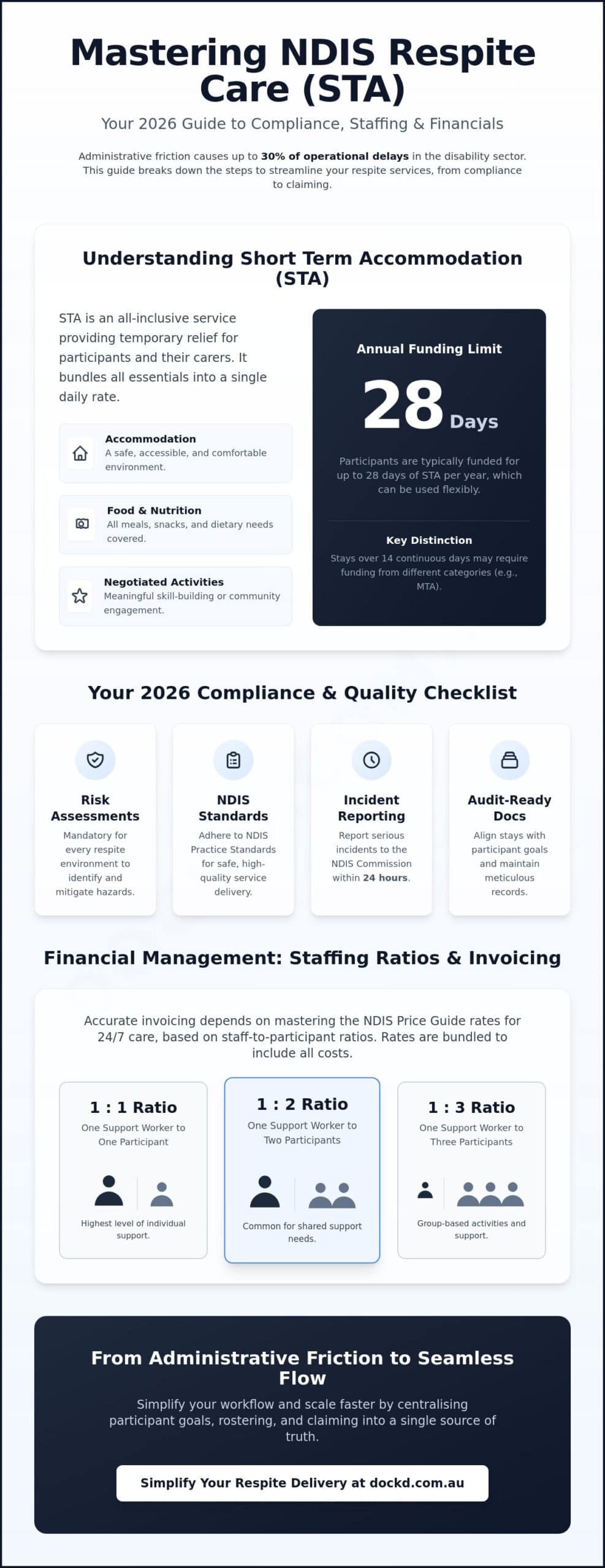
NDIS Respite Care is officially categorised as Short Term Accommodation (STA). It provides participants with a safe, supportive environment away from their usual home for brief periods. Providers deliver an all-inclusive service that covers support, food, and activities within a single daily rate. To better understand the foundational concept, What is Respite Care? refers to the temporary relief provided to primary caregivers. In the NDIS framework, this support facilitates a necessary break for both the participant and their carer. Most participants receive funding for up to 28 days of STA per year. Use this allocation flexibly to meet changing needs throughout the plan period. You must align every stay with the participant’s specific NDIS goals. Every provider must ensure the respite stay directly supports the participant’s autonomy. If the goal is to improve social skills, the stay should include community-based social outings. Your documentation must mirror these objectives to secure continued funding.
Distinguishing between service types is vital for compliance and clear service mapping. Respite (STA) is temporary and bundled. Medium Term Accommodation (MTA) covers up to 90 days while a participant waits for a permanent home solution. Supported Independent Living (SIL) focuses on long-term daily tasks in a shared living environment. Map your services accurately to avoid payment delays or audit failures. In 2026, the NDIA requires clear evidence that STA prevents caregiver burnout and maintains the participant’s current living arrangement. This evidence must be documented in the service agreement before the stay commences.
The Core Components of STA Delivery
Deliver a seamless experience by bundling all costs into a single daily rate. This approach removes friction for the participant and their family. Ensure your service includes the following essentials:
- Accommodation: A safe, accessible, and comfortable environment that feels like a home away from home.
- Food: Full nutritional support including all meals, snacks, and specific dietary requirements.
- Negotiated Activities: Meaningful community engagement or skill-building tasks chosen by the participant.
Tailor your service to specific NDIS impairment categories to ensure safety and quality. A participant with a sensory impairment requires a different environment than one with physical mobility challenges. High-quality respite supports primary carers by providing a necessary break, which directly reduces the risk of placement breakdown. Focus on the outcome. Build a routine that feels like a holiday while maintaining essential care standards.
Eligibility and Funding Streams
Check the participant’s plan for funding under ‘Core Supports – Assistance with Daily Life’. Most respite services use standard price guide items based on the 1:1 to 1:4 support ratios. When a participant has complex needs, you may need to provide specific STA quotes to the NDIA for approval. STA is a bundled support for up to 14 days. Should the stay exceed 14 days, the funding often shifts to different categories such as MTA or individualised living options. Capacity Building funding might occasionally cover respite if the stay focuses specifically on developing independence skills or transition training. Review the 2026 NDIS Pricing Arrangements to confirm current rates. Simplify the process for families. Provide clear invoices that reflect the bundled nature of the support to ensure fast processing.
Compliance and Quality Standards for Respite Service Delivery
Delivering NDIS respite care isn’t just about providing a bed. It’s about maintaining a secure, high-standard environment that survives the scrutiny of a 2026 audit. Compliance keeps your participants safe and your business operational. You must treat every short-term stay with the same rigorous attention to detail as a long-term residential placement.
Risk management is the cornerstone of safe delivery. Conduct mandatory risk assessments for every respite environment, whether it’s a dedicated centre or a community-based stay. If a participant moves from their home to your facility, assess the change in environment immediately. This includes identifying trip hazards, checking fire exit accessibility, and ensuring assistive technology is compatible with the new space.
Incident reporting remains a top priority for the NDIS Quality and Safeguards Commission. You must report serious incidents, such as injuries or unauthorised restrictive practices, within 24 hours. Establish a clear internal hierarchy for these notifications so nothing slips through the cracks during shift changes.
Meeting NDIS Practice Standards in 2026
Providers must align with the NDIS practice standards, particularly the modules covering high-intensity daily personal activities. If your facility handles complex needs like ventilator management or enteral feeding, your documentation must be flawless.
Follow this checklist for ‘Home and Living’ compliance in respite properties:
- Conduct fire safety audits every 12 months with certified professionals.
- Verify accessible bathroom modifications through an Occupational Therapist (OT) assessment.
- Display emergency evacuation plans in every room using accessible formats.
- Maintain a 100% completion rate for staff NDIS Worker Screening Checks.
Documentation and Record Keeping
Paper logs are a liability in a fast-paced environment. Shift to digital progress notes for 24/7 NDIS respite care to ensure real-time data accuracy. This allows for seamless handover protocols between support workers. If a medication dose is missed at 2:00 PM, the 10:00 PM shift needs to see that alert instantly.
The Australian Government Carer Gateway highlights that respite serves both the participant and their family. Your Service Agreements must reflect this by being tailored for short-term engagements. Don’t use a generic long-term agreement. Specify the duration, exact support levels, and cancellation policies to avoid funding disputes.
Securely store sensitive health data. Use encrypted platforms that meet NDIS consent requirements. Clear records protect your organisation during mid-term audits and ensure the participant receives consistent care. Simplify your administrative load and unlock more efficient ways to manage your listings
Streamlining Logistics: Rostering and Support Worker Management
Managing the moving parts of ndis respite care requires a balance of logic and empathy. Group respite settings usually demand specific ratios, such as 1:2 or 1:3, while individual stays often require dedicated 1:1 support for high-intensity needs. You must align these staffing levels with the Official NDIS Respite Guideline to maintain both safety and financial viability. Every staff member on your roster must pass the NDIS Worker Screening Check. This is a non-negotiable safety standard. For participants with complex needs, provide specialised training in areas like dysphagia support or manual handling. Don’t rely on general knowledge when specific skills save lives.
Shift handovers are the bridge to continuity of care. Use digital logging to record medication administration, mood changes, and sleep patterns. This data allows the incoming team to step in without missing a beat. It creates a seamless experience for the participant and builds trust with their families. Professional handovers prevent the loss of critical information during the transition between day and night crews.
Optimising the Respite Workforce
Distinguishing between sleepover shifts and active overnight supports is vital for your budget. A sleepover allows for eight hours of rest with up to two hours of active work; active overnights require the worker to stay awake throughout the night. Make sure your team has completed the NDIS Worker Orientation Module to understand these nuances. Deploy mobile apps to track time and attendance via GPS. This tech-forward strategy eliminates manual errors and ensures you only pay for the hours delivered. It’s about working smarter to unlock better care outcomes.
Managing 24/7 Shift Logistics
Roster gaps are inevitable, but they don’t have to be a crisis. Develop a backup pool of casual staff who can respond to last-minute cancellations within 60 minutes. Use automated alerts to track expiring worker clearances and qualifications. This prevents a compliance breach before it happens. Seamless rostering ensures that a qualified professional is always present, which directly prevents incidents and maintains a secure environment for every participant. By removing friction from the back office, you allow your team to focus on providing high-quality ndis respite care that truly makes a difference.
Financial Management: NDIS Respite Care Rates and Invoicing
Managing the financial side of NDIS respite care requires precision and a tech-forward approach. The 2025-26 NDIS Price Guide sets clear boundaries for Short Term Accommodation (STA) rates. Providers must understand staffing ratios to remain profitable while delivering high-quality support. A 1:1 ratio offers the highest daily rate, while 1:2 and 1:3 ratios split costs between participants. This structure ensures support is available at different price points for various needs. Weekday rates differ significantly from public holidays. For example, public holiday rates can be over double the standard weekday charge. Align your staffing schedules with these peaks to protect your margins.
Mastering the NDIS Price Guide for Respite
The daily STA rate is an all-inclusive bundle. It covers accommodation, food, and activities. However, it’s easy to lose revenue if you don’t itemise correctly. Use the 2025-26 benchmarks to set your internal pricing. A standard 24-hour weekday stay at a 1:1 ratio is currently priced at $2,034.42, while a Sunday stay jumps to $3,139.46. Managing NDIS transport is often where providers stumble. Don’t let travel costs eat your profits. If a participant requires specialized transport to reach your facility, claim it under the appropriate line item rather than absorbing it into the STA bundle. Expenses like specialized equipment or community access fees usually fall outside the bundle. Clearly communicate these to participants before the stay begins.
- 1:1 Ratio: Best for high-needs participants requiring constant attention.
- 1:2 Ratio: Ideal for social stays where two participants share one staff member.
- 1:3 Ratio: Maximises efficiency for group-based respite activities.
Automating Invoicing and Claims
PRODA claims don’t have to be a headache. Automate your workflow to keep cash flowing. Use Xero integration to sync your invoices directly with the NDIS portal. This reduces manual entry errors by up to 40%. Bulk-upload errors often stem from mismatched line item codes or incorrect dates. Double-check your 2026 price codes before hitting submit. Monitor participant budgets weekly to prevent over-servicing. This ensures you get paid for every hour delivered without hitting plan limits. If a payment is delayed, check the PRODA error logs immediately. Fast action keeps your cash flow steady and your business adventurous.
Ready to streamline your operations and focus on the experience? Simplify your service management with our modern tools.
Scaling Your Respite Services with dock’d NDIS Management Software
Scaling ndis respite care requires more than just adding beds to a property. It demands a digital backbone that handles the heavy lifting of logistics. dock’d centralises your rosters, compliance, and billing into a single, high-performance dashboard. This replaces the chaos of multiple spreadsheets with one streamlined interface. It’s about moving away from reactive management and toward a proactive, tech-forward operation.
Every participant arrives with specific goals and care requirements. dock’d acts as the single source of truth for progress notes and support plans. Your team uses the Support Worker Mobile App to log real-time data, ensuring no detail is missed during a shift change. This mobile-first approach simplifies remote management. It gives you total visibility over every property in your portfolio without needing to be on-site. You can track progress, monitor safety, and verify service delivery from any device.
Short-term stays involve a high volume of recurring paperwork. dock’d removes this friction through automated NDIS agreement management. By digitising the sign-off process, you ensure every stay is fully compliant and ready for billing before the participant even arrives. This automation eliminates the 10 to 15 hours per week typically lost to manual data entry and filing. It’s your business, simplified.
Why Tech-Forward Providers Choose dock’d
Transitioning from legacy systems to a unified NDIS software for providers is a strategic move for 2026. dock’d starts with a remote business evaluation to map your current processes and identify bottlenecks. This tailored setup ensures the software fits your specific workflow from day one. Providers using automated PRODA claiming through dock’d often see a 20% increase in cash flow speed. By eliminating manual submission errors, you get paid faster and more reliably.
Future-Proofing Your Respite Business
Preparation is the key to long-term growth. dock’d offers one-click reporting to make NDIS audits a routine task rather than a crisis. You can generate compliance documents and financial summaries in seconds. This level of readiness is essential whether you are launching your first ndis respite care site or managing a national network of 50 properties. The platform adapts to your scale, providing the same high level of security and efficiency at every stage of your journey.
Secure your operations and focus on delivering high-quality care. Unlock the potential of your workforce with tools designed for the modern provider. Ready to simplify your NDIS operations? Discover dock’d today.
Master Your 2026 Operational Strategy
Navigating the complex waters of ndis respite care demands more than just basic compliance. Success in 2026 hinges on your ability to synchronise Short Term Accommodation logistics with the latest NDIS Pricing Arrangements and Price Limits. Providers who automate their PRODA claims and Xero invoicing reduce administrative friction significantly. You can’t afford to let manual rostering anchor your growth. It’s time to shift your focus from paperwork to participant outcomes.
Take command of your operations with a platform designed for the modern provider. dock’d is 100% Australian-owned and engineered to meet rigorous NDIS Quality and Safeguards Commission standards. Our cloud-based system enables remote workforce management from any location, ensuring your team stays connected and compliant. By integrating Xero and PRODA automation directly into your workflow, you simplify complex financial cycles into manageable steps. This high-tech approach removes the traditional barriers to scaling your organisation.
Unlock your business potential with dock’d NDIS software
Secure your spot as a leader in the disability sector and watch your business thrive. Your future, simplified.
Frequently Asked Questions
What is included in the NDIS respite care (STA) daily rate?
The NDIS respite care (STA) daily rate includes accommodation, all meals, personal care, and negotiated community activities. It’s a bundled payment that covers a full 24 hour period of support. Providers must ensure the rate covers every cost associated with the stay so participants don’t face out of pocket expenses for basic needs or food.
How many days of respite care can an NDIS participant access per year?
Participants typically access up to 28 days of Short Term Accommodation per year. The NDIS generally funds these stays in blocks of up to 14 days to ensure the support remains temporary. This allocation helps maintain the primary caring relationship by providing regular breaks. Check the specific funding in a participant’s plan to confirm their available days before booking.
Can NDIS respite care be delivered in the participant’s own home?
NDIS respite care is generally delivered outside the participant’s primary residence to provide a true break for the carer. STA funding supports stays in a centre, a group home, or a hotel environment. If a participant requires care within their own home, they usually access “Individualised Living Options” or “Core Supports” rather than the STA line item.
What staffing ratios are allowed under NDIS Short Term Accommodation?
The NDIS Price Guide defines four standard staffing ratios: 1:1, 1:2, 1:3, and 1:4. Providers must choose the ratio that matches the participant’s specific support needs and the safety requirements of the group. Higher ratios like 1:1 provide intensive support but require specific justification in the participant’s plan. Matching the right ratio ensures a secure and functional environment for everyone involved.
Do I need to be a Registered NDIS Provider to offer respite care?
You don’t need to be a Registered NDIS Provider to offer respite care if the participant is self-managed or plan-managed. However, you must register with the NDIS Quality and Safeguards Commission to support NDIA-managed participants. Registration ensures you meet the high safety standards required for 24 hour care environments. Being registered often builds more trust with families seeking a professional service.
How do I claim for NDIS respite care if the participant cancels at the last minute?
Providers can claim 100% of the agreed fee for a “Short Notice Cancellation” if the participant cancels within 7 clear business days. This rule applies under the NDIS Pricing Arrangements 2024-25 to protect your business’s operational costs. Always include these terms in your service agreement to ensure seamless billing when plans change. Clear communication helps manage these logistics without friction.
What is the difference between respite care and Supported Independent Living (SIL)?
Respite care provides temporary, short-term support, whereas Supported Independent Living (SIL) focuses on long-term daily living assistance in a permanent home. While ndis respite care lasts for days or weeks, SIL is an ongoing arrangement for people who need 24 hour support. SIL funding doesn’t cover the cost of rent or board, unlike the bundled STA rate which includes all stay-related costs.
Can NDIS funding cover respite care for children and early intervention participants?
NDIS funding covers respite care for children through the “Assistance with Daily Life” budget. This support helps families sustain their caring role while giving the child opportunities for social interaction in a new setting. The NDIS focuses on “reasonable and necessary” criteria to ensure the child builds independence safely. It’s a flexible way to support the whole family unit effectively.