

The 1 July 2025 launch of the Support at Home program represents the most significant shift in Australian aged care since the 1997 Act. Transitioning to this new model isn’t just a compliance task; it’s a total recalibration of your operational efficiency. You likely feel the pressure of the new 8-tier classification system and the administrative weight of updated service agreement requirements. Managing the overlap between NDIS and aged care workflows often feels like trying to steer a vessel through thick fog without radar. It’s a heavy burden for any provider trying to maintain high standards of care while keeping the business afloat.
We’re here to clear the air and help you find your bearings. This guide ensures you master the transition by simplifying complex classifications and automating your compliance checks. You’ll gain a clear understanding of the new service categories and learn to build a streamlined process that reduces administrative friction. We’ve mapped out the operational steps required to secure your business through 2026 and beyond. Your transition, simplified. Let’s get your operations ready for the open water of the new aged care landscape.
Key Takeaways
- Navigate the 2026 transition with confidence as the Australian Government unifies in-home care into a single, streamlined system.
- Master the new funding landscape by decoding the three service categories and eight classification levels that define participant budgets.
- Eliminate the “double-compliance” headache for providers managing both NDIS and support at home clients through smarter reporting.
- Audit-proof your operations using a high-level checklist designed to ensure your real-time data capture meets 2026 standards.
- Unify your workflows and simplify complex logistics with tech-forward tools that bridge the gap between aged care and NDIS management.
What is the Support at Home Program? Understanding the 2026 Landscape
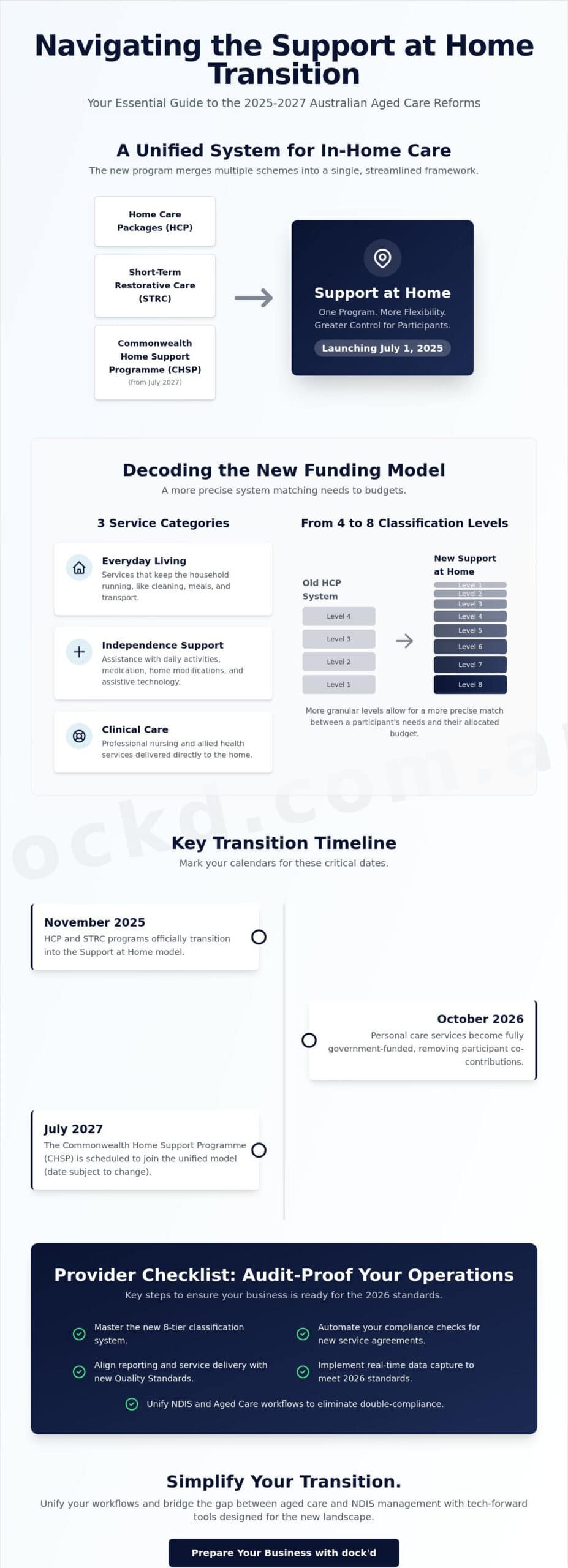
The Support at Home program represents a total overhaul of the Australian aged care system. It merges the Home Care Packages (HCP) and Short-Term Restorative Care (STRC) into a single, streamlined framework. Starting November 2025, this reform changes how providers operate and how seniors access help. The goal is simple. Help older Australians stay in their own homes for longer. This shift moves away from the rigid structures of the past. It offers a flexible, budget-based system that adapts to individual needs. Your operations must evolve to meet these new standards.
For those managing participants over 65, clarity on the NDIS is vital. Existing NDIS participants generally remain within that scheme as they age. However, the Aged Care in Australia framework, specifically the Support at Home program, becomes the primary pathway for new aged care services for the broader population. This ensures that the NDIS remains focused on disability, while support at home handles age-related decline. It is about getting the right care through the right channel without the red tape.
The Core Objectives of the 2026 Reform
The 2026 landscape prioritises transparency. The Royal Commission identified major gaps in the old system. This reform fixes them. It introduces a participant-led funding model. This means seniors have more control over their budgets. Providers must focus on three key areas: clinical care, independence support, and everyday living. Think of it as a more functional approach to ageing. It removes the guesswork. It ensures every dollar spent directly improves the quality of life at home. Transition your business to focus on these outcomes to stay competitive.
- Clinical Care: Nursing and allied health services delivered to the door.
- Independence Support: Assistive technology and home modifications that empower the user.
- Everyday Living: Cleaning, meals, and transport that keep the household running.
Transition Timelines for Registered Providers
Mark your calendars for November 2025. This is when HCP and STRC officially transition. The Commonwealth Home Support Programme (CHSP) will join the unified model later, currently scheduled for no earlier than July 2027. This phased approach gives you time to adjust your systems. Use the “no worse off” principle to reassure your current clients. This guarantee ensures that grandfathered participants don’t lose their current levels of support during the move. Your immediate task for 2026 is compliance. You must align your reporting and service delivery with the new Quality Standards. Simplify your processes now to stay ahead. The future of support at home is efficient, digital, and focused on the participant journey.
The 3 Categories and 8 Classifications: Navigating Funding Levels
The transition to the new Support at Home Program represents a shift toward granular, needs-based funding. Unlike the previous four-level Home Care Package system, the 2026 model introduces eight distinct classification levels. This expansion allows for a more precise match between a participant’s clinical needs and their allocated budget. My Aged Care assessors now use a revamped assessment tool to place individuals into one of these eight tiers based on their functional impairment and health risks.
The framework organises all services into three overarching categories: Clinical, Independence, and Everyday Living. This structure ensures that funding is transparently tied to specific outcomes. By July 2025, the initial rollout begins, but the most significant financial shift occurs in October 2026. On this date, the government will move to fully fund personal care services. This change removes the requirement for participant co-contributions for essential hygiene and mobility tasks, simplifying the financial burden for many Australian seniors.
Clinical Care and Independence Support
Clinical supports form the highest tier of technical care within the support at home framework. This category includes professional services like nursing, occupational therapy, and podiatry. Providers must ensure staff possess the required Australian registrations to deliver these services. Independence supports focus on daily personal activities. This includes assistance with showering, dressing, and medication management. These services are often high-intensity and require strict adherence to safety protocols. Providers should audit their workforce capabilities now to meet the increased demand for these specialised roles as the 8-level system goes live.
Everyday Living and Short-Term Pathways
Everyday living services cover the practicalities of maintaining a household. This includes domestic assistance such as cleaning, gardening, and meal preparation. These services are essential for ageing in place but are subject to different co-contribution rules compared to clinical care. The program also integrates two vital short-term pathways: Restorative Care and End-of-Life care. Restorative Care provides a 12-week intensive burst of support to help participants regain function after a hospital stay or injury. End-of-Life care offers rapid access to high-level funding for those in their final months. These pathways operate alongside the standard 8-level budget to provide flexibility when it is needed most.
Success in this new landscape requires a platform that handles complex logistics without friction. Just as you would secure a premium berth for your vessel, your business needs a stable foundation to manage these shifting classifications. Providers who master the service mix between ongoing budgets and short-term pathways will lead the market in 2026.
Operational Challenges: Managing NDIS and Support at Home Crossover
Operating in the crossover between NDIS and the support at home program creates a heavy administrative load. In 2026, dual-scheme providers face a 25% increase in reporting hours compared to single-scheme agencies. This double-compliance burden isn’t just about paperwork; it’s about business survival. You’re balancing two distinct sets of quality standards. One mistake in reporting can trigger a multi-agency audit that drains your resources.
Manual systems cause 80% of these audit failures. If you’re still using spreadsheets to track worker certifications or service delivery, you’re at risk. Data silos between NDIS and aged care lead to missed incidents and training gaps. Automate your data flow to protect your registration. Secure your business by moving toward a single source of truth for all client data.
- Audit Risk: Conflicting evidence requirements between the NDIS Quality and Safeguards Commission and the Aged Care Quality and Safety Commission.
- System Fatigue: Managing multiple logins for PRODA, My Aged Care, and internal CRM platforms.
- Data Fragmentation: Difficulty in generating a unified financial view of the business across different funding streams.
Invoicing and PRODA Claiming Complexity
NDIS claims are often processed instantly through automated APIs. The support at home program moves on a strict monthly invoicing cycle. This lag creates a significant cash flow crunch for smaller providers. Incorrect service coding is the primary reason for payment delays in the My Aged Care portal. Match your internal service codes to the 2026 price list exactly to avoid rejections. Set aside a 15% cash reserve to bridge the gap between service delivery and government reimbursement.
Rostering for Diverse Care Needs
Matching worker skills to specific tasks is vital for safety. A domestic assistant shouldn’t handle complex clinical needs without specific training. Use a unified rostering system to track NDIS and aged care funding pools simultaneously. This ensures you don’t over-allocate hours or breach price caps. Ensure every staff member completes dual-scheme orientation modules. This prevents compliance gaps and keeps your team ready for any client. Your workforce, simplified.
The Solution: Centralise your operations. Use digital tools that talk to both government portals. This reduces manual entry by 40% and keeps your business audit-ready. Don’t let paperwork keep you off the front lines of care. Implement automated compliance tracking today to find your operational flow.
The Provider Checklist: Audit-Proofing Your Operations
Compliance isn’t a destination; it’s a standard of operation. As the support at home program rolls out in July 2026, the margin for error disappears. You need a system that acts as a digital concierge, keeping your records shipshape and ready for inspection. Start with a rigorous internal audit. Mirror the NDIS practice standards to ensure your team meets the highest quality benchmarks before the regulator knocks.
Your 2026 compliance checklist must include:
- Real-time incident reporting. Capture data the moment it happens on-site.
- Budget transparency. Show clients exactly how their funds are allocated each month.
- Automated audit trails. Every log, edit, and signature needs a digital fingerprint.
Delayed reporting is a liability. Shift to mobile-first data entry to capture incidents instantly. This ensures you meet the strict notification windows required for serious matters. Open communication regarding budget usage prevents disputes and builds long-term trust. It keeps your relationship with clients steady and secure. Your compliance, simplified.
Mastering Service Agreements in 2026
Your service agreement is the anchor of your client relationship. In 2026, these documents must be explicit. Detail the scope of support, pricing schedules, and cancellation policies without using jargon. Integrate NDIS requirements into a unified contract to streamline the onboarding process. Use digital consent forms to lock in agreements instantly. Storing these in a secure, cloud-based vault ensures you’re always audit-ready. It removes the friction of physical paperwork and protects your business from liability.
Financial Reporting and Xero Integration
Manual data entry is a leak in your boat. Automated accounting integration is the only way to scale without sinking under admin labour. Your systems must handle co-contributions and government subsidies without human intervention. This reduces errors and speeds up your cash flow. For a deeper dive into the technical side, check out our 2026 guide to NDIS accounting and invoicing. It provides the roadmap for modern financial management in the support at home sector.
Ready to streamline your operations and secure your future? Unlock a more efficient way to manage your service business today.
Simplifying Support at Home Management with dock’d
The 2026 transition demands more than just endurance; it requires a high-tech facilitator that moves as fast as your team. dock’d is built for modern Australian providers who refuse to be anchored by legacy systems. By unifying NDIS and support at home workflows into a single interface, we remove the friction of dual-platform management. You gain a digital concierge that handles the heavy lifting while you focus on delivering quality care. Our platform doesn’t just store data; it drives momentum.
Our interface follows a strict, functional rhythm: Problem, Solution, Action. Fragmented data creates errors. dock’d centralises every record. You click to approve. This logic ensures your office stays lean and your field staff stay focused. A mobile-first approach means support workers access schedules, client preferences, and care plans instantly on the go. No paper. No delays. Just pure efficiency. By removing the barriers between the office and the front line, we help you reclaim your time.
Seamless Invoicing and Rostering
Manual billing for the new 8-tier classification system is a recipe for administrative burnout. dock’d automates this complexity by linking digital timesheets directly to invoices. When a worker finishes a shift, the data flows instantly into your billing engine, which helps eliminate the 15% error rate common in manual data entry. Providers using automated systems often save over 12 administrative hours per week. If you are already managing NDIS participants, our NDIS software for providers ensures your business scales across both schemes without doubling your workload. Your cash flow stays steady; your admin hours drop.
Future-Proofing Your Business
Growth shouldn’t result in more paperwork. Cloud-based management allows your organisation to scale from 20 to 200 clients without a hitch. dock’d acts as your digital concierge for compliance, tracking every interaction for support at home reporting requirements. You stay audit-ready 24/7 because every action is timestamped and secure. This level of transparency builds trust with the Department of Health and Aged Care. Secure, flexible, and innovative, our platform is the key to unlocking a more profitable care business. Stop fighting your software and start leading your team. Book a demo to see how dock’d simplifies your 2026 operations.
Chart Your Course for the 2026 Transition
The shift to the support at home program on 1 July 2025 marks the most significant reform to Australian aged care in decades. Success in this new landscape depends on mastering the 8 funding classifications and ensuring your team is ready for the full 2026 implementation. Managing the NDIS crossover requires a robust strategy to maintain compliance and protect your provider status during rigorous audits. Don’t let complex logistics anchor your growth or compromise your service delivery.
Efficiency is your greatest asset in a competitive market. Dockd provides NDIS-compliant management software built for the unique needs of Australian service providers. Our platform features integrated Xero and PRODA functionality, removing the friction from your daily claims and financial reporting. It’s a tech-forward solution that simplifies your backend so you can spend more time focusing on your clients. Unlock a seamless operational experience and leave the manual paperwork behind.
Streamline your NDIS and Support at Home operations with dock’d today.
The future of Australian care delivery is fast-paced and digital. Take control of your operations now and lead your team into the 2026 era with absolute confidence.
Frequently Asked Questions
What is the main difference between Home Care Packages and the Support at Home program?
The main difference is the funding model; the Support at Home program replaces the current Home Care Packages (HCP) with a fee-for-service structure starting 1 July 2025. While HCP provides a lump sum budget to the client, the new program pays providers directly for services delivered. This shift simplifies your cash flow and reduces the administrative burden of managing individual client accounts.
How do the 8 classification levels affect my service delivery as a provider?
These 8 classification levels define the funding cap for each participant, ranging from Level 1 to Level 8 with a maximum annual cap of A$78,000 based on 2024 projections. Your service delivery must align with the specific budget tier assigned to the client. Use these levels to plan your staffing requirements and ensure your service mix meets the specific care needs allocated to each tier.
Can I use the same software to manage both NDIS and Support at Home clients?
You can use the same software to manage both NDIS and Support at Home clients, provided your platform integrates with the My Aged Care portal and NDIS APIs. Efficiency is key here. Choose a tech-forward system that automates the different claiming rules for both schemes. This prevents double data entry and keeps your operations lean as you navigate the 1 July 2026 full implementation.
What are the new requirements for Support at Home service agreements?
New service agreements must include clear pricing schedules and a 14-day cooling-off period under the 2024 Draft Aged Care Act. These documents must be written in plain English and detail the specific rights of the participant. Update your templates now to ensure compliance before the July 2026 deadline. Clear agreements build trust and keep your business secure.
How does the “no worse off” principle apply to existing clients in 2026?
The “no worse off” principle ensures that clients transitioning to the new system in 2026 retain their existing funding levels and service types. If a client was entitled to A$59,593.55 under HCP Level 4 in June 2026, their new plan must provide equivalent support. This stability helps you maintain consistent care plans without disrupting the client’s established routine.
Is personal care fully funded under the new Support at Home program?
Personal care is fully funded for many, but the government’s 2024 Aged Care Taskforce report indicates that wealthier participants will contribute more to their everyday living costs. Clinical care remains 100 per cent government-funded. Check the specific subsidy rates for personal care tasks to ensure your hourly rates remain competitive within the new price caps set by the Independent Health and Aged Care Pricing Authority.
How do I transition my current HCP clients to the new system?
Transition your HCP clients by verifying their data in the My Aged Care portal before the July 2026 rollout. The Department of Health and Aged Care will move most clients automatically based on their current package level. Your job is to communicate these changes clearly to families. Use a structured approach to explain how the new system simplifies their access to support at home.
What reporting is required for the new short-term restorative care pathways?
Short-term restorative care pathways require outcome-based reporting focused on functional gains over a 12-week period. You must document specific health improvements and goal attainment to justify the intensive funding. This data-driven approach ensures the program remains effective. Track these metrics digitally to satisfy Department of Health audits and secure ongoing participation in these high-value pathways.