

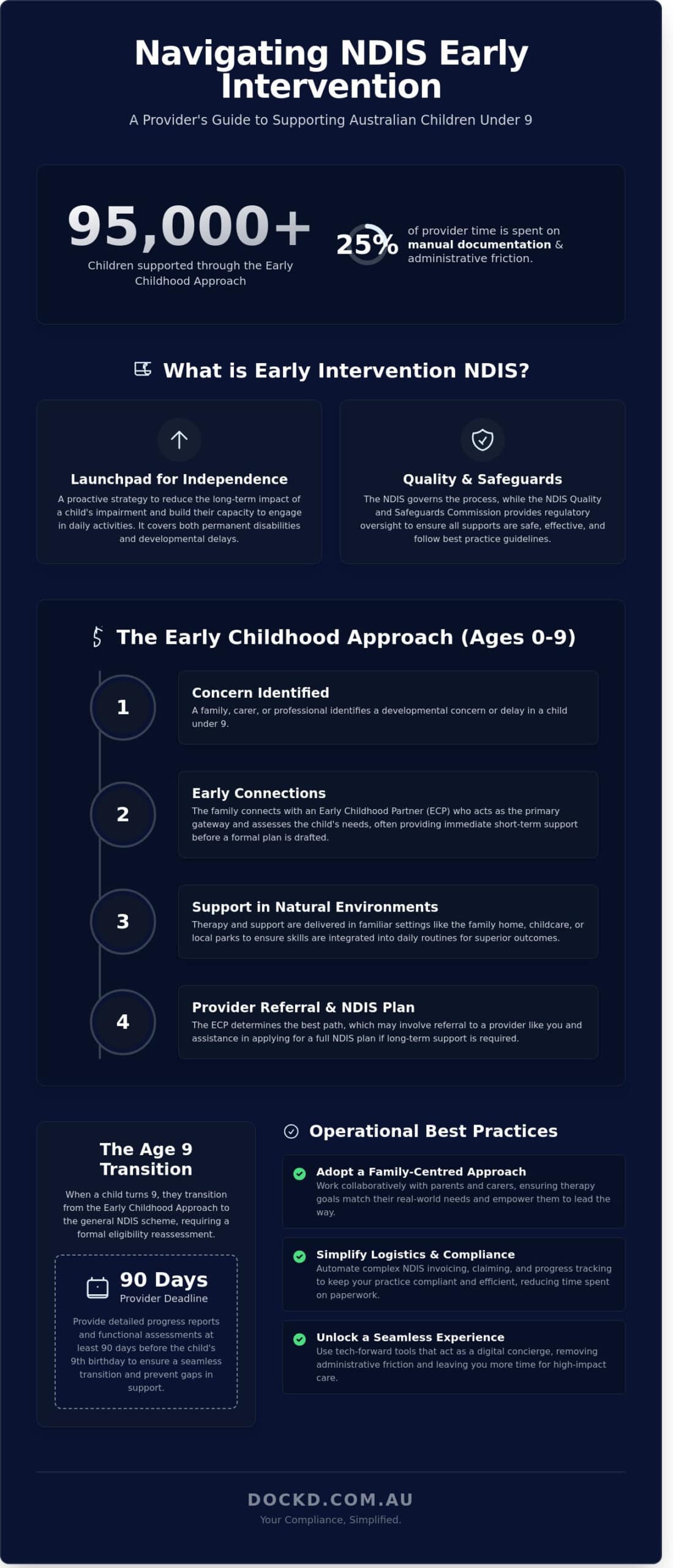
Recent data from the 2023 NDIS Annual Report shows that over 95,000 children are now supported through the Early Childhood Approach, yet many providers still spend 25 percent of their time on manual documentation. You probably agree that your focus should be on developmental milestones, not wrestling with complex reporting requirements and audit trails. Managing early intervention NDIS services shouldn’t feel like a struggle against the tide. It’s time to move away from the administrative friction that slows down your team and creates unnecessary bottlenecks.
This guide promises to simplify your workflow by showing you how to deliver high-quality, compliant support while reducing the burden of paperwork. We will explore the latest compliance standards, practical strategies for tracking progress, and ways to optimise your service delivery for young participants. It’s time to unlock a more efficient way to support Australian families and get back to what matters most. Your compliance, simplified.
Key Takeaways
- Understand the core framework to reduce impairment impact and build essential daily capacity for young children.
- Navigate the specific early intervention NDIS pathway for children under 9, focusing on early connections and functional capacity evidence.
- Adopt a family-centred, transdisciplinary approach to deliver coordinated and professional support across multiple specialist areas.
- Simplify your operational logistics by automating complex NDIS invoicing and claiming to keep your practice compliant and efficient.
- Unlock a seamless management experience with tech-forward tools that handle the paperwork, leaving you more time for high-impact care.
What is Early Intervention NDIS? Defining the Framework
Early intervention NDIS is a proactive strategy designed to provide support to children as soon as developmental concerns emerge. It’s not just a safety net; it’s a launchpad for future independence. The framework focuses on delivering support at the earliest possible stage to reduce the long-term impact of a child’s impairment. By building a child’s capacity to engage in daily activities, providers help unlock potential that might otherwise remain restricted. This approach isn’t limited to permanent disabilities. It also covers developmental delays, ensuring children get the help they need before challenges scale. The National Disability Insurance Scheme (NDIS) governs this process, while the NDIS Quality and Safeguards Commission provides the regulatory oversight to ensure all supports are safe and effective.
The Significance of Early Support
Timing is everything in child development. The window for brain growth in children under 9 is a critical period where targeted support yields the highest returns. Research indicates that early intervention NDIS services can significantly lower the requirement for high-intensity funding in adulthood. As a provider, you’re the knowledgeable local in a complex landscape. Your role in the family-centred support model is to simplify the journey for parents. You provide the tools and expertise that empower families to lead the way. This collaborative approach ensures that support isn’t just a clinical appointment; it’s a seamless part of the child’s daily life.
Key Terminology for Providers
Clarity drives performance in the disability sector. Under Section 25 of the NDIS Act, providers must distinguish between ‘Developmental Delay’ and ‘Disability’. A developmental delay involves a child not reaching milestones at the expected age, while disability often refers to a permanent condition. Understanding this distinction is vital for accurate reporting and service delivery. Early Childhood Partners serve as the primary gateway, acting as the first point of contact for families entering the scheme. To maintain high standards, providers must follow ‘Best Practice’ guidelines. These standards prioritise evidence-based outcomes and family-led goals. Your service should act like a digital concierge, removing friction and making the path to progress clear and achievable for every participant.
The Early Childhood Approach for Children Younger Than 9
The NDIS early childhood approach is the primary gateway for children aged 0 to 9. It focuses on delivering the right support at the right time. Most families start with Early Connections to get immediate help. This phase provides support before a formal NDIS plan is even drafted. It’s about early intervention ndis strategies that build long-term capacity for the child and their carers.
Support happens in natural environments like family homes, childcare centres, or local parks. Delivering therapy where the child lives and plays is vital. Research from the AIFS in 2022 confirms that support integrated into daily routines leads to superior functional outcomes. You’re not just a clinician; you’re a navigator for the family. You must work collaboratively with parents to ensure therapy goals match their real-world needs.
How the Early Childhood Approach Works
Early Childhood Partners (ECP) act as the primary facilitators. The process starts when a family or professional identifies a developmental concern. The ECP then assesses the child’s needs to determine the best path. They might offer short-term support or help the family apply for a full NDIS plan. Providers receive referrals directly through this ECP network. Your job is to make the intake process feel seamless and secure from the first contact.
The Age 9 Transition: Managing the Shift
On 1 July 2023, the NDIS officially increased the age limit for this approach from 7 to 9 years. When a child reaches this milestone, they move to the general NDIS scheme. This requires a formal eligibility reassessment to check if the child meets the Section 24 disability requirements. You must provide detailed progress reports and functional assessments at least 90 days before the child’s ninth birthday. This ensures there’s no gap in funding or support services.
Precise documentation is your most valuable tool during this review. It helps parents navigate the system without the stress of losing their current supports. Just as we help boaters find their spot on the water, you help families find their place in the wider NDIS landscape. Clear data and consistent communication keep the support vessel on course and moving forward.
Navigating Eligibility: Requirements and Evidence
Unlocking the early intervention NDIS pathway requires meeting three specific markers. First, the child must be under 9 years of age. Second, they must meet residency requirements, meaning they are an Australian citizen, a permanent resident, or a Protected Special Category Visa holder. Third, they must meet the early intervention requirement. This framework ensures that support reaches children during their most critical developmental windows.
For young children, “Substantially Reduced Functional Capacity” refers to a child’s inability to participate in age-appropriate activities without significant support. This includes basic tasks like dressing, communicating needs, or playing with peers. Providers must document these gaps using standardised tools such as the PEDI-CAT or Vineland-3. Clear data helps the NDIS understand how the child’s delay compares to 95% of their developmental peers.
Evidence is your primary currency. A diagnosis from a paediatrician is a strong start, but allied health assessments provide the granular detail needed for funding. Speech pathologists and occupational therapists provide the data that proves a child’s developmental delay is significant. You act as the digital concierge for families, organising these reports to ensure the NDIS early childhood approach has a clear, evidence-based view of the child’s needs.
Section 25: The Early Intervention Requirement
Section 25 of the NDIS Act mandates that supports must be “likely to benefit” the participant. Your role is to prove the intervention will reduce the need for future support or mitigate the impact of the impairment. Focus on capacity building. If a child moves from non-verbal to using 12 functional signs over a 6-month period, document this shift. This data proves the investment is yielding a measurable return in the child’s independence.
Documenting Progress for Audits
Audit-proof your practice with precision. Vague notes lead to rejected claims. Every entry must link a specific activity to a defined NDIS goal. Instead of writing “Child played with blocks,” write “Child practiced pincer grip to improve fine motor skills for self-feeding goal.” This demonstrates the support is reasonable and necessary. Avoid the common pitfall of “maintenance” language. The NDIS funds progress, not plateaus. Use clear, punchy reports to show how every A$ spent is unlocking a child’s potential.
Operational Best Practices for Early Intervention Providers
Success in the early intervention NDIS space requires a shift from clinical models to family-centred care. You aren’t just treating a child; you’re coaching a support system. Research from the 2022 NDIS Review highlights that capacity building for parents leads to better long-term outcomes than isolated therapy. Adopt a transdisciplinary approach where OTs, speech pathologists, and physiotherapists share goals. This prevents family burnout and ensures the child receives a cohesive strategy. Move therapy into natural settings like homes, playgrounds, or childcare centres. Data suggests that skills learned in everyday environments have a 40% higher retention rate than those taught in sterile clinics. Prioritise cultural safety for the 12.5% of NDIS participants who identify as First Nations. This means listening first and adapting your clinical tools to fit the family’s unique cultural context.
Managing Service Agreements for EI
Early intervention agreements require more agility than adult contracts. Children’s needs change fast; their schedules change faster. Your agreements must reflect this. Include clauses for flexible scheduling to handle sudden health changes or school events. Be transparent about the A$193.99 hourly rate for therapy. Clearly define your “No Show” policy based on the current NDIS 7-day cancellation rule to protect your revenue. Detail how travel charges apply to community visits so there are no surprises on the first invoice. Clarity builds the trust needed for a long-term partnership.
Rostering and Scheduling for Success
Managing high-frequency, short-duration sessions is a logistical puzzle. A typical early intervention ndis plan might involve weekly 45-minute sessions, creating a high volume of transitions. Don’t let travel eat your margins. Use route optimisation software to cluster appointments by suburb. This simple shift can increase billable hours by 15% per week. Empower your team with mobile tech to document progress notes on-site. This keeps data accurate and ensures your staff spend more time with families and less time behind a desk. Efficiency is the key to sustainability in a high-demand market. Unlock your business potential and streamline your operations today.
Simplifying NDIS Early Intervention Management with dock’d
Managing an NDIS practice shouldn’t feel like being lost at sea. dock’d is your all-in-one management software designed to anchor your operations in efficiency. It handles the complex logistics of early intervention NDIS supports so you don’t have to. Automated invoicing and claiming tools replace hours of manual data entry. You get paid faster while maintaining total accuracy with NDIS pricing arrangements. Integrated service agreements ensure every client relationship is secure and audit-proof from day one. Support workers use the mobile app to record notes directly from natural environments like homes or schools. This ensures data is captured the moment care happens.
Managing early intervention NDIS participants requires precision. dock’d simplifies the workflow by connecting your frontline staff with your back-office team in real time. This “tech-forward” approach removes the friction of paperwork, allowing your clinicians to spend more time on developmental milestones and less time on spreadsheets.
Automated Compliance and Reporting
dock’d monitors NDIS budget categories specific to early childhood without manual intervention. It generates progress reports that align with NDIS Quality and Safeguards standards instantly. You can sync every transaction with Xero for a clear financial view. This keeps your practice ready for an audit at any moment. The system tracks:
- Capacity building budgets for early childhood.
- Consumables and equipment claims.
- Travel and non-face-to-face support hours.
- Real-time funding balances for every participant.
Unlock Efficiency for Your EI Practice
Cut down on back-office tasks and put the focus back on the children. Many providers see administrative workloads drop by 30% after their first month on the platform. The software is built for growth; it supports solo practitioners and enterprise-level organisations with equal ease. You can manage 5 or 500 participants with the same level of precision. High-tech features like digital signatures and GPS-verified shift logs remove the guesswork from your daily operations.
Simplify your NDIS operations with a dock’d demo today.
Navigate the Future of Early Childhood Support
Success in the early intervention NDIS space requires a balance of clinical excellence and operational precision. By mastering the Early Childhood Approach for children under 9 and maintaining rigorous evidence for eligibility, your practice can provide the high-impact support families need. Focus on your core mission by removing the administrative hurdles that often slow down service delivery across Australia.
Don’t let manual processes anchor your business down. dock’d offers a high-tech solution designed specifically for Australian service providers to manage NDIS-compliant service agreements with a few clicks. Our platform integrates automated PRODA claiming and Xero synchronisation to eliminate hours of data entry every week. It’s time to swap your spreadsheets for a seamless digital concierge that handles the heavy lifting of compliance and billing.
Streamline your Early Intervention NDIS management with dock’d and unlock a more efficient way to work. You’ve got the expertise to change lives; we’ve got the tools to make your business run like a well-oiled vessel. Let’s get your operations moving forward with confidence and clarity.
Frequently Asked Questions
What is the difference between the NDIS Early Childhood Approach and the general NDIS?
The Early Childhood Approach specifically serves children under 9 years old, while the general NDIS supports individuals aged 9 to 65. This specialized pathway focuses on rapid response to developmental delays to provide support before a child enters primary school. On 1 July 2023, the age limit for this approach increased from 7 to 9 to ensure more children receive tailored assistance during their early years.
Can a child receive early intervention NDIS support without a formal diagnosis?
Children under 6 can access early intervention NDIS support without a formal diagnosis if they show clear signs of developmental delay. This ensures 100% of eligible children get help when it matters most rather than waiting for medical assessments. You must demonstrate that the child has a delay in two or more areas, such as communication or self-care. Early action simplifies the pathway to better long-term outcomes for the family.
What age does the NDIS early intervention pathway end?
The early intervention pathway officially ends when a child turns 9. At this milestone, the NDIS transitions the child to the general scheme if they meet the criteria for permanent disability. Recent 2023 policy updates ensure this transition is seamless for families. Your role as a provider is to guide families through this 12-month transition period to avoid any gaps in essential services.
What types of supports are funded under early intervention?
The NDIS funds various early intervention NDIS services including speech pathology, occupational therapy, and physiotherapist consultations focused on building a child’s skills. Funding also covers assistive technology like specialized strollers or communication devices. These supports aim to reduce the need for higher-level funding later in life. Focus on delivering evidence-based therapies that empower parents to manage daily routines effectively.
How do I become a registered NDIS provider for early childhood supports?
You must apply through the NDIS Quality and Safeguards Commission and pass a suitability audit to become registered. Registration requires meeting the NDIS Practice Standards, which involves an audit fee ranging from A$900 to A$5,000 depending on your business size. Once approved, you gain access to the PRODA portal. This unlocks your ability to claim payments directly for agency-managed participants and simplifies your billing process.
What evidence do I need to provide for a child’s NDIS access request?
Provide a comprehensive report from a specialist or allied health professional dated within the last 6 months. This evidence must detail the child’s functional capacity across 6 life domains like learning and mobility. Include specific assessment scores from tools like the PEDI-CAT or Vineland-3 to provide objective data. Clear documentation speeds up the NDIS decision-making process, ensuring families aren’t left waiting for vital funding.
Can early intervention supports be delivered in a childcare or school setting?
Supports can be delivered in natural settings like childcare centres or schools if the facility grants access. This “in-situ” approach helps children apply skills in real-world environments where they spend most of their time. You’ll need to coordinate with the 1 or 2 key educators involved to ensure therapy goals align with the child’s daily routine. It makes the intervention more effective and simplifies the family’s weekly schedule.
How often are early intervention plans reviewed by the NDIS?
The NDIS typically reviews early intervention plans every 12 months to track progress and adjust funding levels. Some plans may last up to 24 months if the child’s needs are stable and goals are consistent. Check the plan’s end date in the NDIS portal to prepare your progress reports 6 weeks in advance. Regular reviews ensure the support remains relevant as the child grows and hits new developmental targets.