

What if the software that supported your growth in 2022 is the very thing capping your potential in 2026? You already know that NDIS compliance is a moving target. According to the 2023 NDIS State of the Sector report, 42% of providers still cite administrative burden as their primary challenge. It’s frustrating when manual rostering errors lead to missed shifts or when your team spends hours manually reconciling data with Xero. While platforms like visualcare have long provided a foundation for Australian care businesses, the shift toward a more digital-first NDIS demands even more agility and precision.
We’re here to help you unlock a more efficient way to work. You’ll learn exactly which features are non-negotiable for automated claiming and how to ensure your tech stack delivers better participant outcomes. This guide provides a clear checklist to evaluate your current software against modern alternatives. Your NDIS management, simplified. We’ll show you how to streamline your operations so you can spend less time on paperwork and more time delivering high-quality care.
Key Takeaways
- Navigate the 2026 NDIS landscape by replacing outdated paper systems with a secure, digital care management ecosystem.
- Compare legacy platforms like visualcare against our 7-point checklist to ensure your software meets modern compliance and efficiency standards.
- Prioritise participant-centric design over simple rostering to improve support quality and gain real-time visibility into your service data.
- Master the transition process with a professional roadmap that simplifies data migration and staff training for your Australian care team.
- Scale your provider business with a tech-forward, local solution that turns complex NDIS logistics into a seamless, adventurous experience.
What is Care Management Software in the 2026 NDIS Landscape?
Care management software is the digital ecosystem that powers modern service delivery. It acts as the central command centre where participant goals, staff schedules, and financial claims converge. For providers operating under the National Disability Insurance Scheme (NDIS), this technology has transformed from a basic digital diary into a critical compliance engine. By 2026, the NDIS Quality and Safeguards Commission expects a level of data integrity that paper-based systems cannot match. Moving away from manual filing is no longer a choice; it is a requirement for survival in a highly regulated market.
The industry has shifted from simple rostering to participant-centric workflows. This means the software focuses on outcomes rather than just filling shifts. It tracks progress against specific goals and ensures that every hour of support aligns with a participant’s plan. The core users of these systems include:
- Care Coordinators: They use the platform to match staff skills with participant needs and manage complex schedules.
- Support Workers: They access mobile apps to log progress notes, record shift start times, and view care plans in real-time.
- Finance Teams: They rely on the software to generate bulk claims and manage payroll without the risk of manual data entry errors.
Platforms like visualcare have historically helped providers manage these moving parts. By centralising information, these tools remove the friction that slows down service delivery.
The Evolution of Platforms like Visualcare
The history of Australian care platforms began with local servers and clunky, office-bound interfaces. Early versions of visualcare and its contemporaries focused heavily on the administrative side of aged care and disability services. Today, the standard has changed. Providers now demand cloud-based, any-device accessibility to support a mobile workforce. Modern platforms must also handle integrated funding streams. This allows an organisation to manage NDIS participants and Aged Care packages within a single, seamless interface, ensuring business agility as government policies evolve.
Why “Good Enough” Software is a Risk
Using generic tools like Excel or basic calendars is a high-stakes gamble for NDIS providers. Generic software lacks the specific validation rules required for NDIS claiming, which often leads to payment delays or rejected invoices. Data visibility is another major hurdle. Poor record-keeping is a primary reason for failing NDIS audits. Automated software provides “audit-proofing” by creating a permanent, timestamped trail of every interaction. This transparency builds trust with the regulator and secures your provider registration. Stop relying on luck and start using a system designed for the task.
The 2026 NDIS Provider Software Checklist: 7 Non-Negotiables
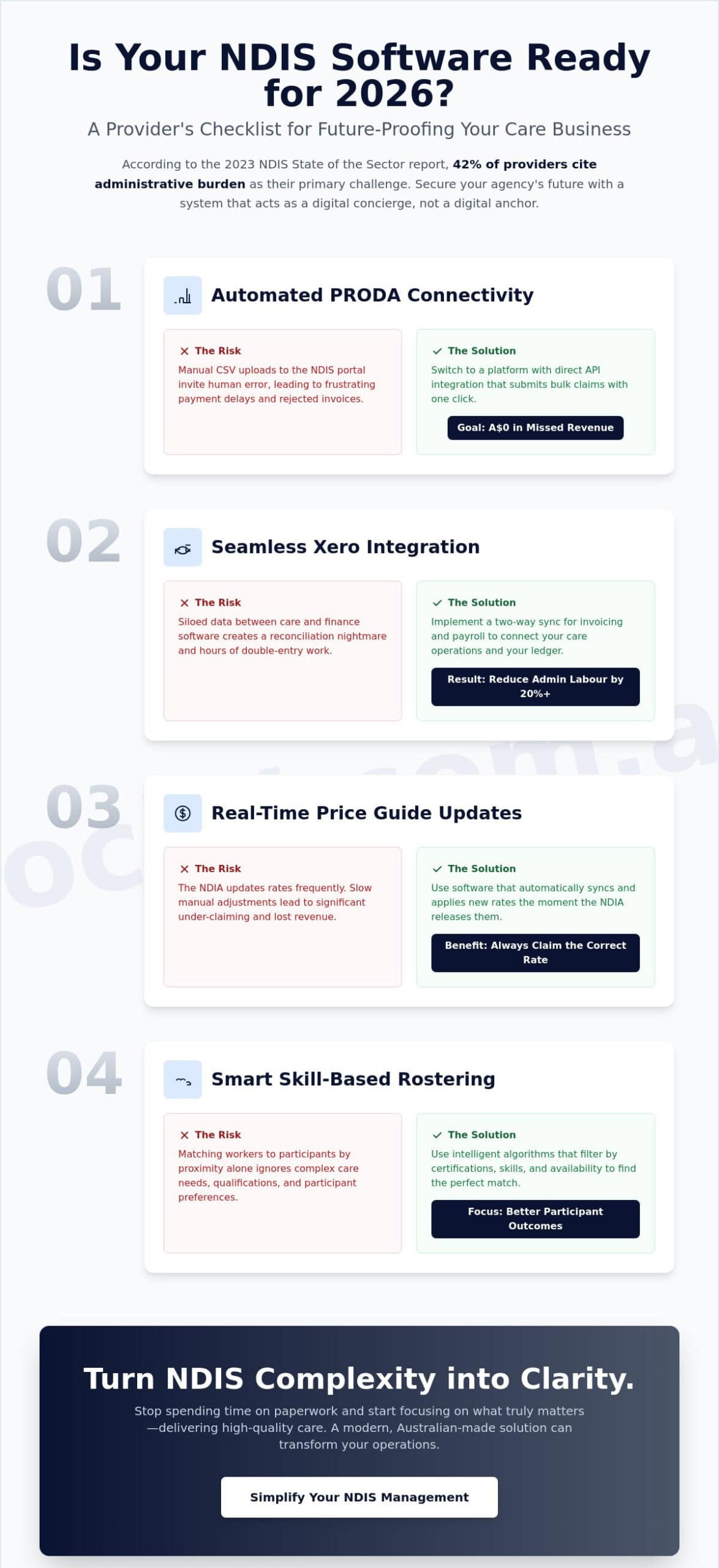
Selecting a platform like visualcare or its modern rivals isn’t just about ticking boxes. It’s about securing your agency’s future. By 2026, the Australian Government’s Data and Digital Government Strategy will drive even higher standards for data security and service delivery. You need a system that acts as a digital concierge, not a digital anchor.
Essential Compliance and Finance Features
- Automated PRODA Connectivity. Problem: Manual CSV uploads to the NDIS portal invite human error and payment delays. Solution: Direct API integration. Action: Switch to a platform that submits bulk claims with one click to ensure A$0 in missed revenue.
- Seamless Xero Integration. Problem: Siloed data between care software and finance creates a reconciliation nightmare. Solution: A two-way sync for invoicing and payroll. Action: Connect your ledger to eliminate double-entry and reduce administrative labour by 20% or more.
- Real-Time Price Guide Updates. Problem: The NDIA updates rates frequently, leading to significant under-claiming for providers who don’t adjust fast enough. Solution: Automatic price guide syncing. Action: Use software that updates rates the moment the NDIA releases them.
Operational and Care Delivery Tools
- Smart Skill-Based Rostering. Problem: Matching workers to participants based on proximity alone ignores complex care needs. Solution: Intelligent matching algorithms that filter by certifications and participant goals. Action: Filter your roster by worker skills to guarantee compliance and safety.
- Digital Incident Management. Problem: Paper trails and scattered emails lead to audit failures and NDIS Commission flags. Solution: Integrated reporting workflows that trigger instant manager alerts. Action: Log incidents on-site to centralise all mandatory NDIS documentation.
- Mobile-First Progress Notes. Problem: Progress notes written at the end of a week are often inaccurate or incomplete. Solution: Real-time mobile entry for support workers. Action: Deploy an interface that allows for instant entry before the worker leaves the shift.
- Participant Self-Service Portals. Problem: Families feel disconnected from care plans, leading to constant phone enquiries. Solution: Secure access to schedules and budget tracking. Action: Provide a transparent login for participants to “unlock” their own care data.
While visualcare has long served the sector, the 2026 landscape demands even more agility. Agencies need tools that move at the speed of the sharing economy. If you’re ready to scale your operations without the friction, explore how modern platforms simplify your day.
Pro-tip for Mobile Evaluation: When testing a mobile app, don’t just look at the home screen. Ask a worker to try logging a note while offline in a remote area. If the data doesn’t sync perfectly when they’re back in range, it’s a compliance liability. A modern app must be functional in the field, not just in the office.
Beyond Rostering: Why Participant-Centric Design Matters
Schedules should serve people, not the other way around. For too long, NDIS software focused strictly on the back-office grid. This prioritised agency efficiency over the human experience. Modern providers now realise that the roster is just a tool to facilitate person centred care. When software puts the participant at the core, the entire service model shifts. It moves from “filling a shift” to “fulfilling a goal.” While legacy systems like visualcare provided the initial digital foundation for the industry, the 2026 landscape demands a deeper integration of data and empathy.
Visibility is the ultimate trust builder. When data flows freely between the support worker, the manager, and the participant, the quality of care rises. Automated alerts play a massive role here. They act as a financial guardrail. If a service agreement is on track to overspend by A$2,000, the system flags it immediately. This prevents the administrative nightmare of unfunded supports. It keeps the focus on the participant’s budget health without requiring a manual audit every Friday afternoon.
Improving Participant Outcomes with Data
Data isn’t just a collection of numbers; it’s the story of a participant’s journey. Digital progress notes allow coordinators to track goal attainment in real-time. If a participant shows a 15% decline in community participation over a month, the system identifies the trend. This allows for an immediate adjustment to the support plan. Giving families access through dedicated portals creates a transparent, secure environment. They no longer have to wonder if a shift occurred or what was achieved. This visibility turns plan reviews from a stressful guessing game into a data-backed conversation with the NDIS.
Reducing Administrative Burnout
Manual data entry is a primary driver of staff turnover in the disability sector. Modern, tech-forward platforms function like a digital concierge, handling the heavy lifting of compliance and logistics. By eliminating redundant entry tasks, agencies can save upwards of 12 hours of admin time per staff member every month. This efficiency directly impacts support worker retention. When tools are intuitive and punchy, workers feel empowered rather than burdened. They spend less time on their screens and more time with the people they support. It’s a simple equation: better tools lead to a more adventurous and engaged workforce. Platforms that mirror the seamless nature of a high-end marketplace make the “visualcare” of the past feel like a relic of a slower era. Your team deserves a platform that moves as fast as they do.
Transitioning Systems: Managing Data Migration and Training
The biggest hurdle for NDIS providers isn’t the software cost; it’s the fear of a messy transition. Many teams cling to legacy platforms like visualcare simply because the idea of moving years of participant data feels overwhelming. This hesitation costs you efficiency every single day. A structured migration turns a chaotic overhaul into a controlled upgrade. You need a clear path to move from clunky local servers to a streamlined cloud environment without losing a single line of progress notes.
The 4-Step Migration Process
Switching systems requires precision. Follow this roadmap to ensure your data remains secure and your operations stay live during the move.
- Step 1: Audit and clean. Review your existing data. Remove duplicate participant profiles and expired service agreements. Clean data at the start prevents errors in your new system.
- Step 2: Technical transfer. Move your records into the new cloud-based environment. This stage focuses on maintaining data integrity while migrating from older setups like visualcare to modern, high-speed infrastructure.
- Step 3: Configuration. Set your NDIS-specific rules. Map your line items and pricing limits to ensure every claim is compliant. Connect your financial tools to automate your entire workflow.
- Step 4: Role-based training. Don’t overwhelm the team. Provide specific training for admin staff on billing and separate sessions for support workers on mobile app usage.
Ensuring Long-Term Success
NDIS regulations change constantly. A “set and forget” approach leads to non-compliance and rejected claims. Your software must evolve with the latest NDIS Price Guide updates. Modern platforms offer regular software updates and firmware improvements that keep your business agile. Localised Australian support is vital during this phase. Having a team that understands the local landscape ensures you aren’t left waiting for overseas help when a payroll deadline looms.
Financial integration is the backbone of your business. You can use a Xero trial to test how your new software handles invoicing and payroll before you commit fully. This sandbox approach lets you iron out any kinks in the workflow without risking your actual accounts. It builds a reliable foundation for your future growth. Success depends on choosing a partner that provides the tools and the local expertise to keep you moving forward.
Ready to upgrade your operations? Simplify your NDIS management today.
Choosing an Australian-Made Solution for Your Care Business
Selecting the right platform isn’t just about checking boxes on a feature list. It’s about finding a partner that understands the specific regulatory hurdles of the Australian landscape. Local expertise matters when NDIS price guides change or when the NDIA introduces new compliance standards like the PACE transition. While legacy systems like visualcare have served the industry for years, the shift toward 2026 requires a more agile, tech-forward approach. You need NDIS software for providers that feels less like a digital filing cabinet and more like a helpful concierge.
The dockd Difference
We built dockd to be the knowledgeable local for your business operations. Our platform isn’t a collection of bolted-on parts; it’s a seamless, all-in-one ecosystem where your CRM, rostering, and invoicing live in harmony. We’ve designed specific modules for SIL and Support Coordination to ensure every niche of your service delivery is covered. Our team brings an adventurous, tech-forward culture to the sector, replacing the stuffy, formal language of traditional maritime and care industries with tools that actually work. We focus on removing friction, so your team spends less time fighting with software and more time supporting participants.
- Integrated Rostering: Match the right staff to the right shift instantly based on availability and skills.
- Automated Invoicing: Reduce payment delays with NDIS-ready claims that sync directly with your accounting software.
- Specialised SIL Modules: Manage complex living arrangements and shared supports without the spreadsheet headache.
Unlocking Your Business Potential
The right software acts as a catalyst for growth rather than a bottleneck. When you simplify your backend, you unlock the freedom to scale your impact. Many providers find that moving to a modern, integrated alternative allows them to increase their participant capacity by up to 25% without hiring additional administrative staff. It’s about efficiency and reliability. Your NDIS operations, simplified. This is the brand promise we deliver to every provider who joins our community.
Don’t let paperwork anchor your progress. Evaluate your current operational efficiency and ask if your current tools are helping you reach the horizon or holding you back. The future of care is mobile, instant, and secure. It’s time to find your spot in a more connected, digital-first marketplace. Book a dockd demo to see the future of NDIS management and start your next chapter today.
Chart Your Course for 2026 NDIS Success
Navigating the NDIS landscape in 2026 requires more than a digital roster. You need a system that prioritises participant outcomes while automating complex compliance workflows. Legacy platforms like visualcare served their purpose in the past; however, the modern provider demands a seamless, Australian-made solution that handles data migration without the headache. Success hinges on three pillars: participant-centric design, local accountability, and technical reliability. Don’t let outdated paperwork anchor your growth. Instead, choose a platform that scales with your ambitions and keeps your business compliant with every legislative shift.
Your NDIS management, simplified. Stop juggling disconnected tools and start focusing on the quality of care your participants deserve. It’s time to trade manual entries for a high-tech experience that feels like a digital concierge for your business operations. Our purpose-built tools ensure you stay ahead of the curve while maintaining a grounded, secure atmosphere for your staff and clients alike.
Simplify your NDIS operations with dockd. Our platform is 100% Australian-made and owned; it features a seamless Xero integration purpose-built for NDIS compliance. Unlock a smoother way to manage your care business and find your rhythm today.
Frequently Asked Questions
Is Visualcare suitable for small NDIS providers?
Visualcare is built for scale, making it a powerful choice for medium to large NDIS organisations. While small providers can use the platform, the extensive feature set often requires a dedicated administrator to manage. If you’re a solo provider or have a team of under 5, you might find the interface more complex than leaner alternatives designed for rapid growth.
How does NDIS software handle the 2025-26 Price Guide changes?
Modern platforms automate these transitions through direct API integration with the NDIA portal. When the 1 July 2025 price updates arrive, the software syncs new line items and rate caps across your entire system instantly. This automation prevents claiming errors and ensures your 2026 budget forecasts stay accurate without manual data entry or spreadsheet updates.
Can I integrate my NDIS software with Xero or MYOB?
Yes, most leading platforms offer seamless two-way integration with Xero and MYOB. You can push your NDIS invoices and payroll data directly to your accounting software with a single click. This connection eliminates double-handling and reduces administrative labour by roughly 15 hours per week for a standard provider. It’s your financial workflow, simplified.
What is the average cost of NDIS management software in Australia?
Expect to pay between A$50 and A$250 per user per month for high-quality NDIS software. Some vendors also charge a flat implementation fee ranging from A$500 to A$5,000 to handle your initial data setup and staff training. Always confirm if the price includes GST and check for hidden costs like SMS notification credits or storage limits.
How long does it take to migrate data from one care platform to another?
A standard data migration usually takes 4 to 8 weeks to complete from start to finish. This timeline includes auditing your current participant files, mapping data fields to the new system, and conducting a final test run. Providers with fewer than 20 participants can often fast-track this process in under 14 days if their current records are tidy.
Does NDIS software assist with audit preparation and compliance?
Yes, the software acts as a secure digital vault for all NDIS Commission audit requirements. It tracks every support note, incident report, and shift log with an immutable timestamp. You can generate comprehensive compliance reports in seconds, proving you’ve met the NDIS Practice Standards. Stop worrying about paper trails and let the technology handle the heavy lifting.
Is there a mobile app for support workers to log shifts and notes?
Yes, most modern alternatives and Visualcare offer dedicated mobile apps for iOS and Android devices. Support workers use these apps to clock in via GPS, view participant goals, and record progress notes while on-site. Real-time logging improves documentation accuracy by 40% because notes are captured at the point of care rather than at the end of the week.
What is the difference between NDIS provider software and plan management software?
NDIS provider software manages the daily delivery of care, including rostering, worker notes, and service bookings. Plan management software is a financial tool used to pay invoices from other providers and track a participant’s total NDIS budget. While some 2026 platforms offer hybrid modules, they serve two very different functions in the disability sector. Choose the tool that matches your specific registration group.