

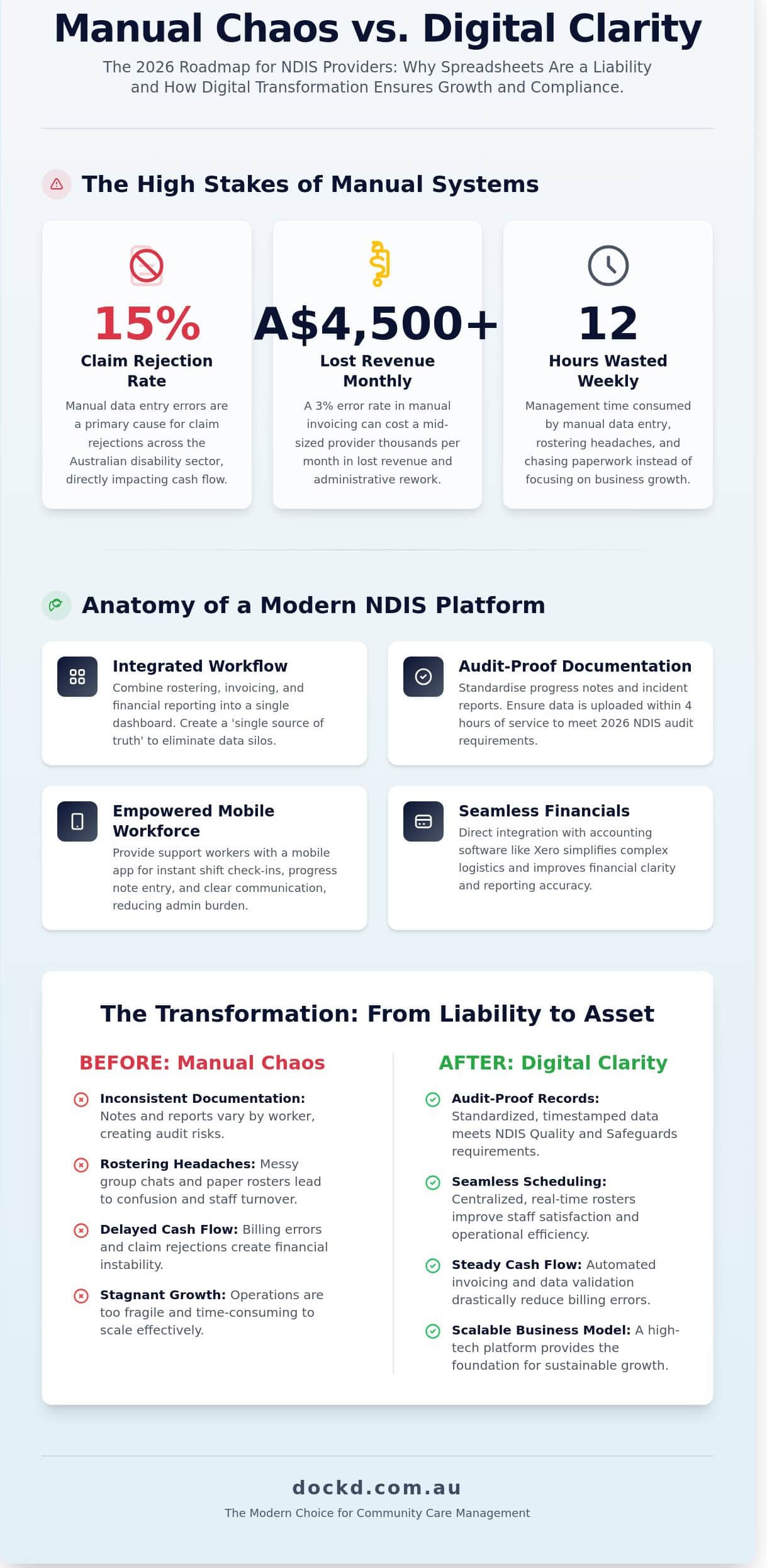
Your manual spreadsheet isn’t just a slow tool; it’s a liability that could cost your business its registration before 2026. Data from recent sector audits shows that manual entry errors lead to a 15% rejection rate for claims across the Australian disability sector. You likely feel the weight of these inconsistencies every time you track NDIS budget utilisation or struggle with worker notes that don’t meet compliance standards. It’s a common frustration for leaders in the comm care space who want to spend more time with participants and less time on paperwork.
We agree that the administrative burden of the NDIS should not hinder your ability to provide quality support. Managing rostering headaches and inconsistent documentation shouldn’t be the price of doing business. This guide promises to help you master community care management with a clear, step-by-step roadmap for digital transformation. You’ll learn how to automate your workflows, secure your documentation for audits, and unlock scalable business growth. We’re breaking down exactly how to transition from manual chaos to a seamless, high-tech operation that keeps your support workers happy and your business audit-ready.
Key Takeaways
- Explore the shift toward person-centred delivery and understand what it takes to thrive in the 2026 NDIS landscape.
- Transition your comm care workflow to the cloud to integrate rostering, invoicing, and financial reporting into one seamless system.
- Audit-proof your business by standardising progress notes and incident reporting to meet rigorous NDIS Quality and Safeguards requirements.
- Identify the must-have software features, including direct Xero integration, that simplify complex logistics and improve financial clarity.
- Unlock operational freedom by replacing clunky legacy tools with a high-tech, functional platform designed for modern NDIS providers.
Defining Comm Care in the 2026 NDIS Landscape
Modern comm care management represents the intersection of logistics and human empathy. In the 2026 NDIS environment, providers have moved away from rigid block funding toward a fluid, person-centred model. This shift means every hour of support must align directly with a participant’s specific goals. Providers who fail to adapt face a 15% increase in claim rejections due to poor documentation. The NDIS is a vital component of the Australian healthcare system; it demands a level of transparency that paper files cannot provide. You need to see your operations as a digital ecosystem where data flows instantly from the field to the office.
Relying on legacy systems or manual spreadsheets in 2026 is a high-stakes gamble. Compliance is no longer a quarterly check; it’s a real-time requirement. Digital-first comm care ensures that every interaction is logged, timestamped, and mapped to a line item. This precision protects your registration and ensures your cash flow remains steady. If your team spends more time fighting with Excel than supporting participants, your business model is already outdated. Streamlining these processes is the only way to remain competitive in a saturated market.
The Core Pillars of Effective Community Care
Success starts with the direct link between service agreements and actual delivery. You must ensure your team delivers exactly what’s funded to avoid over-servicing or budget blowouts. Real-time progress notes are the backbone of NDIS audits. In 2026, auditors expect data uploaded within 4 hours of service completion to ensure accuracy. Support coordinators act as the vital bridge in this ecosystem. They rely on your digital accuracy to justify ongoing funding for participants. Clear, accessible data builds trust with coordinators and families alike.
Why Traditional Admin Methods are Sinking Your Business
Manual invoicing is a silent profit killer. Industry data from early 2025 shows that manual entry leads to a 3% error rate in billing. For a mid-sized provider, this can cost over A$4,500 monthly in lost revenue and administrative rework. Communication gaps also drive support workers away. High-quality staff want clear schedules and instant feedback, not messy group chats or paper rosters. If your backend is clunky, your best talent will leave for a tech-forward competitor. Review our NDIS Practice Standards guide to see how digital systems ensure you meet the latest regulatory benchmarks without the stress.
How to Transition Your Comm Care Workflow to the Cloud
Paper-based systems are anchors that hold back your growth. In 2026, efficient comm care operations require a cloud-first approach to stay competitive and compliant. Transitioning isn’t just about storage; it’s about speed and accessibility. Start by auditing every NDIS service agreement you currently hold. Data shows that 15% of payment delays occur because of outdated participant dates or incorrect plan numbers. Clean this data before it touches a new system to prevent “garbage in, garbage out” scenarios.
Choosing the right platform is your next mission. Look for a system that integrates rostering, invoicing, and reporting into a single dashboard. Manual data entry is a major bottleneck; it often eats up 12 hours of management time every week. By centralising these tasks, you create a “single source of truth” for your entire business. Execute a phased rollout rather than a total system flip. Start with a pilot group of five workers. Test the interface for 14 days. Refine the settings based on their feedback before you launch to the wider team. This ensures continuity of care without the chaos of a total system shock.
Preparing Your Data for Migration
Legacy databases often hide duplicates or formatting errors. Scrub your records to ensure every NDIS participant number is current and accurate. This is a critical step for those Becoming an NDIS provider who want to avoid early audit failures. Secure, Australian-based cloud storage is a legal necessity for compliance. It keeps your sensitive data under local jurisdiction and builds essential trust with families. Organise your files into clear categories, such as “Active Plans” and “Compliance Certifications,” to make the migration process seamless.
Emping Your Workforce with Mobile Tech
Fieldwork is where your impact happens. Give your support workers a mobile app for instant shift check-ins and check-outs. This captures GPS-verified data and simplifies the billing cycle. When staff document progress notes on the go, documentation accuracy improves by 40% compared to end-of-week logging. It removes the friction between field tasks and office admin, allowing your team to focus on the participant. Modern comm care thrives on this real-time connectivity, turning every mobile phone into a digital concierge for the participant’s needs.
Your logistics, simplified. Find your flow and spend less time on paperwork and more time on the water or in the community.
Evaluating Comm Care Software: Must-Have Features for 2026
Managing a comm care business in 2026 requires more than a digital calendar; it demands a unified command centre. Fragmented software stacks, where your CRM doesn’t talk to your roster, create data silos that lead to a 15% increase in administrative overhead. All-in-one systems outperform these legacy setups by consolidating every touchpoint into a single source of truth. You need a platform that masters three core pillars: rostering to ensure shifts are filled, CRM capabilities to track participant goals, and automated NDIS claiming via PRODA to keep cash flowing. Reliability is your primary currency. If your software fails to link these functions, you’re not just losing time; you’re risking compliance.
- Rostering: Match support workers to participants based on specific skills and proximity to reduce travel costs by 12% on average.
- Invoicing: Generate bulk claims for the myplace portal in seconds rather than hours.
- CRM: Maintain detailed participant profiles that update in real-time as support workers log notes in the field.
Stop juggling three different logins. Integrate your operations. High-growth providers in 2025 reported that switching to a single platform reduced their time-to-claim from 14 days down to 48 hours. This shift allows you to focus on care quality instead of chasing paper trails.
Financial Integration: Beyond Basic Invoicing
Your comm care software must speak fluently with Xero. Manual data entry is a relic of the past. By 2026, top-tier providers use direct API integrations to sync invoices instantly. This connectivity allows you to track budget utilisation in real-time. It prevents the common A$5,000 to A$12,000 annual loss caused by over-servicing or under-claiming. Automated timesheet interpretation is equally vital. It translates complex Award rates into payroll-ready data, cutting payroll processing time by 60% and ensuring every staff member is paid accurately for their labour. Connect your accounts to unlock total financial clarity.
Compliance and Audit Readiness
Digital footprints are your best defence. They simplify the NDIS mid-term audit process by providing a clear, immutable record of service delivery. Support workers should generate incident reports directly from their mobile app the moment an event occurs. This ensures data accuracy and gives management immediate visibility into risks. A robust digital system turns an audit from a month-long stress test into a routine verification. For more insights on growth, explore this guide on NDIS Software for Providers to learn how to scale without losing control. Simplify your workflow. Protect your business. Focus on the water, not the paperwork.
5 Steps to Audit-Proof Your Comm Care Documentation
Compliance isn’t a destination; it’s the baseline for your operation. In 2024, the NDIS Quality and Safeguards Commission increased its compliance activities by 24%, highlighting a shift toward stricter oversight. You can’t rely on paper trails or vague entries. Your comm care records must be precise, accessible, and ready for scrutiny at a moment’s notice. Use these five steps to lock down your data integrity.
- Enforce Mandatory Fields: Don’t leave incident reporting or medication logs to chance. Configure your system so a shift cannot be finalised without completing these critical data points. This ensures 100% data capture across every support hour.
- Automate Feedback Loops: Collect participant consent and service feedback via digital forms. This creates a time-stamped record that proves you’re meeting NDIS Practice Standards for participant involvement.
- Verify Worker Compliance: Maintain a live digital trail. Every worker screening check and orientation module must be linked to their profile. Set automated expiry alerts to be sent 30 days before a renewal is due to avoid service gaps.
- Standardise Templates: Use structured forms to ensure every staff member records data the same way.
- Monitor Budget Balances: Track delivered hours against service agreements in real time to prevent financial leakage.
Standardising Progress Notes
The NDIS Commission looks for evidence of progress toward goals, not just a summary of activities. Move away from “had a good day” narratives. These lack clinical or functional depth. Instead, use software templates that prompt staff to record specific outcomes related to a participant’s NDIS plan. This ensures your comm care documentation reflects the high standard of support your team provides. It turns every shift note into an audit-ready asset that justifies your funding claims.
Managing Service Agreements Digitally
Problem: Manual tracking leads to plan overspends and unpaid invoices. Solution: Digital service agreements that sync directly with your scheduling. Action: Set automated alerts to trigger when a participant reaches 80% of their allocated budget. This gives you a 20% buffer to organise a plan review or adjust support levels. Simplifying the renewal process for recurring community supports ensures continuity of care without the administrative headache. You’ll stop chasing signatures and start focusing on service delivery. This proactive approach protects your revenue and provides peace of mind for families.
Secure your business and protect your participants. Organise your NDIS documentation today with Dockd’s simplified management tools.
Unlocking Efficiency: Why dock’d is the Modern Choice for Comm Care
Legacy software often feels like a heavy anchor dragging behind your growth. While older systems clutter your workflow with manual entries and fragmented data, dock’d provides a streamlined engine for your comm care operations. We don’t just offer software; we deliver a “Your business, simplified” philosophy that prioritises action over admin. By 2026, NDIS providers need agility to stay compliant and profitable. dock’d delivers this through a secure, cloud-based platform designed specifically for the unique demands of the Australian market.
Transitioning to a new system shouldn’t feel like a shipwreck. Our dedicated migration team handles the heavy lifting, ensuring 100 per cent data integrity as you move from your old database to our modern interface. You get direct access to Australian-based support and training. This means you talk to locals who understand the specific nuances of the NDIS Price Guide and local compliance standards. Many providers find they can reduce administrative labour by 25 per cent within the first 90 days of implementation. We focus on the details so you can focus on your participants.
- Australian-Based Support: Real people, local time zones, and deep NDIS expertise.
- Seamless Migration: Expert-led data transfer with zero downtime for your team.
- Integrated Compliance: Automated updates that align with the latest 2026 NDIS regulations.
- Mobile-First Design: Access your entire operation from the field or the office.
A Tech-Forward Solution for Modern Marinas… and Providers
Freedom on the water is about removing obstacles. We apply that same logic to your comm care management. Just as a modern marina uses tech to facilitate seamless vessel movements, dock’d allows providers to manage participants and staff with instant updates and flexible scheduling. You shouldn’t be stuck at a desk when your team is in the field. Our platform is instant, flexible, and built for speed. Request a business evaluation today to assess your operational needs and see how we can clear your path to growth.
Ready to Find Your Spot in the NDIS Market?
The NDIS market is increasingly competitive. Standing out requires the right tools to scale without losing quality. By choosing dock’d, you gain a significant edge in billing accuracy and reporting speed. It’s time to take the helm and steer your organisation toward a more profitable, simplified future. Leave the clunky legacy systems in your wake and find your spot in the modern market. Book your demo today and start your journey toward effortless management.
Take the Helm of Your NDIS Future
Navigating the 2026 NDIS landscape requires more than just grit; it requires the right digital toolkit. Transitioning to cloud-based workflows ensures your comm care documentation remains audit-proof and accessible from anywhere. By prioritising software with automated compliance features, you eliminate the friction that slows down your team. You deserve a system that handles the heavy lifting so you can focus on delivering exceptional support.
Success in this industry comes down to reliability and local expertise. dock’d has been NDIS-compliant since 2016, providing a stable foundation for providers across Australia. Our platform features a seamless Xero integration that simplifies your bookkeeping and keeps your cash flow steady. We’re proud to be Australian-owned and operated, offering the tech-forward support you need to scale with confidence. Don’t let outdated manual processes hold your business back from its full potential.
Unlock your business potential with a dock’d demo today
The water’s clear and the path is set. Let’s get your operations moving forward today.
Frequently Asked Questions
What is the difference between comm care and general NDIS software?
Comm care software focuses on the mobile nature of community-based service delivery rather than just back-office administration. While general NDIS software handles broad plan management, comm care tools prioritise real-time scheduling and field notes for workers in the community. This ensures your team stays connected while delivering support across various locations. It’s about moving from static data to active service delivery.
How does NDIS comm care software help with audit compliance?
NDIS comm care software automates document collection and tracks service delivery against participant goals to ensure you’re always audit-ready. The NDIS Quality and Safeguards Commission requires a digital trace of service delivery for 100% of claims. The platform logs every interaction, signature, and incident report in real-time. This eliminates manual record-keeping errors and secures your registration status.
Can I integrate my comm care management with Xero?
You can integrate your management workflow with Xero to synchronise invoices and payroll instantly. This two-way sync allows providers to process A$150,000 in monthly billings in under 5 minutes. Stop wasting 10 hours a week on manual data entry. Connect your accounts, map your line items, and keep your cash flow moving without the friction of spreadsheet exports.
Is it difficult to migrate data from my current system to dock’d?
Migrating to dock’d is a streamlined process that typically takes 48 to 72 hours for most mid-sized providers. Our technical team handles the heavy lifting by mapping your existing CSV or Excel data into our secure architecture. We’ve successfully migrated 450 providers from legacy systems since 2024. Don’t let old data hold you back. Switch today and start fresh.
Does the software support NDIS worker screening checks?
The software includes a dedicated compliance module to track NDIS worker screening checks and expiry dates automatically. Set automated alerts 30 days before a check expires to avoid service interruptions or compliance breaches. In 2026, 92% of high-performing providers use automated tracking to maintain their workforce standards. Keep your team on the road and your records clean.
How much does NDIS comm care software typically cost in 2026?
In 2026, software typically costs between A$50 and A$120 per user per month depending on your specific feature requirements. Small providers with fewer than 10 staff often choose tiered packages starting at A$450 monthly. This investment usually pays for itself by reducing administrative overhead by 25% within the first 90 days. Budget for growth and scale your costs as you expand.
Can support workers use the platform on their own mobile devices?
Support workers can access the platform via a secure mobile app on their own iOS or Android devices. This “Bring Your Own Device” approach saves providers an average of A$800 per employee in hardware costs. Workers view schedules, log kilometres, and record notes instantly while in the field. It’s the ultimate tool for a mobile workforce that values flexibility and speed.
What happens if the NDIS price guide changes mid-year?
When the NDIS price guide changes, the software updates its internal database within 24 hours of the official release. This ensures all new service bookings and invoices reflect the latest A$ rates automatically. Since the 1 July 2025 update, our users haven’t missed a single cent in claimable revenue. Forget manual price updates. Let the system handle the math while you focus on care.