

Your client’s medical diagnosis is no longer the primary key to unlocking NDIS support. You’ve likely felt the pressure of shifting from clinical labels to functional assessments, especially when a single data entry error during onboarding can trigger a compliance red flag. It’s a complex landscape where the NDIS Quality and Safeguards Commission reported a 15% increase in oversight activities in their 2023-24 annual report. Staying ahead means moving beyond the old ways of managing paperwork.
We understand that navigating these regulatory changes feels like steering through a storm without a map. This 2026 guide empowers you to master the six core ndis impairment categories and implement a foolproof framework for documenting functional impact. You’ll learn how to translate complex needs into the specific language the Agency requires for total compliance. We’ll show you how to ditch the manual hurdles and use tech-forward systems to keep your client data secure, accessible, and ready for any audit. It’s time to simplify your onboarding and get back to what matters: delivering world-class support to your participants.
Key Takeaways
- Navigate the 2026 legislative shift by prioritising functional capacity over medical diagnosis to secure accurate funding for your participants.
- Master the six core ndis impairment categories to align your service delivery with the specific cognitive and intellectual needs of your community.
- Streamline your compliance workflow by linking Service Agreement goals directly to mandatory Impairment Notices during the intake phase.
- Unlock operational efficiency with tech-forward software that automates the connection between impairment data and error-free NDIS invoicing.
Understanding NDIS Impairment Categories in 2026
Unlock the framework of modern disability support. NDIS impairment categories serve as the functional map for every participant journey. These categories don’t just label a medical condition; they define the specific support needs required to achieve independence. In 2026, the National Disability Insurance Agency (NDIA) implemented a mandatory shift toward “Impairment Notices” during all plan reviews. This update streamlines how funding flows, ensuring every A$1 allocated aligns directly with a participant’s functional capacity.
For service providers, using the correct ndis impairment categories is now a technical requirement for PRODA claiming. If the category assigned to a participant doesn’t align with the support item billed, the claim will fail. This precision helps maintain a secure and transparent marketplace. The NDIA determines eligibility by assessing “permanent and significant” impairment under Section 24 of the NDIS Act 2013. This legislative foundation, established by the National Disability Insurance Scheme (NDIS), ensures the scheme remains sustainable for the 610,000+ Australians currently receiving support.
The Purpose of Categorisation
Categorisation creates a fair system. It ensures “reasonable and necessary” funding applies consistently across different regions and demographics. By linking an impairment type to specific NDIS support items, the system reduces the risk of plan underspend. Recent 2025 data indicated that participants with accurately categorised plans utilised 18% more of their allocated budget compared to those with vague descriptors. This structure prevents overclaiming and keeps the scheme watertight. It acts as a digital concierge, matching the right resources to the right people without friction.
Who Determines the Category?
Your NDIA planner holds the helm. They issue the formal Impairment Notice after a rigorous review of functional impact. Providers then use this notice to draft agreements that remain compliant with NDIS practice standards. The process relies heavily on allied health evidence. Reports from occupational therapists, physiotherapists, or psychologists provide the technical data needed to justify a specific category. Without high-quality evidence, a participant’s plan may not reflect their true needs. High-tech assessments and clear documentation are the keys to unlocking the full potential of a participant’s funding.
The Six Core NDIS Impairment Categories Explained
The NDIS framework isn’t a suggestion; it’s the legislative gatekeeper for your funding. To secure a plan, your condition must align with specific NDIS disability requirements and impairment categories. These categories focus on how a disability affects your daily life rather than just the medical diagnosis. The NDIA organises support based on six primary NDIS impairment categories to ensure resources reach those with substantial functional limitations.
- Intellectual Impairment: Focuses on deficits in communication, social skills, and self-management.
- Cognitive Impairment: Addresses challenges with thinking, memory, and complex decision-making.
- Neurological Impairment: Involves movement, coordination, and sensory processing issues.
- Sensory Impairment: Covers vision and hearing loss that impacts daily interaction.
- Physical Impairment: Targets limitations in mobility, dexterity, and physical stamina.
- Psychosocial Impairment: Relates to mental health conditions that result in a functional disability.
Intellectual and Cognitive Nuances
Distinguishing between congenital intellectual disabilities and acquired cognitive issues is vital for your application. Intellectual disabilities are typically diagnosed before a person turns 18 and focus on communication and social skill deficits. Acquired cognitive issues often result from external factors like a stroke or traumatic brain injury. While both require support, the NDIS funds learning supports for the former and decision-making interventions for the latter. You’ll need detailed clinical reports to prove a substantial functional limitation in one of the six life domains. Documentation for cognitive interventions must clearly show how the impairment hinders independent living.
Physical and Sensory Requirements
Mapping physical impairments to Assistive Technology (AT) ensures you have the right tools for independence. This includes everything from custom wheelchairs to complex home modifications like ramps or widened doorways. Sensory support needs are often prioritised within early intervention NDIS programs to help children develop vital communication skills. For those with severe mobility issues, NDIS plans may include funding for high-intensity daily personal activities. This ensures safety during complex tasks like ventilation or tracheostomy care. These supports are essential for maintaining health and dignity while living at home.
Psychosocial Disability Framework
Understanding the episodic nature of psychosocial impairments is a core part of the NDIS framework. Unlike a permanent physical limb loss, mental health conditions can fluctuate in intensity. The NDIS funds recovery-oriented practice to help participants build resilience and community connections. This means the focus is on capacity building rather than just symptom management. Providers must maintain strict safety protocols and incident reporting to manage support worker safety effectively. This transparent approach builds a secure environment for both the participant and the carer. Your NDIS management, simplified. Find your spot in the marketplace at dockd.com.au.
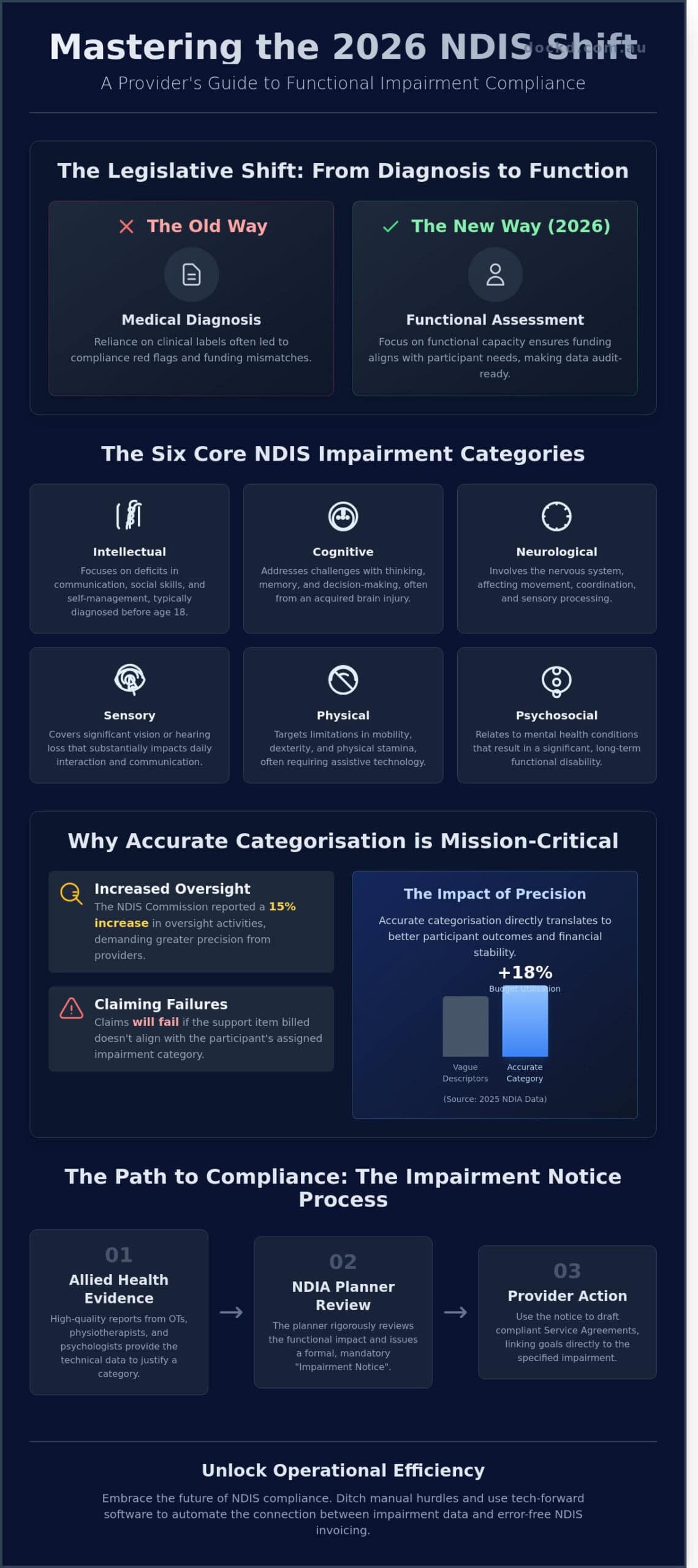
Diagnosis vs. Functional Impairment: The NDIS Legislative Shift
The NDIS is moving away from medical labels. For years, a diagnosis was the primary entry point for funding. This changed with the NDIS Amendment (Getting the NDIS Back on Track No. 1) Act 2024. The scheme now prioritises how a condition affects your daily life rather than what a doctor calls it. By 2026, functional capacity will be the central metric for support allocation. This shift ensures that funding follows the person, not the pathology.
Old systems relied on a “list of disabilities” to determine eligibility. The new framework replaces this with an Impairment Notice. This document outlines specific areas where a participant lacks capacity, such as mobility, communication, or self-management. It creates a clearer link between a person’s challenges and the budget they receive. Providers must now focus on these ndis impairment categories to justify the supports they deliver.
Provider feedback is now a critical part of the evidence chain. When a participant shows functional decline or significant improvement, the NDIS requires documented proof. This real-world data informs the Impairment Notice and ensures funding remains accurate. It’s about capturing the reality of a participant’s day, not just their initial clinical assessment.
Why Labels Aren’t Enough
Two participants might share a diagnosis of Level 2 Autism but fall into different ndis impairment categories based on their environment. One person might live independently with minimal physical help; another might require 24/7 care for safety. Assessments like the WHODAS 2.0 or PEDI-CAT now drive the Impairment Notice. This person-centred approach recognises that a label doesn’t define a person’s potential or their needs.
The Impact on Service Delivery
Providers must modernise their intake processes. You can no longer rely on a diagnosis to build a care plan. Staff need training to recognise and record functional impacts in every shift note. If a participant struggles with a new task, it must be logged as a functional barrier. Using high-quality NDIS software for providers helps teams capture this data instantly. Digital tools ensure that functional data is structured, searchable, and ready for plan reviews. This transition turns paperwork into a strategic asset for the participant’s journey.
How Providers Should Document Impairment for NDIS Compliance
Effective documentation is the bridge between service delivery and successful NDIS audits. It transforms daily support into measurable data. Providers must move beyond simple checklists to create a narrative of functional improvement. Follow these five steps to ensure your records remain secure and compliant.
- Step 1: Review the formal NDIS Impairment Notice during the intake phase. Confirm the primary and secondary ndis impairment categories to ensure your service delivery matches the NDIA’s established criteria.
- Step 2: Align Service Agreement goals directly with identified impairment categories. This creates a clear line of sight for auditors from the participant’s needs to your specific interventions.
- Step 3: Train support workers to use specific functional language in progress notes. Replace vague phrases like “had a good day” with “participant utilised mobility aids to access the community independently for 45 minutes.”
- Step 4: Conduct regular internal audits of client files against the NDIS Practice Standards, which were updated in November 2021. Aim for a 10 percent file review every quarter to catch documentation gaps early.
- Step 5: Use digital tools to track support delivery against impairment-specific budgets. This prevents overspending and ensures funds are allocated to the correct functional domains.
Drafting Compliant Service Agreements
Precision in your Service Agreement prevents payment delays. Link specific support hours to an impairment category to justify the necessity of the service. Ensure consent forms and agreements explicitly reflect the functional needs of the client rather than using “generic” support descriptions. Under the NDIS Quality and Safeguards Commission 2023 guidelines, vague agreements are a high-risk area for compliance failures. Clearly state how many hours of A$193.99 per hour therapy or support work relate to the participant’s mobility or social goals.
Evidence-Based Progress Reporting
Auditors look for specific evidence of “reasonable and necessary” support. Write a single, punchy sentence defining functional progress that an auditor can extract, such as: “Participant increased their ability to self-regulate during social transitions from 20 percent to 60 percent over a three-month period.” Shift notes are the primary evidence for the NDIS plan review process; they must document how supports mitigate risks associated with specific ndis impairment categories. If an incident occurs, manage the report by highlighting the specific impairment-related risks involved and the corrective actions taken to maintain safety.
Ready to navigate the complexities of provider management? You can streamline your administrative workflow and focus more on delivering high-quality support.
Managing Impairment Data with dock’d NDIS Software
Managing participants across various ndis impairment categories shouldn’t feel like navigating a heavy sea without a compass. dock’d provides a high-tech solution to this administrative weight. Our platform centralises the intake of clients with complex, multi-layered needs. You can categorise primary and secondary impairments within a single digital profile. This removes the friction of manual filing and fragmented paper records. It allows your team to focus on delivery rather than data entry.
The software automates the link between specific impairment types and NDIS line items. This ensures your invoicing is accurate and compliant from the first shift. Recent industry feedback suggests that NDIS providers spend over 15 hours a week on manual data correction and reconciliation. dock’d reduces this labour through seamless cloud-based integration. Your business moves faster. Your data stays secure. You spend more time on care and less on the back-office grind.
Real-time reporting on functional progress is built into the core of the platform. Instead of waiting for quarterly reviews, you can see how a participant is tracking against their goals every day. This data is vital during NDIS plan reviews, providing the evidence needed to justify continued or increased funding. It transforms raw data into a narrative of improvement and independence.
Seamless Onboarding and Rostering
Matching the right worker to the right participant is critical for safety and quality. dock’d lets you map worker skills to specific ndis impairment categories, such as sensory or physical impairments. If a participant has a specific mobility requirement, the system only suggests workers with the relevant training. This reduces risk and improves the participant experience.
- Workers use the mobile app to capture functional evidence at the point of care.
- Every shift is logged against the correct NDIS budget category automatically.
- GPS-verified check-ins ensure that support is delivered exactly where and when it’s needed.
This level of precision keeps your operations on track and your roster optimised. It’s your workforce management, simplified. By capturing evidence in the moment, you avoid the “memory gap” that often occurs when staff try to write notes at the end of a long week.
Audit-Ready Reporting
Audits can be a source of stress for any provider. dock’d makes them a routine task. You can generate one-click reports that show exactly how support delivery aligns with the participant’s Impairment Notice. This transparency builds trust with the NDIA and ensures your organisation remains in good standing. The software handles the complex mapping of hours to dollars, so you don’t have to.
The platform integrates directly with Xero for total financial transparency. This creates a clear trail for every dollar spent and every claim made. You get a real-time view of your business health and claim history. It’s the ultimate tool for modern providers who value efficiency and growth. Unlock a more streamlined way to manage your NDIS business today.
Simplify your NDIS management with dock’d – Book a demo today
Navigate the 2026 NDIS Landscape with Confidence
The legislative shift toward functional assessment over clinical diagnosis represents the most significant change for providers in 2026. Mastering the six ndis impairment categories ensures your team delivers compliant, high-quality support while protecting your business from audit risks. Accurate documentation is no longer optional; it’s the anchor of your service delivery. You need a system that handles the details so you can focus on your participants.
Managing these complex requirements shouldn’t keep you stuck at your desk. dock’d is designed specifically for Australian NDIS providers to simplify the heavy lifting of compliance. Our platform features integrated Xero and PRODA functionality to keep your finances and claims in sync. Because it’s cloud-based, your remote teams can access critical data from anywhere, ensuring your operations remain as fluid as the tide. Stop wrestling with manual spreadsheets and start moving forward.
Unlock seamless NDIS management with dock’d
Set your course for growth and spend less time on paperwork. Your mission is to support the community; our mission is to make that journey effortless.
Frequently Asked Questions
What is an NDIS Impairment Notice?
An NDIS Impairment Notice is a formal document issued by the NDIA that confirms your eligibility based on specific functional limitations. It acts as a roadmap for your support journey. This notice details the permanent and significant impairments identified during the access process. It ensures the NDIS understands exactly how a condition impacts daily life before funding begins. Understanding your specific ndis impairment categories helps you navigate the system more effectively.
Can a participant have more than one NDIS impairment category?
Yes, participants can and often do have more than one impairment category. While the NDIA usually identifies a primary disability for administrative purposes, your plan should cover all functional needs. This approach ensures your support is comprehensive. It allows you to access diverse services that address the full spectrum of your daily challenges. You don’t have to choose just one area of need if multiple conditions impact your life.
How do the 2026 NDIS changes affect existing participants?
The 2026 changes transition participants to “whole-of-person” budgets under the NDIS Amendment Act 2024. This shift means your funding is based on your total support needs rather than individual line items. It simplifies your spending. You gain more flexibility while the NDIA ensures the scheme remains sustainable for the 660,000 Australians currently enrolled. These updates aim to make the system more predictable for everyone involved.
What is the difference between a disability and an impairment in the NDIS?
An impairment is a loss of physiological or psychological function, whereas a disability is the functional impact on your life. The NDIS focuses on the “functional capacity” resulting from these impairments. Think of the impairment as the medical condition and the disability as the barrier it creates. This distinction helps the NDIA determine the exact level of support you need across different ndis impairment categories to live more independently.
How should a provider document psychosocial impairment for an audit?
Focus on documenting the episodic nature of the condition and its impact on daily social participation. Use objective evidence like the Life Skills Profile 16 (LSP-16) to show functional changes over time. Clear, consistent records are your best defence during a Quality and Safeguards Commission audit. They prove your services are effective and directly address the participant’s specific goals. Don’t leave your compliance to chance; keep your data precise.
Do I need a new Service Agreement if a client’s impairment category changes?
Update your Service Agreement whenever a change in impairment alters the support delivered or the budget allocation. This keeps your professional relationship transparent and legally sound. It prevents payment disputes and ensures you’re meeting the participant’s current needs. A quick revision now saves time and stress during the next plan review. It’s a simple step that builds trust and maintains the security of your service delivery.
How does NDIS software help with impairment category tracking?
Smart NDIS software automates the tracking of functional goals against specific impairment categories. It removes the manual burden of data entry. You get an instant view of participant progress and budget health. This digital concierge approach ensures you stay compliant while maximising the time you spend supporting your clients. It’s about working smarter, not harder. You can unlock better outcomes by using tools designed for the modern NDIS landscape.
What happens if the NDIA disagrees with a provider’s functional assessment?
Request an internal review under Section 100 of the NDIS Act 2013 if the NDIA disputes your assessment. You must submit additional objective evidence or a secondary report from an allied health professional. Be precise with your data to strengthen the case. This proactive step ensures the participant receives the correct funding level based on their actual functional needs. Don’t accept a generic refusal when the participant’s quality of life is at stake.