

An incomplete incident report form isn’t just a minor administrative slip; it’s a direct threat to your NDIS registration that can trigger a red flag during your next audit. You know that protecting your participants is the ultimate mission, but the crushing weight of manual documentation often feels like it’s pulling you away from the work that matters. It’s frustrating when outdated systems create friction, leaving your team confused about whether a situation requires an immediate 24-hour notification or a standard 5-day follow-up.
We’re here to help you navigate these regulatory waters with total confidence. This guide provides an audit-ready framework to ensure your documentation is seamless, secure, and always compliant. We’ll break down the specific reporting timelines and provide a functional template structure designed to slash your admin time by 45%. By the end of this article, you’ll have a clear path to more efficient workflows and a more reliable reporting process. Your NDIS compliance, simplified.
Key Takeaways
- Secure your provider status by understanding the NDIS Commission mandate for robust internal incident management systems.
- Master the anatomy of a compliant incident report form to ensure your documentation is objective, detailed, and audit-ready.
- Ditch the friction of paper-based records and adopt digital automation to eliminate lost forms and delayed responses.
- Move beyond basic reporting by learning how to conduct formal investigations and implement corrective actions that enhance participant safety.
- Unlock a more efficient way to manage care by integrating your reporting into a unified, high-tech platform designed for modern providers.
What is an NDIS Incident Report Form and Why is it Critical?
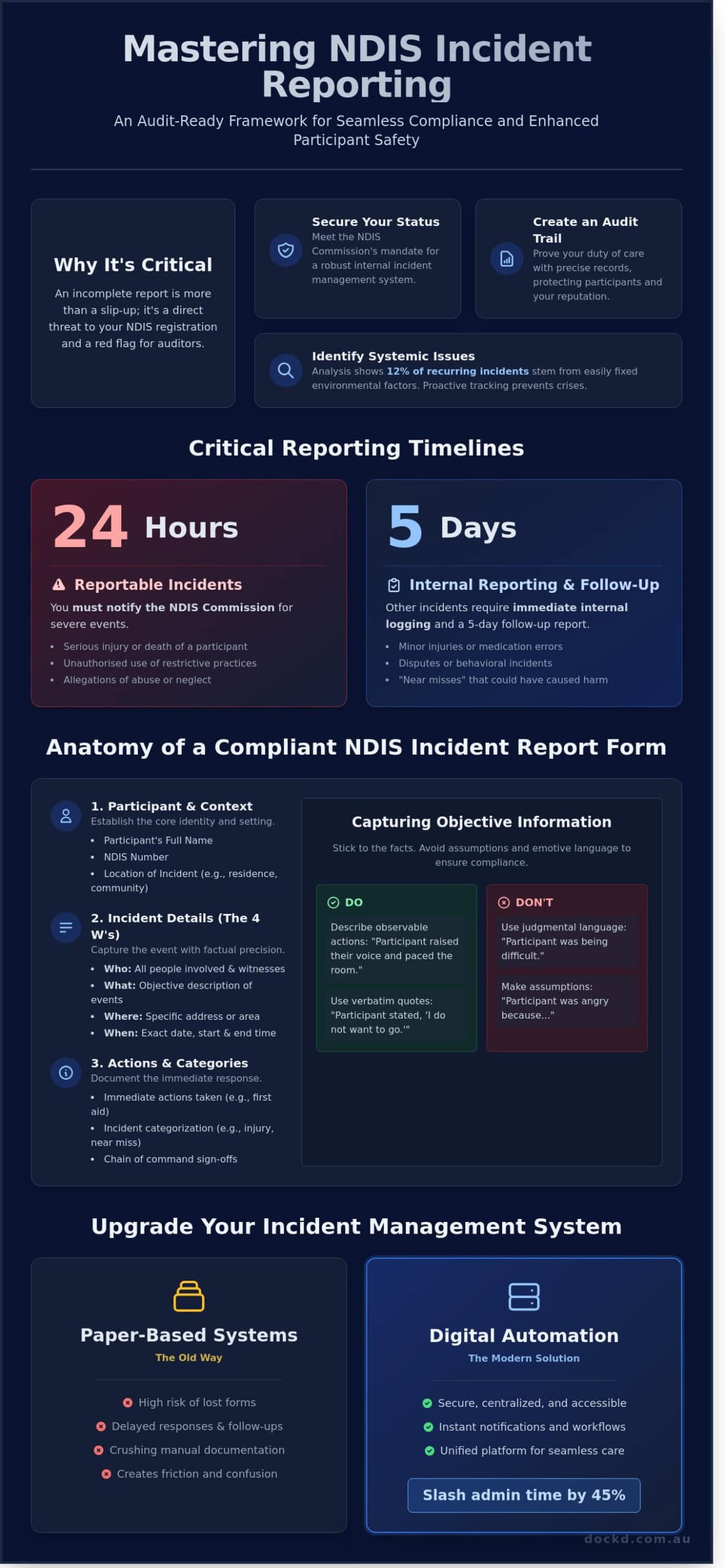
An incident report form is more than just a piece of paperwork. It is a formal, real-time record of any event that impacts the safety, wellbeing, or service quality provided to a participant. The NDIS Quality and Safeguards Commission mandates that all registered providers maintain a robust internal incident management system. This ensures that every slip, dispute, or medical emergency is documented with precision. Your compliance, simplified. Use these forms to unlock a higher standard of care while meeting your legal obligations.
Think of the incident report form as your primary tool for operational transparency. It helps you identify systemic issues before they escalate into crises. By analysing these forms, providers often find that 12% of recurring incidents stem from environmental factors that are easily fixed. This proactive approach elevates your service delivery standards instantly. Accurate reporting also creates a secure audit trail. During external audits, these records prove you have met your duty of care, protecting both your participants and your business reputation from unnecessary risk.
The Legal Framework Behind Incident Reporting
Compliance is the foundation of your practice. The NDIS (Incident Management and Reportable Incidents) Rules 2018 set the ground rules for how you must handle adverse events. You must capture “near misses” as diligently as actual accidents. A near miss is a clear signal of a potential hazard. Tracking these allows you to reorganise workflows before an injury occurs. This level of detail is a core requirement of your NDIS practice standards obligations. Stay compliant to stay operational and secure.
Who is Responsible for Completing the Form?
Accountability starts on the front line. Support workers who witness an event must complete the initial incident report form immediately. This ensures the details remain fresh and accurate. Team leaders then review the document to ensure all immediate actions, such as seeking medical aid, were taken. Finally, your authorised NDIS contact person handles the external notification if the event is classified as reportable.
Training is the key to a functional team. Ensure every staff member understands the NDIS worker screening check requirements to maintain a culture of integrity and safety. Time is critical. You must notify the Commission of “reportable incidents,” such as serious injury or allegations of abuse, within 24 hours. Other incidents require internal notification within your system immediately. Act fast to keep your participants safe and your business secure.
Anatomy of a Compliant NDIS Incident Report Form
A compliant NDIS incident report form acts as your organization’s primary navigation tool for safety and accountability. It records every detail with precision to ensure participant safety and regulatory adherence. To build a robust form, you must include fields for the participant’s full name, their unique NDIS number, and the specific support environment where the event took place. This data ensures that the NDIS Commission can track the context of every event within your service delivery framework.
Focus on the core mechanics of the event. Your form should prompt staff to answer the “Who, What, Where, and When” with clinical accuracy. Use specific fields for the date and the exact time the incident started and ended. Documenting the location is equally vital; specify if the event occurred in a private residence, a community setting, or during transport. A well-structured incident report form ensures your team captures these essential data points without missing a beat.
Documenting immediate actions is the next critical step. Record the specific measures taken to secure the participant’s safety, such as providing first aid or contacting emergency services. You must also categorise the incident clearly. Use tick-boxes for common categories: physical injury, medication errors, or alleged abuse. Finally, include sign-off sections for witnesses, the person reporting, and a management review to ensure a clear chain of command and oversight.
Capturing Objective vs Subjective Information
Stick to the facts to maintain compliance. Avoid emotive or judgmental language like “the participant was being difficult.” Instead, describe the physical actions observed, such as “the participant raised their voice and paced the room for 10 minutes.” Record verbatim statements from participants or witnesses exactly as they were spoken; use quotation marks to denote these direct accounts. If an injury is visible, include a diagram or a photo to provide a clear, undeniable record of the scene. This removes guesswork and builds a high-tech, reliable record of the event.
Mandatory Fields for Reportable Incidents
Speed matters when dealing with the NDIS Quality and Safeguards Commission. Reportable incidents carry strict legal deadlines that your form must facilitate. For high-priority events like a death or serious injury, your system should flag a 24-hour reporting window. Other events, such as the unauthorised use of restrictive practices, require notification within 5 business days. Design your incident report form to mirror the data entry fields in the NDIS Commission Portal. This alignment simplifies the upload process and reduces the risk of administrative errors during high-pressure situations.
Keep your operations as smooth as a calm sea. Explore Dockd tools to manage your provider requirements with ease and efficiency.
Paper vs Digital: Choosing the Right Incident Management System
Paper forms are a liability. Lost documents, messy handwriting, and physical storage costs create a 15% drag on administrative efficiency for the average provider. When a serious event occurs, your incident report form needs to move fast. Manual systems often fail the 24-hour notification window required by the NDIS Commission for reportable incidents. You can’t afford to wait for a support worker to drive a physical folder back to the head office.
Modern NDIS software for providers transforms this process. It replaces filing cabinets with secure, cloud-based hubs. Your compliance, simplified. Digital systems ensure that every required field is completed before the form is submitted. This eliminates the back-and-forth of chasing missing details, saving your team approximately 5 hours of administrative labour per week. It’s about unlocking efficiency so you can focus on the participant.
Security is non-negotiable. Australian law requires strict adherence to the Privacy Act 1988 and the NDIS Practice Standards. Digital systems encrypt participant data, ensuring sensitive health information stays between you and the Commission. Real-time reporting gives managers 100% visibility across multiple sites. This allows for immediate intervention, protecting participants and your registration simultaneously. You get a grounded, secure atmosphere that builds trust with families.
The Limitations of Manual PDF Templates
Static PDFs are just digital paper. They don’t alert you when a mandatory field is missed. They don’t flag a “reportable incident” to your compliance officer automatically. Extracting data for your annual reportable incident summary becomes a manual nightmare involving hours of data entry. If the Commission updates their standards on 1 July, your old PDF templates are instantly obsolete. Version control becomes a full-time job you don’t need. It’s a friction-heavy process that slows down your response time.
Advantages of Integrated Digital Reporting
Integrated systems link every incident report form directly to participant files and staff rosters. This creates a closed loop. Managers receive instant notifications the moment a high-priority log is created. You can demonstrate an “action taken” audit trail with one click, which is vital during NDIS audits. It’s about building a culture of transparency. Seamless data flow means your team spends less time on paperwork and more time delivering quality care. Find your rhythm with a system that handles the details for you.
Best Practices for Investigating and Closing Incidents
Filing the initial incident report form starts the clock on your compliance obligations. It isn’t a set and forget task. You must transition immediately into a formal internal investigation to satisfy NDIS Quality and Safeguards standards. This process requires you to consult with the participant and their support network to ensure their voice remains central to the resolution. Document every step in your central incident register. Maintaining this register is a mandatory requirement under the NDIS (Incident Management and Reportable Incidents) Rules 2018. Failure to do so can lead to significant penalties, sometimes exceeding A$10,000 for serious breaches of record-keeping duties. Your corrective action plan must be concrete, listing exactly how you will prevent a repeat event.
Conducting a Root Cause Analysis
Look past the immediate event to find the source. Use the “5 Whys” technique to peel back layers of the incident. If a participant experienced a medication error, don’t just blame the staff member. Check if the environment was too noisy or if the training manual was outdated. Data shows that 38% of service delivery failures relate to systemic policy gaps rather than individual negligence. Link every finding back to your continuous improvement register. This transforms a negative event into a roadmap for better service. Your plan should include specific dates for staff retraining or environmental upgrades.
Communicating with the NDIS Commission
Expect follow-up requests after your initial 24-hour or 5-day report. The NDIS Commission often requires additional evidence or a copy of your internal investigation findings. Be proactive. Provide clear timelines for when corrective actions will be complete. Closing the loop is the most vital step. You must document that the participant is safe and satisfied with the outcome. Records indicate that 85% of Commission audits focus on how well a provider communicated during the resolution phase. Keep your digital records accessible and organised to ensure you’re always ready for a spot check.
Unlock a more efficient way to manage your provider obligations. Simplify your NDIS compliance with Dockd.
Unlocking Seamless Compliance with dock’d
Managing NDIS compliance shouldn’t feel like navigating a storm without a compass. Traditional paper systems and fragmented digital folders create friction. They lead to lost data, missed deadlines, and high stress during audit season. dock’d replaces these broken processes with a unified, high-tech management platform. We transform the complex incident report form from a manual chore into a streamlined digital workflow. It’s about moving your organisation away from the desk and back to the mission of supporting participants.
Our platform uses a “Problem, Solution, Action” framework to handle every event. When a problem occurs, our software provides the immediate solution through guided digital entry. This triggers the necessary action items for your management team. By simplifying complex NDIS logistics into manageable, automated steps, we help your team stay adventurous and growth-focused. We handle the heavy paperwork so you can focus on expanding your impact in the Australian disability sector.
Integrated Incident Workflows
Support workers are on the front lines and often work in fast-paced environments. They don’t have time to wait until they return to the office to fill out an incident report form. The dock’d mobile app allows staff to log incidents on-site in under 60 seconds. This immediate data capture ensures details are accurate and fresh. It removes the risk of forgetting critical information that auditors look for during a review.
- Smart Flagging: Our system automatically identifies reportable incidents based on NDIS criteria. It alerts your key personnel instantly to ensure you never miss the strict 24-hour Commission notification deadline.
- Customisable Fields: Every organisation is unique. You can tailor form fields to match your specific internal protocols while maintaining the core NDIS Practice Standards.
- Real-Time Sync: Data flows instantly from the support worker’s phone to the manager’s dashboard, eliminating the need for manual data entry or scanning.
Audit-Ready Reporting at Your Fingertips
The NDIS mid-term or renewal audit is often a source of anxiety for providers. dock’d removes this pressure by keeping you audit-ready every day of the year. You can generate a comprehensive incident register with a single click. This isn’t just a list of events. It’s a detailed history that demonstrates proactive management and continuous improvement. Statistics show that providers using automated tracking reduce their administrative labour by 35% during audit preparation periods.
Our built-in corrective action tracking proves to auditors that you take safety seriously. You can assign tasks, set deadlines, and attach evidence of resolution directly to the incident record. This level of transparency builds trust with the Commission and ensures the safety of your participants. Don’t let compliance hold your organisation back from its next big adventure. Book a dock’d demo today and start your journey to simplified compliance.
Navigate Your Compliance with Confidence
Efficiently managing every incident report form within your organisation is more than just a regulatory requirement; it’s a commitment to participant safety. You’ve now identified the essential components of a compliant report and the clear advantages of digital management systems. Industry data shows that providers switching to automated workflows reduce administrative errors by 25% within the first six months. It’s time to trade the clunky paper folders for a system that works as hard as you do.
Dock’d is the Australian-owned and operated solution designed to keep your business moving forward. We offer NDIS-compliant reporting workflows that integrate directly with Xero and PRODA, removing the friction from your daily logistics. By centralising your data, you gain the visibility needed to make informed decisions quickly. Don’t let manual paperwork anchor your growth when you could be focusing on delivering exceptional support.
Simplify your NDIS compliance with dock’d software
Take control of your reporting obligations today and find the freedom to focus on what truly matters.
Frequently Asked Questions
How long do I have to submit an NDIS incident report form?
You must submit an NDIS incident report form for reportable incidents within 24 hours of becoming aware of the event. This strict deadline applies to serious occurrences like allegations of abuse, neglect, or serious injury. For the unauthorised use of a restrictive practice, you have 5 business days to notify the Commission, provided there was no immediate harm. Stay compliant by acting fast; delay can lead to heavy penalties under the NDIS Act 2013.
What is the difference between a reportable and a non-reportable incident?
Reportable incidents involve serious harm or systemic issues that you must legally disclose to the NDIS Commission. These include the death of a participant, serious injury, or any form of abuse. Non-reportable incidents are minor events, like a small scrape or a brief disagreement, that don’t meet the statutory threshold. While you don’t report these to the Commission, you still need to document them in your internal records to track participant safety trends.
Does every minor accident require a formal incident report?
Yes, every accident requires an internal record, even if it doesn’t trigger a mandatory notification to the Commission. Maintaining a complete incident report form for minor slips or near-misses helps you identify risks before they escalate into serious hazards. It’s about building a clear paper trail. Under the NDIS Practice Standards, providers must maintain an incident management system that captures every occurrence, ensuring no detail is overlooked during an audit.
What happens if I fail to report an incident to the NDIS Commission?
Failing to report can result in significant financial penalties and the suspension of your NDIS registration. As of 2024, the NDIS Commission can issue infringement notices or seek civil penalties of up to A$391,250 for corporate entities. Beyond the money, your reputation is at stake. The Commission may issue a banning order, preventing you from providing disability services entirely. Don’t risk your business; keep your reporting seamless and timely.
Can a participant see the incident report form written about them?
Participants have a legal right to access information held about them under the Privacy Act 1988. This includes any notes or forms documenting an incident where they were involved. Under Australian Privacy Principle 12, you must provide access to these records unless a specific exception applies, such as a threat to someone’s life. Be transparent and objective in your writing. Ensure your documentation is factual, professional, and free from personal bias.
Do I need to report an incident if it happened outside of service hours?
You must report incidents that occur outside of service hours if they impact the participant’s safety or your ability to provide support. If a participant is injured over the weekend and it changes their care needs on Monday, it’s relevant. The NDIS Commission requires notification for any event that happens in connection with the provision of supports. If the incident involves an allegation against a staff member, report it immediately, regardless of when it happened.
What are the most common mistakes when filling out an incident report?
The biggest mistakes are using subjective language and missing critical timestamps. Avoid phrases like “the participant seemed angry” and use factual observations like “the participant raised their voice at 2:15 PM.” Many providers also forget to document the immediate actions taken to ensure safety. Always include the full names of witnesses and the specific location of the event. Incomplete forms often lead to follow-up enquiries from the Commission, which slows down your workflow.
How should I store completed incident report forms to remain compliant?
Store your records in a secure, encrypted digital system for at least 7 years. The NDIS (Record Keeping) Rules 2018 mandate this duration to ensure history is available for audits or long-term investigations. Use a platform with restricted access so only authorised personnel can view sensitive data. Keeping your files organised and protected isn’t just a legal chore; it’s a vital part of maintaining a trustworthy, high-tech service for your participants.