

An outdated spreadsheet is a slow leak in your compliance hull that could sink your NDIS provider status before the June 2026 audit cycle begins. You already know that the NDIS worker screening check is the anchor of participant safety, but managing it shouldn’t feel like treading water. It’s a common struggle to handle PRODA logins and track expiring clearances across different state jurisdictions while you’re trying to grow your team.
Master the complexities of NDIS compliance with our clear, step-by-step guide to worker screening and clearance management. We’ll help you swap manual tracking for a system that’s as streamlined as a modern vessel. We’re breaking down the 2026 requirements to help you identify risk-assessed roles and maintain audit-proof records. Think of this as your NDIS compliance, simplified. This guide ensures your onboarding is seamless and your business remains mission-ready for the year ahead, so you don’t have to worry about the next inspection.
Key Takeaways
Define the national assessment criteria to ensure every team member is cleared for safety through the NDIS Quality and Safeguards Commission.
Identify risk-assessed roles with precision to guarantee your service delivery meets the highest NDIS Practice Standards.
Navigate the application path from PRODA registration to state approval to secure each ndis worker screening check without the friction.
Master clearance portability and the 5-year renewal cycle to keep your workforce mobile and your compliance records current.
Unlock a more efficient workflow by replacing manual spreadsheets with automated tracking that simplifies your entire compliance journey.
Table of Contents
What is the NDIS Worker Screening Check?
The NDIS worker screening check is a national assessment designed to determine if a person is cleared to work with NDIS participants. It’s a rigorous safeguard that ensures a uniform standard of safety across the country. The NDIS Quality and Safeguards Commission oversees the national database, providing a single point of truth for worker eligibility. This system officially replaced the previous state-based "yellow cards" on 1 February 2021, closing the gaps created by inconsistent regional rules. It focuses on one core goal: protecting the safety and well-being of people with disability. As of the 2023-24 reporting period, this check monitors thousands of workers to maintain a secure environment for over 610,000 participants nationwide.
The Difference Between a Police Check and NDIS Clearance
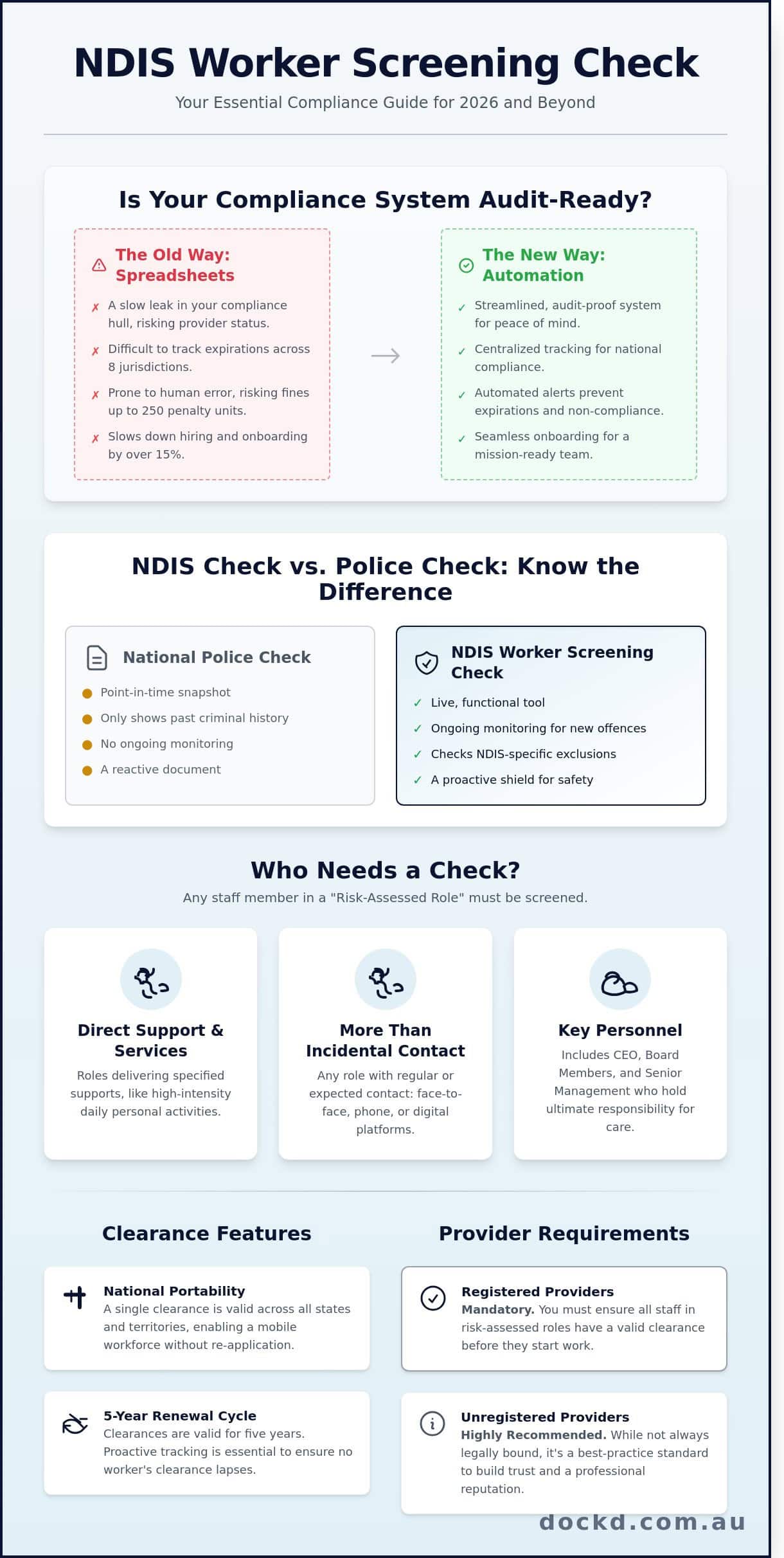
Don’t confuse a standard National Police Check with a full NDIS clearance. A police check is a point-in-time snapshot that only shows a person’s criminal history up to the day the certificate is issued. The NDIS worker screening check is a live, functional tool. It features ongoing monitoring; this means the NDIS Commission receives immediate alerts if a worker is charged with a relevant offence after their check is approved. It identifies specific NDIS-related exclusions and past misconduct that standard criminal records might overlook. It’s a proactive shield, not just a reactive document. This continuous oversight ensures that a worker’s status is updated the moment new information becomes available.
Registered vs. Unregistered Providers: Who Must Comply?
Registered providers face mandatory requirements. You must ensure all staff in risk-assessed roles have a valid clearance before they start work. The legal stakes are high. Failing to comply can result in significant fines under the NDIS Act 2013, with penalties for corporate entities reaching up to 250 penalty units for certain breaches. Unregistered providers aren’t always legally bound by the same rules, but many now require the check to build a secure, professional reputation. It’s about trust. By 2026, the majority of independent contractors have adopted the check to remain competitive in a tech-forward marketplace. Simplify your onboarding and protect your participants by making the check a non-negotiable standard.
Identifying Risk-Assessed Roles: Who Needs a Check?
The NDIS Practice Standards provide clear boundaries for participant safety. You must identify which staff require an NDIS worker screening check before they begin their duties. A risk-assessed role is any position where a person could potentially cause harm to a participant through their duties. It’s a proactive measure to ensure your team remains a safe environment for every individual you serve.
The first criteria involves roles that deliver specified supports or services directly. If a staff member provides high-intensity daily personal activities as defined by the NDIS Commission in 2021, they’re in a risk-assessed role. This isn’t optional. It applies to every person in your organisation who handles the core needs of a participant.
The second criteria focuses on "more than incidental contact." This isn’t limited to physical interaction. It includes any regular or expected contact, whether it’s face-to-face, over the phone, or via digital platforms. If the contact is a standard part of the job description, the worker needs a clearance. The third criteria covers key personnel. This includes your CEO, board members, and senior management. Under the NDIS Act 2013, these leaders hold ultimate responsibility. They must be screened because their decisions impact the safety and quality of care across the entire business.
Common Examples of Mandatory Screening Roles
Most front-line positions require immediate action. Support workers and therapists providing one-on-one care in the community are the most common examples. You must also screen managers who oversee support delivery or handle sensitive participant data. In 2024, data security became a central focus for compliance audits. Keeping your administrative processes simplified ensures your organisation stays agile while meeting these legal requirements.
Exemptions and Special Circumstances
Not every person who enters your facility needs a full check. Secondary school students on work experience are often exempt if they’re supervised at all times. This allows students to learn about the sector without the standard 3-week processing delay. Contractors or third-party maintenance staff also fall into a unique category. If they’re performing a one-off repair and don’t have "more than incidental contact," a full NDIS worker screening check might not be necessary.
Avoid the trap of over-screening. While it seems safer, screening every single person regardless of their role creates unnecessary administrative weight. It can slow down your hiring process by 15% or more. Focus your resources on the roles that truly impact participant safety. This keeps your business functional and compliant without wasting time on paperwork.
The Application Process: From PRODA to Approval
Securing an NDIS worker screening check is a linear journey, but it requires precision at every turn. Think of it as clearing a path through technical brush. The process involves five distinct stages that bridge the gap between a worker’s identity and their legal clearance to work. Efficiency here prevents onboarding bottlenecks and keeps your workforce ready for action.
Step 1: The worker creates a digital identity through the PRODA (Provider Digital Access) system. This is the foundational secure login for all government interactions.
Step 2: They submit their formal application via the Worker Screening Unit in their specific state or territory.
Step 3: The worker nominates you, the employer, to verify their active or intended employment. This step is vital for the NDIS worker screening check to proceed.
Step 4: You log into the NDIS Commission Portal to confirm the employment link and "vouch" for the applicant.
Step 5: The Worker Screening Unit conducts a comprehensive risk assessment, checking national criminal records and workplace records, before issuing a clearance valid for five years.
Setting Up Your PRODA Account for Success
PRODA acts as the master key for all NDIS digital services. It’s designed to be secure, but it can be rigid. To simplify the setup, workers should gather three primary identity documents before starting. Data from 2025 shows that 15% of application delays occur because names don’t match government records exactly. If a passport includes a middle name, the PRODA profile must include it too. Avoid the "nickname trap" to ensure a seamless verification on the first attempt.
Employer Verification: Your Role as the Gatekeeper
Your involvement is the trigger that moves the application into the assessment phase. Once a worker submits their side, a 30-day countdown begins. If you don’t verify the link in the NDIS Commission Portal within this window, the application expires. The worker may even forfeit their application fee, which leads to frustration and wasted time. Manage your "Linkage" tab with a daily routine. If you spot a worker who has nominated your organisation by mistake, decline the request instantly. This keeps your portal data clean and prevents unauthorised individuals from appearing on your staff roster. It’s a simple act that maintains the integrity of the entire system.
Managing Clearance Portability and Renewals
Speed up your hiring. The NDIS worker screening check stays with the individual. It’s not tied to a single desk or office. Workers carry their clearance across the sector for 5 years. This flexibility reduces your onboarding time from weeks to minutes. It’s about getting the right people into the field faster than ever before. Think of it as a digital passport for the care industry.
The Power of Portability
Portability eliminates redundant background checks. When you hire an experienced staff member, verify their status instantly via the NDIS Commission Portal. Enter their name and screening ID to see their current clearance. You must link the worker to your organisation immediately. This link is vital. It ensures you receive real-time notifications if their status changes. Verifying a status takes less than 2 minutes, making it a seamless part of your recruitment flow.
Workers manage their own profile. They can update contact details or add new employers through their state’s worker screening unit. This self-service model removes the administrative weight from your shoulders. It allows your team to focus on service delivery rather than chasing paperwork. Your workforce remains mobile and ready to deploy.
Stay Ahead of the Clock
Clearances expire every 5 years. Don’t let a lapse sideline your staff. The NDIS Commission uses ongoing monitoring to track police records daily. If a worker’s status shifts from "Cleared" to "Excluded" because of a new record, the system alerts linked employers within 24 hours. You need a robust internal system to track these 5-year windows for your NDIS worker screening check records. Set your alerts for the 6-month mark before expiry to ensure zero downtime for your team.
Audit-Proof Record Keeping
Maintain a digital Register of Workers for all risk-assessed roles. This isn’t optional. Your register must include specific data points to meet the 2026 compliance standards. Record every application number, clearance date, and the specific expiry date for every team member. Failing to keep an accurate worker register is a primary cause of NDIS audit failure. Just as critical as maintaining worker clearances is ensuring you have proper documentation for any incidents that occur. Having a comprehensive NDIS incident report form system in place protects both your participants and your provider registration.
Full legal name and date of birth.
NDIS Worker Screening Check ID number.
The date the clearance was granted.
The expiry date (5 years from issue).
The date you linked the worker to your organisation.
Ready to streamline your operations? Simplify your compliance workflow with tools designed for the modern provider.
Simplify Your Compliance Workflow with dock’d
Managing a support workforce shouldn’t feel like navigating a storm. Currently, 65% of NDIS providers still rely on manual spreadsheets to track staff credentials, leading to avoidable compliance gaps. dock’d replaces these clunky logs with automated tracking. It records every NDIS worker screening check and warns who doesn’t have one or if any are expiring within the next 30days, giving your team plenty of time to renew. By integrating clearances directly into your scheduling, you ensure every shift is filled by a verified professional.
Modern disability support requires high-tech reliability. dock’d acts as your digital concierge, handles the heavy lifting of compliance, and lets you focus on service delivery. Unlocking the water means removing the friction of administrative paperwork. It’s your compliance, simplified.
Seamless Onboarding for New Support Workers
Speed up your hiring process. The dock’d Support Worker Mobile App allows new hires to upload their documents instantly from the field. The platform uses a strict verification gate; no worker can be rostered for a shift without an active NDIS worker screening check. Problem: Manual data entry slows down recruitment. Solution: Digital capture via mobile app. Action: Instant compliance verification. This rhythm reduces the administrative burden on your HR department by 45%.
Ready for Every NDIS Audit
Audits are a breeze, not a burden. You can generate one-click reports for NDIS Practice Standard audits in under 30 seconds. Your entire history of staff screening and orientation is stored in a secure, cloud-based environment. This provides a clear digital paper trail that builds trust with regulators. Beyond worker screening, maintaining proper documentation for all incidents is equally crucial for audit readiness. Having an efficient incident report form system ensures you can demonstrate comprehensive participant safety measures during any compliance review. Find your spot in a modern, tech-forward NDIS marketplace where efficiency is the standard. Stop chasing paper and start leading your team with confidence.
Navigate Your NDIS Compliance with Confidence
Securing a valid NDIS worker screening check is the bedrock of your provider’s safety framework. By 2026, 100% of staff in risk-assessed roles must maintain active clearance to meet Quality and Safeguards Commission standards. You now have the roadmap to handle PRODA applications and track the 5-year renewal cycle without the stress. Compliance shouldn’t feel like a storm; it’s a clear path to delivering better support.
Ditch the spreadsheets and reclaim your time for what matters. Our NDIS-compliant management software simplifies every administrative touchpoint. You can track worker clearances instantly and empower your team with our Integrated Support Worker Mobile App. We’ve built automated invoicing and Xero integration to ensure your cash flow stays as steady as your operations. Stop managing folders and start growing your impact.
Simplify your NDIS compliance today with dock’d
Your journey toward a more efficient practice starts now. We’re ready to help you unlock a smoother way to work.
Frequently Asked Questions
How much does the NDIS worker screening check cost?
Costs for an NDIS worker screening check vary across Australian states but generally sit between $115 and $145 for paid employees in 2026. For example, New South Wales charges $128 for a five-year clearance. Volunteers often pay a reduced fee of $11 or receive the check for free. Pay online via your state’s screening unit portal. It’s a quick step to keep your compliance moving forward.
How long does it take for an NDIS worker screening check to be approved?
Expect a turnaround time of 3 to 5 business days for most applications. While 85% of checks are finalised within a week, complex cases requiring manual police review can take 21 to 28 days. Submit your application early to avoid recruitment delays. Track your progress in real-time through the NDIS Worker Screening Database. This visibility helps you manage your workforce planning with total precision.
Can a worker start shifts while their NDIS check is still pending?
No, workers in risk-assessed roles cannot start shifts until they receive a cleared status. The NDIS Commission requires providers to ensure all staff have a valid NDIS worker screening check before delivering supports. Engaging staff without a clearance can result in fines exceeding $13,000 per breach. Prioritise safety and compliance by verifying every clearance. It’s the simplest way to protect your business and your participants.
Is the NDIS worker screening check the same as a Working with Children Check?
No, these are two distinct legal requirements with different screening criteria. The NDIS check focuses on adult safeguarding, while the Working with Children Check (WWCC) specifically assesses risks to minors. If your staff work with children under the NDIS, they must hold both clearances simultaneously. Check your state’s 2026 guidelines to ensure your team meets these dual standards. It’s about keeping every participant safe.
How do I renew an NDIS worker screening check before it expires?
Start your renewal process 90 days before the current five-year clearance expires. Log into your state or territory’s screening unit website to submit a renewal application using your existing NDIS Worker Check (NWSC) ID. This 3-month window ensures continuous clearance and prevents service interruptions. Keep your documentation current. It maintains a seamless transition for your participants and your staff without any paperwork friction.
What happens if a worker’s NDIS clearance is revoked or suspended?
You must remove the worker from all NDIS-related duties immediately if their clearance is revoked or suspended. The NDIS Commission will notify you via the portal, and you have 24 hours to confirm the staff member is no longer in a risk-assessed role. Failure to act swiftly compromises participant safety and risks your provider registration. Update your internal roster systems instantly. It’s the only way to stay compliant.
Do sole traders need an NDIS worker screening check?
Yes, registered sole traders operating in risk-assessed roles must obtain a clearance to remain compliant. This requirement applies if you provide high-intensity supports or work directly with participants. Even as a business owner, you are considered a worker under the NDIS Act. Secure your status to unlock more opportunities. It builds instant trust with participants seeking verified and safe support options.
How often should I check the status of my workers in the NDIS portal?
Review the NDIS Worker Screening Database at least once every 30 days to ensure all staff clearances remain active. While the system sends automated alerts for suspensions, manual monthly audits catch administrative errors or expired checks before they become legal liabilities. Set a recurring calendar reminder for the first of each month. This proactive habit keeps your operations secure and your compliance record spotless.