

Your manual filing system is the single biggest threat to your registration as we approach the July 2026 regulatory updates. It’s a heavy anchor that slows your growth and drains your team’s energy. You likely feel the weight of compliance anxiety every time a new commission circular arrives. Staying current with the ndis practice standards shouldn’t feel like steering through a storm without a GPS. You deserve a business that runs with the efficiency of a high-tech vessel, not one leaking time into endless paperwork.
We’ll help you master these requirements with professional precision and ease. This guide simplifies the complex divide between Core and Supplementary modules so you can build audit-ready processes that actually work. We’ll explore the specific 2026 compliance benchmarks and provide a clear roadmap to digitise your workflow. By the end of this article, you’ll have the tools to unlock a seamless management style that keeps your focus on the people you support.
Key Takeaways
Unlock the benchmark for high-quality disability support and understand how the NDIS Commission mandates safety for every participant.
Navigate the complexity of Core and Supplementary modules to ensure your service meets the essential NDIS practice standards with ease.
Demystify the audit process by identifying your specific pathway—Verification or Certification—and prepare your business with professional precision.
Your compliance, simplified: discover how to embed quality requirements into daily workflows and automate your team’s orientation modules.
Replace messy spreadsheets with a digital concierge that creates a seamless, secure environment for managing your operational data.
Table of Contents
What Are the NDIS Practice Standards? Your Compass for Quality
Navigating the NDIS Modules: Core and Supplementary Requirements
From Paperwork to Practice: Implementing Standards in Daily Operations
What Are the NDIS Practice Standards? Your Compass for Quality
The ndis practice standards act as the definitive benchmark for high-quality, safe disability supports across Australia. These aren’t optional suggestions. The NDIS Quality and Safeguards Commission mandates these standards to ensure every participant receives the care they deserves. They serve a dual purpose. First, they protect participants from harm and exploitation. Second, they provide a structured framework for provider excellence. View these standards as your operational GPS. Compliance is a continuous journey of refinement, not a "set and forget" task. It requires regular check-ins and constant operational updates to stay relevant in a fast-moving sector.
Operating without a clear understanding of these benchmarks is like sailing without a chart. The standards define what "good" looks like in the eyes of the regulator. They cover everything from governance and operational management to the delivery of specific technical supports. By 2026, the expectations for transparency have reached new heights. Providers must demonstrate not just that they have policies, but that those policies actually improve lives. It’s about moving beyond paperwork to produce real-world outcomes for the 600,000+ Australians currently using the scheme.
Who Needs to Comply with the Standards?
Registration status determines your specific compliance path. All registered NDIS providers must meet the core modules of the ndis practice standards. If you provide high-risk supports like behaviour intervention or early childhood supports, you’ll face more rigorous, specialised modules. Unregistered providers don’t undergo the same formal audit cycle. However, they aren’t exempt from safety rules. Every provider in Australia must adhere to the NDIS Code of Conduct as a baseline. This ensures a minimum level of safety across the $44 billion marketplace. Your compliance level signals your professional integrity to participants and their families.
The Core Objectives of the NDIS Commission
The NDIS Commission focuses on two main pillars: participant rights and provider competency. In the 2026 landscape, the emphasis has sharpened on informed choice and active participation. Data from recent Commission reports indicates that 88% of participants prioritise safety and reliability when choosing a new provider. The standards address this by mandating strict worker screening and robust incident management systems. These rules create a level playing field for the 20,000+ registered providers across the country. They ensure a participant in regional Western Australia receives the same high-standard care as someone in downtown Melbourne. By aligning your business with these objectives, you simplify your logistics and build a more resilient service model.
Participant Rights: Ensuring dignity, privacy, and freedom of expression for every individual.
Governance and Operational Management: Building a business that’s financially viable and ethically sound.
The Support Provision Environment: Creating safe spaces where risks are identified and mitigated before they cause harm.
Competency: Investing in workforce training to meet the evolving needs of the disability community.
Navigating the NDIS Modules: Core and Supplementary Requirements
Think of your compliance journey like building a seaworthy vessel. Your hull is the Core Module. It keeps you afloat and ensures basic safety for everyone on board. Without a solid hull, you can’t leave the marina. Every registered provider must meet these baseline ndis practice standards to remain operational in 2026. Once your hull is secure, you add specialised gear. These are the Supplementary Modules. They allow you to handle rougher seas or specific tasks like complex clinical care. You don’t need a deep-sea winch if you’re staying in the harbour; similarly, you only add modules that match your specific service risk profile.
The Four Pillars of the Core Module
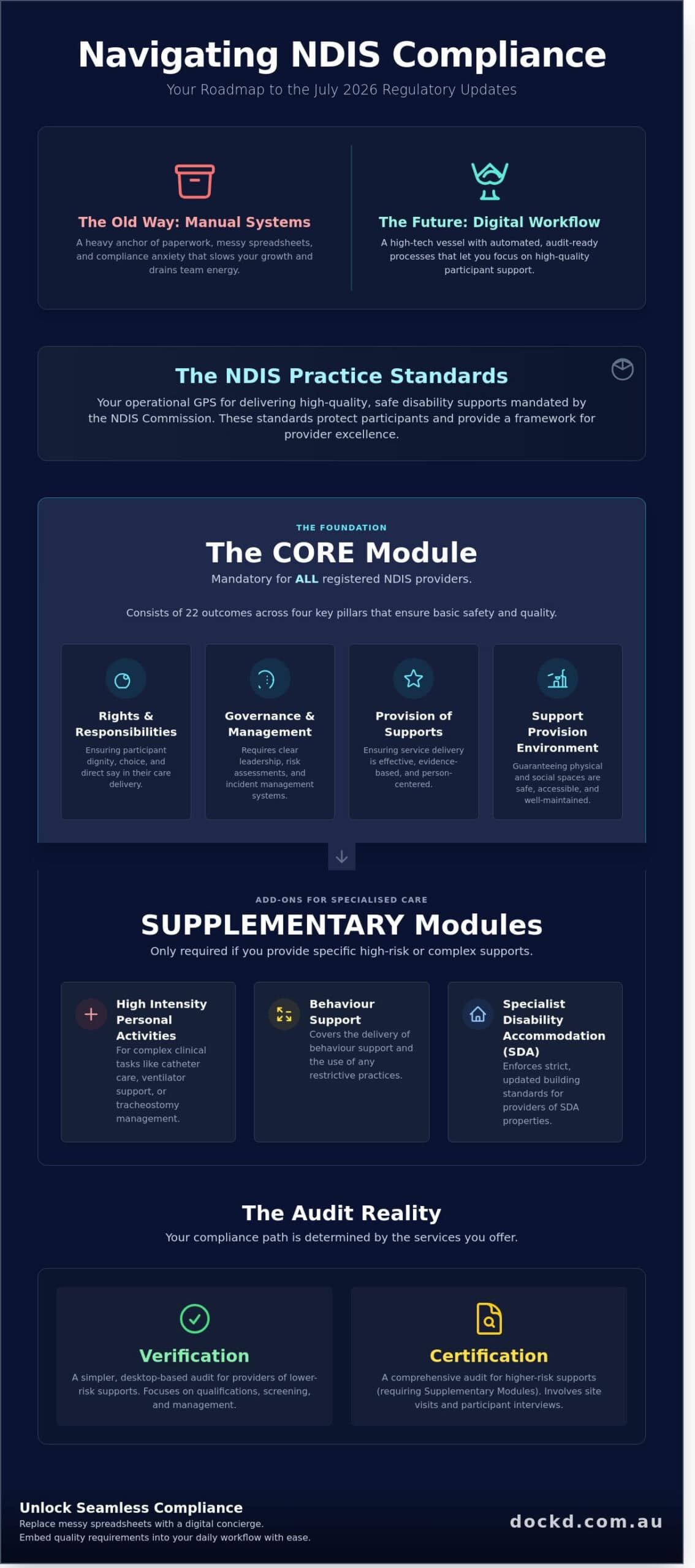
The Core Module is the foundation of the NDIS Quality and Safeguards Commission’s framework. It consists of 22 outcomes that every provider must achieve. First, Rights and Responsibilities focus on participant dignity and choice. You must prove that 100% of your clients have a direct say in their care delivery. Second, Governance and Operational Management requires you to organise your business with clear leadership. This includes mandatory incident management systems and documented risk assessments. Third, the Provision of Supports ensures your service delivery is effective and evidence-based. Finally, the Support Provision Environment guarantees that the physical or social space where you operate is safe and accessible. Efficient systems help you simplify your administrative load so you can focus on support delivery.
When Do Supplementary Modules Apply?
You only need extra gear for specific, high-risk missions. These modules are additional to the Core requirements and target specialised services. High Intensity Daily Personal Activities require Module 1. This involves complex clinical tasks like catheter care, tracheostomy management, or ventilator support. If your business provides Specialist Disability Accommodation (SDA), you must adhere to Module 5. This module enforces strict building standards that were updated for the 2026 regulatory cycle.
Behaviour support and the use of restrictive practices fall under Module 2A. The NDIS Commission reported a 15% increase in targeted audits for these specific modules in 2024 to ensure provider transparency. If you offer Early Childhood Supports, you’ll need to meet Module 3 requirements. These standards ensure that participants living in shared arrangements maintain their independence and privacy. Compliance here is non-negotiable for safety. Keep your documentation sharp and your processes transparent to avoid being grounded during your next audit. Every piece of specialised gear must be maintained to the highest standard to ensure a smooth voyage for your participants.
The Audit Reality: Verification vs. Certification Pathways
Audits often feel like a storm on the horizon for NDIS providers. It’s the number one fear for 62% of providers according to 2024 sector surveys. Don’t let the paperwork sink your mission. Think of the audit as a vessel inspection. You wouldn’t take a boat into open water without checking the hull and the life jackets. The NDIS Commission uses independent, approved quality auditors to ensure your business is sea-worthy. These aren’t government employees; they’re private professionals trained to spot leaks in your compliance. They verify that you meet the mandatory ndis practice standards before you’re cleared to trade. Your specific route depends entirely on the risk level of your cargo, which is the type of services you provide to participants.
Verification Audits for Low-Risk Providers
Verification is the lighter path. It’s designed for sole traders or small teams delivering low-risk supports like equipment, home maintenance, or travel assistance. This is largely a document-based check. You’ll submit evidence of your qualifications, insurance, and complaints processes through a digital portal. It’s faster and more affordable than the alternative. A typical verification audit in 2026 costs between A$900 and A$1,500. It’s a streamlined way to prove your safety without the heavy lifting of a full site inspection. Focus on your core policies to ensure a smooth voyage through this process. Keep your records tidy and your certificates up to date.
Certification Audits for High-Risk Supports
High-risk services require a Certification audit. This applies if you provide complex care, group homes, or early childhood supports. It’s a rigorous, two-stage process that leaves no stone unturned. Stage one is a design review of your manuals and systems. Stage two involves auditors boarding your vessel for on-site visits. They’ll interview your staff and your participants to see your policies in action. You must have your ndis practice standards documentation ready and active in your daily operations. Certification is an investment in your brand’s trust. Expect costs to range from A$3,000 to over A$15,000 depending on your scale and the number of sites you operate. Prepare your team early to avoid last-minute stress.
Identify your risk category before booking an auditor to avoid unnecessary costs.
Select an NDIS-approved auditor that fits your specific budget and timeline.
Organise your digital files for instant access during the remote review stages.
Conduct a mock audit to find gaps in your compliance hull before the real inspection.
Ensure all staff members can explain your incident management and feedback processes.
The audit isn’t a barrier; it’s your proof of quality. By understanding the pathway that fits your service model, you can clear the administrative fog and focus on what matters. Secure your registration, build your reputation, and start delivering the supports that participants need. Your journey to becoming a registered provider is about more than just rules. It’s about creating a safe, reliable marketplace for every Australian with a disability.
From Paperwork to Practice: Implementing Standards in Daily Operations
Transitioning from theoretical policy to daily action is how you ensure safety and excellence. Your team must embed the NDIS practice standards into their regular workflow to keep the business on course. If compliance feels like a burden, your systems aren’t working hard enough for you. Effective implementation means these standards become the background rhythm of your service delivery rather than a periodic panic before an audit.
Problem: Compliance documents often sit on a digital shelf while staff follow outdated or informal habits during their shifts.
Solution: Integrate mandatory NDIS practice standards checklists into your shift-reporting software to ensure real-time data capture.
Action: Audit your internal communication logs by June 2026 to ensure every staff member is documenting participant outcomes against their specific goals.
Managing Worker Screening and Competency
High-quality care starts with the right crew. You must verify the NDIS worker screening check for every employee in a risk-assessed role before they begin their first shift. Use a centralised digital dashboard to track expiry dates and NDIS clearance status to prevent administrative lapses. This proactive tracking ensures your roster remains compliant even during peak periods. The NDIS worker orientation module serves as a mandatory induction for all new staff. Beyond this initial step, organise quarterly competency reviews to ensure your team’s skills evolve alongside updated NDIS guidelines. This keeps your workforce sharp and your participants secure.
Incident Reporting and Risk Management
Speed is critical when things go wrong. You are required to report ‘reportable incidents’ to the NDIS Commission within 24 hours for serious events, such as allegations of abuse or serious injury, or 5 business days for others. A structured incident report form ensures your team captures vital data immediately without missing technical requirements. This documentation is your primary defence during a quality review.
Maintain a live risk register that evolves with your business operations. Update this register every 90 days to reflect new environmental hazards or changes in participant health profiles. Complaints are an early warning system; treat every piece of feedback as a chance to refine your service. A robust complaints management system proves to auditors that you prioritise participant voice and continuous improvement. By standardising how you handle friction, you turn potential hazards into manageable tasks that protect your business reputation. Embedding person centred care principles into your daily operations ensures that participant autonomy remains at the heart of every interaction, not just during audit preparation.
Your NDIS business, simplified.
Navigating Compliance with Ease: The Power of NDIS Software
Compliance shouldn’t feel like a heavy anchor dragging your business down. In 2026, the gap between thriving providers and those struggling is the technology they use. dock’d acts as your digital concierge, simplifying the complex world of NDIS compliance. It replaces the chaos of manual filing with a streamlined, tech-forward marketplace feel. We turn the tide on paperwork so you can focus on the horizon.
Automating Your Compliance Workflow
Manual tracking is a liability. Data from 2025 indicates that manual entry errors account for 22% of compliance breaches during audits. Transitioning to NDIS software for providers integrates NDIS practice standards into every daily roster. This isn’t just about storage; it’s about smart automation that keeps your business secure. Key features include:
Digital document storage: Keep service agreements and NDIS consent forms secure and accessible in one central hub.
Automated alerts: Receive instant notifications for worker screening renewals to ensure your team is always qualified.
Integrated compliance: Embed specific standards into daily shift notes to maintain high service quality.
This proactive approach to risk management ensures that your records are always accurate and ready for review.
Unlocking Efficiency with dock’d
Efficiency is the engine of growth for any modern provider. dock’d provides automated invoicing and accounting workflows and direct PRODA integration to speed up your cash flow and reduce administrative friction. Support workers use the mobile app to log progress notes in real-time while they are on the go. These notes are designed to align with NDIS practice standards, creating an audit-ready environment 365 days a year. This removes the stress of last-minute preparations before a quality review. We focus on a single, powerful goal: Your NDIS business, simplified. This clarity allows you to scale your operations without losing control of your regulatory obligations.
Stop drowning in admin tasks. Every hour saved on a spreadsheet is an hour invested in a participant’s life. By June 2026, successful providers will be those who have traded their paper files for digital precision. Choose a system that keeps you compliant while you focus on what matters most. Spend less time on paperwork and more time delivering the high-quality care your participants deserve. As your organisation grows beyond 50 participants, it’s also worth reviewing MYOB Advanced pricing for NDIS providers to understand how enterprise accounting platforms compare against purpose-built NDIS management software.
Chart Your Course for NDIS Success
Mastering the ndis practice standards isn’t just about ticking boxes; it’s about building a robust foundation for your service. You’ve seen how the 2026 requirements demand a shift from manual paperwork to integrated digital systems. Whether you’re facing a Verification or Certification audit, the key lies in maintaining consistent, real-time evidence across your Core and Supplementary modules. Don’t let the complexity of PRODA or Xero reconciliations and NDIS accounting slow your mission down.
Secure your operations with a platform designed specifically for the Australian market. dock’d gives you cloud-based access to manage your remote team from any location, ensuring compliance is always within reach. With integrated Xero and PRODA claiming, you can automate the administrative heavy lifting and focus on what matters: delivering high-quality support. It’s time to unlock a more efficient way to work. Your compliance, simplified.
Ready to simplify your NDIS compliance? Book a dock’d demo today. Your journey to a seamless, audit-ready future starts here.
Frequently Asked Questions
What are the NDIS Practice Standards for small providers?
Small providers delivering low-risk supports generally focus on the Verification module. This covers four key areas: human resources, risk management, complaints, and incident management. If you’re a sole trader, you’ll undergo a desktop audit of your policies. It’s a streamlined process designed to keep your business agile while ensuring participant safety remains the top priority.
How often do NDIS providers need to be audited?
Registered providers typically undergo a full audit every 3 years, with a mid-term surveillance audit occurring around the 18-month mark. Certification audits follow this 3-year cycle to ensure ongoing compliance. Verification audits for low-risk providers generally occur every 3 years without the mid-term check. Stay ahead of the schedule to ensure your registration doesn’t lapse and your services remain uninterrupted.
What is the difference between NDIS verification and certification?
Verification is a simplified audit for low-risk services, while Certification is a rigorous process for high-risk or complex supports. Verification involves a desktop review of 4 key standards by an approved auditor. Certification requires an onsite visit and covers the full Core Module plus any relevant supplementary modules. Choose the path that matches your specific registration group to stay compliant.
Are the NDIS Practice Standards mandatory for all providers?
The NDIS Practice Standards are mandatory for all registered providers, but unregistered providers must still follow the NDIS Code of Conduct. Registration is required if you manage agency-managed plans or provide high-risk supports like Specialist Disability Accommodation. Understanding the NDIS registration requirements builds trust and unlocks access to a wider market of participants who require the security of a registered provider.
How much does an NDIS audit cost in 2026?
In 2026, Verification audits typically cost between A$900 and A$1,500, while Certification audits range from A$3,000 to A$15,000 depending on your size. These fees are paid directly to approved quality auditors, not the NDIS Commission. Larger organisations with multiple sites or complex modules will see higher costs. Budget early to ensure your compliance journey stays on track without financial surprises.
Can NDIS software help with practice standards compliance?
Yes, NDIS software automates document control, incident reporting, and evidence collection to meet the NDIS practice standards efficiently. Use digital tools to centralise your records and track mandatory training dates for your staff. This tech-forward approach reduces administrative friction and ensures you’re always audit-ready. It’s the simplest way to manage your compliance workload while focusing on delivering high-quality participant support.
What happens if a provider fails an NDIS audit?
If a provider fails an audit, the auditor issues a non-conformity notice that must be resolved within a specific timeframe, usually 3 to 12 months. Minor non-conformities require a corrective action plan to be submitted. Major non-conformities can lead to registration suspension or cancellation by the NDIS Commission if not addressed. Fix these issues quickly to keep your business operational and secure.
Where can I find the latest NDIS Practice Standards modules?
You can find the most recent modules on the NDIS Quality and Safeguards Commission website under the ‘Provider’ section. The 2026 guidelines include the Core Module and various supplementary modules like Early Childhood Supports. Download these documents to map your policies against current legislative requirements. Staying updated with the latest NDIS practice standards ensures your business remains a leader in the disability sector.