

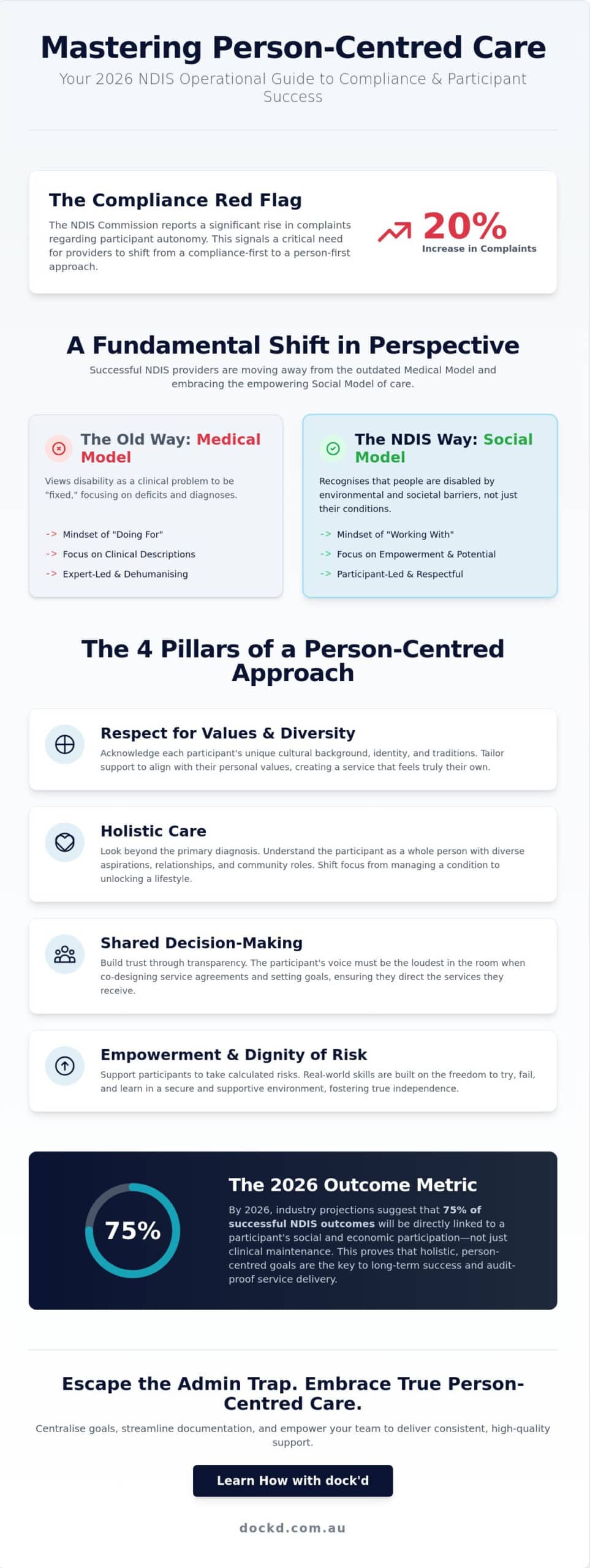
Your NDIS audit success isn’t decided during the inspection; it’s decided every time a support worker interacts with a participant. Many providers treat choice as a compliance checkbox, yet the NDIS Quality and Safeguards Commission reported a 20 percent increase in complaints regarding participant autonomy in recent reporting periods. You’ve likely felt the heavy administrative burden of tracking individual goals while trying to implement person centred care across a rotating roster. It’s exhausting to manage paperwork when you’d rather be focused on people.
We’re here to change that. This 2026 operational guide helps you master these principles to improve participant outcomes and secure your NDIS compliance without the typical stress. You’ll learn how to transform your service delivery from a manual grind into a high-tech, high-touch operation that participants love. We’ll show you the exact steps to streamline your documentation, reduce staff inconsistency, and turn your compliance requirements into a competitive advantage for your business.
Key Takeaways
- Shift your perspective from ‘doing for’ to ‘working with’ participants by mastering the social model of person centred care.
- Identify and dismantle the “admin trap” that restricts individualised support and stalls your team’s productivity.
- Implement a practical framework to co-design service agreements that prioritise participant goals and cultural values.
- Align staff skills and personalities with participant needs to maintain a consistent, person-first culture despite high turnover.
- Unlock operational freedom by centralising goals and preferences in a secure platform to simplify NDIS compliance.
What is Person Centred Care in the NDIS Context?
Person centred care is a fundamental shift in how disability support operates across Australia. It moves away from the traditional medical model that views disability as a clinical problem to be “fixed.” Instead, it embraces a social model. This framework recognises that people are often disabled by their environment and societal barriers, not just their physical or cognitive conditions. For providers, this means moving from a mindset of “doing for” a participant to “working with” them. It is about unlocking the person’s potential by placing them at the helm of their own life journey.
The core mission of the NDIS is to foster individual independence. Every support delivered must align with this goal. When providers adopt person centred care, they aren’t just ticking a compliance box; they’re facilitating a participant’s right to live a life of their choosing. This approach is particularly critical when implementing early intervention NDIS frameworks. Starting these practices early ensures that children and their families develop the skills and confidence needed to navigate the scheme with autonomy from day one.
The Social Model of Disability vs. The Medical Model
The medical model focuses on deficits and diagnoses. It relies on clinical descriptions that can often feel dehumanising. In contrast, the social model identifies environmental barriers that prevent full participation in the community. NDIS providers must focus on empowerment by removing these hurdles. Use person-first language to signal this shift. Instead of referring to a “wheelchair user,” focus on the person who requires mobility support. This subtle change in vocabulary reinforces that the individual is the priority, while the disability is just one aspect of their identity. Empowerment begins with respect.
Why Choice and Control Matter in 2026
Choice and control are legal requirements embedded within the NDIS Act 2013. They aren’t optional extras. By 2026, the NDIS Quality and Safeguards Commission will intensify its focus on participant-led service agreements during audits. These documents must prove that the participant directed the services they received. Choice and control drive all participant funding decisions. When a person has the power to choose their provider, they hold the market accountable. This creates a competitive environment where high-quality, flexible services thrive. Providers who fail to facilitate true choice will find themselves left behind in a marketplace that increasingly values transparency and individual agency. Your role is to simplify the logistics so the participant can focus on their goals.
The 4 Core Principles of a Person Centred Approach
Effective person centred care isn’t a checklist. It’s a mindset shift that puts the participant in the captain’s chair. To deliver high-quality support in 2026, providers must anchor their services in four foundational pillars. These principles ensure that every interaction respects the individual’s autonomy while driving real-world outcomes.
- Respect for Values and Diversity: Acknowledge that every participant brings a unique cultural background. Tailor support to align with their identity, language, and traditions.
- Holistic Care: Look past the clinical charts. A person is more than their primary diagnosis; they’re a member of a community with diverse aspirations.
- Shared Decision-Making: Move away from “expert-led” models. Transparency in service delivery builds trust and ensures the participant’s voice is the loudest in the room.
- Empowerment and Dignity of Risk: Support participants to take calculated risks. Building skills often requires the freedom to try, fail, and learn in a secure environment.
Holistic Support and Individualised Planning
Support planning should encompass a participant’s entire life journey. While the NDIS provides the framework, the individual provides the vision. Understanding specific NDIS impairment categories helps in tailoring technical support, but the real magic happens in non-clinical goal setting. For instance, a participant might prioritise finding a local bridge club or securing part-time employment over traditional therapy hours. By 2026, industry projections suggest that 75% of successful NDIS outcomes will link directly to social and economic participation rather than just clinical maintenance. Shift your focus from managing a condition to unlocking a lifestyle. This creates a robust framework for person centred care that evolves with the participant.
Shared Decision-Making and Transparency
Transparency is the bedrock of agency. Participants need to own their data. The NDIS Quality and Safeguards Commission reported a 15% increase in participant-led complaints regarding agency in 2023, which highlights the need for better transparency. Use digital portals to provide instant access to service logs and progress notes. This tech-forward approach removes the friction of traditional paperwork. When involving families or carers, ensure the participant remains the primary decision-maker. Use accessible communication like Easy Read formats to simplify complex NDIS jargon. This ensures everyone is on the same page without stripping the individual of their right to lead. Just as boaters use a seamless platform to find the perfect berth, NDIS participants should have clear tools to manage their own support journey.
Operational Barriers to Individualised Support
The transition to person centred care often stalls at the operational level. Many Australian providers find themselves caught in the ‘Admin Trap’. This occurs when compliance requirements overshadow the actual support provided. When paperwork dominates a shift, the human connection suffers. High staff turnover, which remains a systemic challenge in the NDIS sector, further complicates things. It’s difficult to maintain a consistent, person-first culture when new staff cycle through every few months. This churn often leads to a ‘cookie-cutter’ approach because it’s easier to train staff on generic routines than on the unique preferences of fifty different individuals.
- Fragmented software systems create data silos that hide participant progress.
- Manual goal tracking leads to missed milestones and delayed plan reviews.
- Compliance fatigue reduces the quality of face-to-face interactions.
The Cost of Inefficient Documentation
Generic case notes are a significant liability. If your progress notes lack detail, you risk audit failure under the NDIS Quality and Safeguards Commission guidelines. Inconsistent reporting makes it impossible to prove that person centred care is actually happening. Manual tracking often results in missed milestones. A participant might reach a goal; however, if the data isn’t captured instantly, the opportunity for celebration and plan adjustment is lost. This creates a high-pressure environment for support workers. They spend more time wrestling with reporting than they do assisting participants. Streamlining this process is the only way to restore the focus on the individual.
Managing Complex Logistics Like NDIS Transport
Personalising NDIS transport is one of the toughest logistical hurdles for any provider. Participants have specific needs; some require wheelchair-accessible vehicles while others have sensory preferences regarding music or temperature. Rigid booking systems often ignore these details. You need flexible rostering that puts the participant’s choice first. Real-time communication is essential here. If a driver is running five minutes late, the participant needs to know immediately via a secure platform. This level of transparency builds trust. It transforms a standard transit service into a reliable, tailored experience that respects the participant’s time and autonomy. Simplify your logistics to ensure the focus remains on the journey, not the paperwork.
Implementing Person Centred Care: A Practical Framework
Shifting from a compliance-heavy mindset to a participant-first model requires a clear roadmap. It’s about moving beyond the paperwork to create a seamless experience that empowers every individual. Follow these five steps to ensure your agency delivers authentic person centred care in 2026. This framework helps you move from basic service delivery to a tech-forward, responsive support system.
- Step 1: Co-design service agreements directly with the participant to ensure their voice leads the way.
- Step 2: Align staff skills and personality traits with the specific needs and interests of the participant.
- Step 3: Implement real-time goal tracking and feedback loops to catch issues before they escalate.
- Step 4: Conduct regular reviews and adapt support plans as the participant’s life evolves.
- Step 5: Audit your internal processes against the latest NDIS practice standards to maintain high-quality benchmarks.
Co-Designing Your Service Agreements
Generic templates are anchors that hold your service back. Unlock a truly individualised approach by building agreements from the ground up. Document specific preferences for support worker traits, such as shared hobbies or communication styles. Don’t treat consent as a one-off signature. In 2026, the NDIS requires active, ongoing consent. This means your agreements should be living documents that participants can update as their goals change. It’s about giving them the keys to their own support journey and ensuring every detail is simplified and transparent.
Matching staff isn’t just about availability; it’s about synergy. If a participant enjoys the outdoors, find a worker who shares that energy. This reduces staff turnover and improves participant satisfaction. Use digital dashboards to track goals in real-time. This allows families and participants to see progress instantly, removing the friction of manual reporting. When you align personality with purpose, the quality of care reaches new heights. Ensuring your service agreements also accurately reflect the correct NDIS categories of support is equally critical, as a single coding error can trigger a compliance audit that stalls your cash flow for months.
Feedback Loops and Continuous Improvement
Real-time data is your best tool for improvement. For non-verbal participants, use visual aids, digital observation tools, or sensory feedback systems to capture their experiences effectively. Don’t view incident reports as just a compliance burden. Use them as a diagnostic tool to improve person centred care outcomes. The NDIS Quality and Safeguards Commission standards require proactive adjustments, not just reactive fixes. By 2026, high-performing providers will use automated feedback systems to ensure no voice goes unheard. This creates a secure, transparent environment where trust can flourish and services can evolve at the speed of the participant’s needs.
Ready to modernise your approach? Simplify your NDIS service delivery with our streamlined tools.
How dock’d Simplifies Person Centred Management
NDIS service providers often struggle with the heavy weight of administrative compliance. It’s a common barrier that prevents teams from focusing on what matters most. dock’d removes this friction. By centralising participant goals and unique preferences into one secure cloud platform, your team stays aligned and informed. You transition from reactive management to proactive support. This ensures that person centred care isn’t just a buzzword; it’s the operational standard for your entire organisation. Your admin, simplified.
Support workers gain autonomy through the dock’d mobile app. They record real-time, personalised notes during or immediately after a session. This eliminates the common struggle of remembering specific details days after a shift. The platform automatically links these goal-related notes to NDIS claiming processes. This smart automation allows you to scale your business without losing the personal connection that defines your brand. It’s your business growth, accelerated through reliable technology.
Data security is a priority for Australian providers. dock’d hosts information in a secure cloud environment that meets local standards. This gives families peace of mind knowing their sensitive information is protected. When your data is organised, your team feels more confident. They spend less time chasing files and more time engaging with participants. It’s a tech-forward approach that respects the human element of the disability sector.
Goal Tracking and Progress Reporting
Proving outcomes for NDIS plan reviews requires clear, data-backed evidence. dock’d transforms raw shift notes into visual progress reports. This transparency keeps families and primary carers informed about every milestone achieved. Administrative teams save significant resources by ditching manual entry. In fact, moving to these automated workflows can reduce the time spent on manual reporting by up to 50%. You get the data you need for the NDIA without the traditional paperwork headache.
Seamless Rostering for Better Matches
Consistency is the backbone of high-quality disability support. dock’d helps you match workers to participants based on more than just a calendar. You filter by specific skills, shared interests, and availability. For high-needs participants, this consistency reduces anxiety and improves long-term therapeutic outcomes. Your rosters become a tool for better connection rather than a logistical puzzle. It’s time to move your focus back to the people you support. Unlock seamless person centred care with dock’d.
Chart Your Course Toward 2026 Compliance
Success in the 2026 NDIS landscape requires more than a simple mindset shift. It demands a robust operational framework that places every participant at the helm of their own journey. By masterfully applying the four core principles of person centred care, your organisation can bridge the gap between regulatory compliance and genuine participant impact. You now have the practical framework needed to dismantle operational barriers and streamline your service delivery.
Stop letting administrative friction pull your team away from what matters most. Dock’d delivers NDIS-compliant software built to simplify complex logistics and keep your mission on track. Use our built-in goal tracking modules to monitor participant progress with precision. Our Australian-based support and training team ensures you’re never navigating these waters alone. It’s time to trade manual paperwork for a seamless, tech-forward management experience that empowers your staff and your participants alike.
Book a dock’d demo to see person centred care in action
The future of NDIS support is agile, transparent, and deeply personal. We’re ready to help you unlock it.
Frequently Asked Questions
What is the primary goal of person centred care in the NDIS?
The primary goal of person centred care is to place the NDIS participant at the helm of their own support journey. By 2026, the NDIS aims for 100% of individual plans to reflect the participant’s personal goals rather than provider-led agendas. This approach empowers individuals to lead an ordinary life by ensuring every service aligns with their specific aspirations. It shifts the power dynamic, turning the provider into a facilitator of the participant’s unique vision.
How does person centred care differ from traditional disability support?
Traditional disability support often relies on a “one size fits all” model where participants must fit into existing service schedules. In contrast, person centred care flips the script by tailoring the service to the individual. Under the NDIS Practice Standards updated in 2024, providers must demonstrate that support is responsive to the participant’s environment and preferences. This means moving away from institutional routines and toward flexible, bespoke solutions that respect personal choice.
Is person centred care a mandatory requirement for NDIS providers?
Yes, person centred care is a core requirement under the NDIS Practice Standards. The NDIS Quality and Safeguards Commission mandates that all registered providers adhere to the “Individualised Outcomes” standard. During audits, providers must prove that participants are actively involved in developing their support plans. Failure to implement these practices can lead to compliance notices or the revocation of registration, as seen in the 2023 regulatory crackdown on non-compliant providers.
How can small NDIS providers afford to implement individualised care?
Small providers can afford individualised care by leveraging lean digital platforms to automate administrative tasks. By reducing overheads by up to 20% through efficient scheduling software, you can reinvest those hours into direct participant engagement. Focus on niche service delivery where your team’s expertise adds the most value. This strategy allows you to maintain high-quality care without the massive infrastructure costs of larger organisations. It’s your NDIS delivery, simplified.
What role does technology play in person centred care?
Technology acts as the digital engine that makes person centred care scalable and transparent. Modern NDIS CRM systems can reduce communication delays by 40% through real-time data sharing between participants and support workers. These tools ensure every team member has instant access to the participant’s latest goals. By using cloud-based platforms, you eliminate the friction of manual paperwork, ensuring that support remains consistent and data-driven across all touchpoints.
How do I measure the success of a person centred approach?
Measure success by tracking the achievement of specific goals outlined in the participant’s NDIS plan. Use a 5-point Likert scale to gather regular feedback on participant satisfaction and autonomy. If 90% of your participants report feeling more in control of their daily lives, your person centred care approach is working. Additionally, monitor staff retention rates; teams that feel they’re making a genuine impact through individualised care often show 15% higher engagement levels.
Can person centred care be applied to participants with complex communication needs?
Absolutely, person centred care is essential for participants with complex communication needs. Utilising Augmentative and Alternative Communication (AAC) tools ensures that every individual has a voice in their care plan. Providers should use the “Communication Bill of Rights” as a framework to ensure 100% of participants have the opportunity to express preferences. By investing in specialised training for support workers, you unlock the ability to understand non-verbal cues and facilitate meaningful choice for everyone.