

What if your support workers spent zero minutes every week manually calculating their mileage? Managing ndis transport often feels like a losing battle against messy spreadsheets and the latest NDIS Pricing Guide updates. You already know that one small error in a logbook can lead to a rejected invoice or a stressful audit. It is time to reclaim your schedule and focus on what matters.
This 2026 guide helps you master the complexities of NDIS transport funding, delivery, and administrative compliance to streamline your provider operations. Your transport logistics, simplified. We will outline a clear workflow for transport delivery and show you how to reduce administrative time by 40 per cent while keeping your documentation audit-proof. Unlock a more efficient way to move your participants today.
Key Takeaways
- Understand how to leverage NDIS transport as a Core Support to boost community participation while navigating complex funding models.
- Identify the most efficient delivery models for your business to reduce administrative friction between direct and accompanied travel.
- Safeguard your business against audit failures by ditching manual logbooks and identifying the hidden costs of paper-based tracking.
- Optimise your workflow for a seamless transition from plan manager coordination to precise service delivery.
- Unlock operational freedom by replacing slow, manual processes with high-tech automation that simplifies your daily logistics.
Understanding NDIS Transport Funding Levels for Providers
Accessing the community shouldn’t be a logistical nightmare. The National Disability Insurance Scheme (NDIS) provides transport as a Core Support to ensure participants reach their destinations safely. This funding acts as a catalyst for independence, allowing individuals to engage in social, economic, and daily activities without friction. It’s about unlocking the local area and ensuring every participant has the key to mobility.
Most participants choose to have their ndis transport funding self-managed or plan-managed. This gives them the flexibility to select providers that suit their specific lifestyle and schedule. As a provider, your responsibility starts with verification. Always confirm the available budget and management type before service delivery. This proactive step builds trust and ensures your payments remain secure and instant.
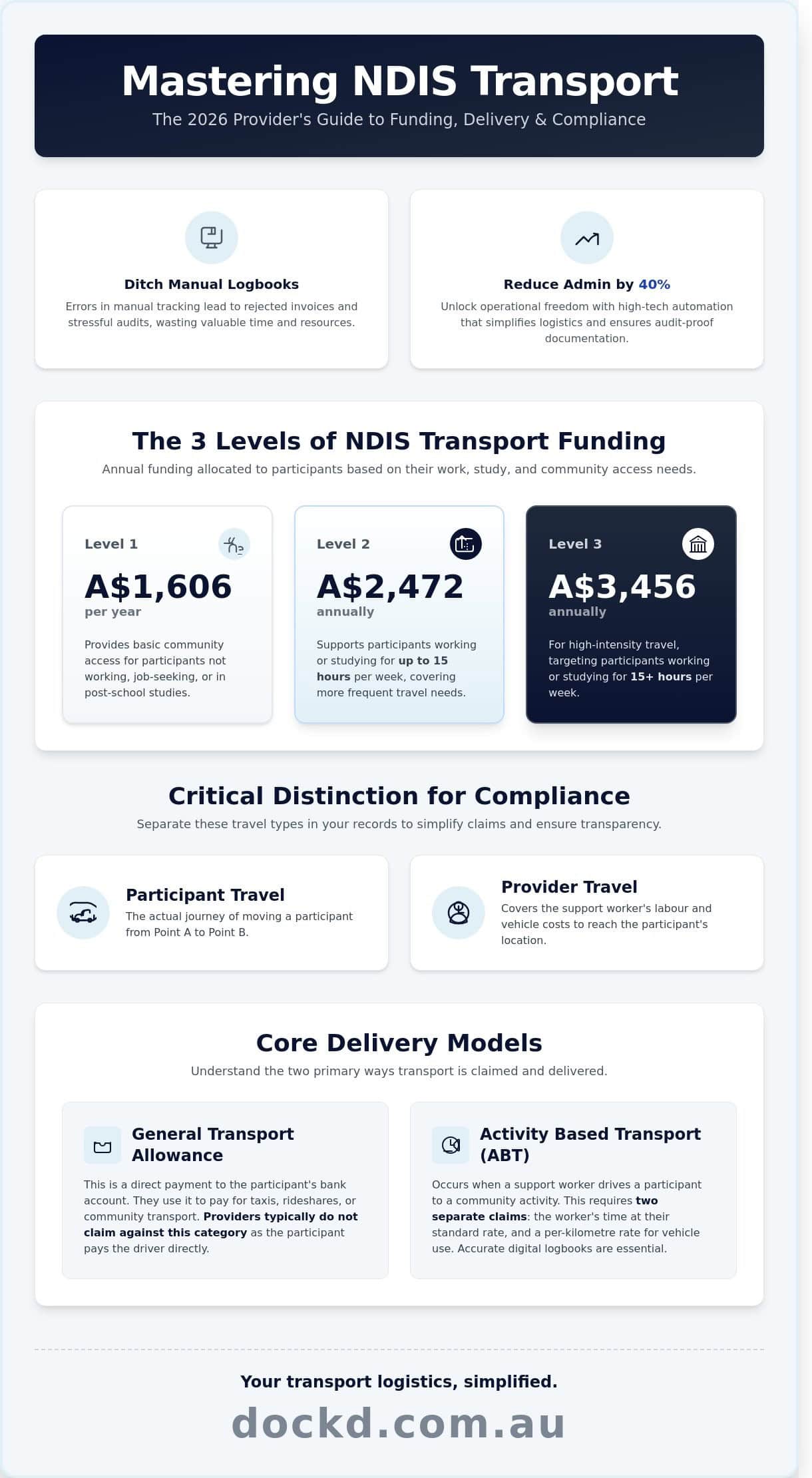
Logistics require precision. You must distinguish between participant travel and provider travel to maintain accurate records. Participant travel refers to the actual journey of moving the individual from point A to point B. Provider travel covers the labour and vehicle costs for a worker to reach the participant’s location. Keep these categories separate to simplify your claims and provide transparency to your clients.
The Three Levels of Participant Transport Funding
- Level 1: Provides basic community access for participants who are not currently working, searching for a job, or enrolled in post-school studies. This level typically offers up to A$1,606 per year.
- Level 2: Supports frequent travel for participants working or studying up to 15 hours every week. This level provides up to A$2,472 annually to cover increased transit needs.
- Level 3: Designed for high-intensity travel. It targets participants working or studying for 15 hours or more per week. Funding reaches up to A$3,456 annually to facilitate these demanding schedules.
Reasonable and Necessary Criteria for Transport
The NDIS evaluates transport requests based on specific “reasonable and necessary” benchmarks. They determine if a participant’s disability prevents them from using public transport independently. When standard buses or trains aren’t an option, ndis transport funding steps in to bridge the gap. This often includes specialized vehicle modifications to ensure a standard car or van meets the user’s physical requirements. Understanding how NDIS impairment categories influence transport eligibility helps providers document functional limitations more effectively.
Simplify your workflow by understanding these levels today. Efficient management ensures that participants spend less time worrying about the trip and more time enjoying the destination. It’s about creating a seamless journey from the driveway to the community.
The Four Key Ways NDIS Transport is Delivered
Effective ndis transport management starts with choosing the right delivery model. Providers must distinguish between simply getting a participant from A to B and providing active support during the journey. This distinction is vital for accurate claiming. Professional providers often handle complex logistics that informal supports, like family or friends, cannot manage. Mastery of these models ensures your organisation remains compliant while delivering high-quality service. Start by understanding the NDIS framework to avoid common administrative errors that stall payments. Accuracy builds trust; trust builds your reputation.
General Transport Allowance
This allowance functions as a direct payment to the participant. They use these funds for private taxis, rideshares, or community transport. Most providers won’t claim against this category because the money goes straight to the participant’s bank account. It’s often divided into three specific NDIS transport funding levels based on the individual’s needs. Clarify expectations early. If a participant has ‘General’ funding, they pay the driver directly. If they have ‘Core’ funding, the billing process changes entirely. Don’t let funding confusion delay a trip.
Activity Based Transport (ABT)
ABT occurs when a support worker drives a participant to a community activity. You bill for two separate things. First, claim the worker’s time at the standard support rate. Second, claim a per-kilometre rate for the vehicle use. This requires precision. Use GPS tracking or digital logbooks to record every trip. The NDIS Pricing Arrangements allow providers to negotiate these costs with participants. Keep your records sharp. Accurate data turns a logistical headache into a seamless revenue stream. It’s about getting the details right so the focus remains on the participant’s experience.
Building Capacity for Independent Travel
The goal here is independence. This involves training participants to use buses, trains, or trams without help. For younger participants, link these activities to early intervention NDIS goals to build long-term skills. Document every milestone. When you report progress during plan reviews, show how the participant’s reliance on 1:1 ndis transport is decreasing. This proves the value of your service. Much like finding the right mooring, helping a participant navigate their world requires the right tools and a clear map. You can simplify your logistics by adopting tech-forward management habits today.
Overcoming the Administrative Burden of NDIS Transport Tracking
Manual logbooks are the primary cause of NDIS audit failures. They are often illegible, easily lost, and impossible to verify after the fact. Relying on paper creates a massive friction cost for your team. Admin staff spend roughly 8 to 12 hours every month reconciling physical mileage slips with digital rosters. This double-handling drains your resources and increases the risk of human error. It slows down your cash flow and keeps your team stuck in back-office tasks instead of focusing on participant care. Providers managing multiple support types, such as those also delivering NDIS respite care, face compounded administrative pressure when paper-based systems fail to integrate across service lines.
Many providers mistakenly believe Excel is a secure vault for ndis transport data. It isn’t. Spreadsheets lack the encryption, version control, and tamper-proof audit trails required for high-level compliance. They are vulnerable to accidental deletions and data breaches. Transitioning to NDIS software for providers eliminates these vulnerabilities. It replaces messy paperwork with a unified digital system. Your data, simplified.
Real-Time Mileage and Shift Tracking
Mobile apps allow support workers to log kilometres the moment the engine stops. This removes the “memory gap” that leads to under-claiming or over-charging. GPS validation acts as your digital shield. It provides concrete evidence of service delivery, which is essential for meeting the standards set by the NDIS Quality and Safeguards Commission. By capturing data at the source, you reduce the lag time between service delivery and invoice generation from weeks to minutes. It makes your operation faster and more transparent.
Automating Invoicing for Transport Kilometres
Efficiency starts with your service agreements. Set up ndis transport as a dedicated line item to ensure every trip is tracked against the correct budget. Modern software automatically recognises the GST-free status of these supports, preventing costly tax errors. It also ensures every kilometre is billed at the exact NDIS Price Guide rates, such as the A$0.97 per kilometre allowance for provider-travel. This automation protects your margins. You no longer have to manually check price updates or calculate totals. The system handles the logic while you focus on the journey.
Stop chasing paper trails. Switch to a digital workflow that captures every kilometre with precision. It is the only way to scale your services without increasing your administrative headcount. Secure your data, protect your audits, and get your team back to what matters most.
How to Set Up a Compliant NDIS Workflow
Compliance acts as the hull of your business. It keeps your operations afloat and protects your longevity in a competitive market. When the transition occurs from an NDIS plan manager to the service provider, the data exchange must be seamless. Establish a rigid process for every shift involving ndis transport to eliminate guesswork. Clear communication with support workers is your primary tool here. If they don’t understand the billing rules, your claims will fail. View compliance as a preventative measure rather than a chore. It anchors your business against the risks of audits and clawbacks.
Step 1: Update Your Service Agreements
Vague agreements lead to payment delays and disputes. You need to explicitly list transport rates, typically A$0.97 per kilometre for a standard vehicle, alongside your hourly support rates. Define the exact boundaries for ‘pick up’ and ‘drop off’ billing to avoid overcharging. If a worker travels 15 kilometres to reach a participant, specify if that cost is billable. Secure written participant consent for these specific costs before the first trip. This transparency builds immediate trust. It ensures everyone understands the financial layout before the journey begins. Clear contracts prevent 90% of billing friction.
Step 2: Implement Digital Logbooks
Ditch the paper trails that get lost in gloveboxes. Move your data to a centralised digital database. This tech-forward approach allows for instant oversight and better security. Require every support worker to add detailed shift notes that explain the purpose of the travel. If they’re heading to a community centre, the notes must reflect that goal. Use your digital system to track and verify worker vehicle insurance and registration. Set automated alerts for expiry dates. This ensures no uncertified vehicle ever operates under your brand. Digital logs turn messy paperwork into a secure, searchable asset.
Step 3: Conduct Monthly Transport Audits
Don’t wait for the NDIS Commission to find your errors. Take control by spot-checking mileage logs against scheduled rosters every four weeks. Compare the kilometres claimed with the actual distance between locations using mapping software. Reconcile your PRODA claims with internal transport reports to catch discrepancies early. If a claim for 50 kilometres appears for a 5-kilometre trip, you can fix it before it becomes a legal issue. Monthly reconciliation ensures your records remain accurate and fully compliant with NDIS audit standards. This habit keeps your business ready for any external review. Embedding person centred care principles into your audit process also demonstrates to the NDIS Commission that participant choice and autonomy are reflected in every transport decision you document.
Ready to navigate your business toward better efficiency? Simplify your service management with dock’d today.
Simplifying NDIS Operations with dock’d Management Software
Manual mileage logs are slow, messy, and prone to human error. They drain your team’s energy and delay your cash flow. dock’d provides an instant solution for transport-heavy providers who need to move fast. It’s a high-tech marketplace for your operational needs that replaces paper trails with digital precision. Book a demo today to reclaim your time and focus on what matters.
Managing ndis transport requires absolute accuracy to ensure compliance and profitability. Industry reports suggest that administrative tasks can consume up to 30% of a provider’s weekly labour hours. dock’d eliminates this friction. Our mobile app allows support workers to log kilometres in real-time with a few taps. It’s tech-forward and intuitive, designed for staff who are always on the move. Your team focuses on the participant while the software handles the data. It’s the digital concierge your business deserves.
Seamless Integration with Accounting and Rostering
Connecting your field data to your back office shouldn’t be a struggle. dock’d syncs transport logs directly with Xero for seamless payroll and invoicing. We believe in a “one place” philosophy. You won’t need to switch between three different apps just to verify a single trip. This integration prevents billing gaps and ensures every A$ is accounted for accurately. It allows you to scale your business without adding to your administrative staff costs. Your workflow, simplified.
Audit-Proofing Your Transport Data
Compliance is the anchor of your NDIS registration. dock’d stores every ndis transport record in a secure, cloud-based environment that meets Australian data standards. This setup makes NDIS Commission audits or plan reviews straightforward and stress-free. You can generate detailed reports with a single click. No more searching through gloveboxes for lost logbooks or faded receipts. We help you unlock the water by removing the barriers to business freedom. By digitising your records, you build a reliable foundation for long-term growth. It’s about spending less time on paperwork and more time on the journey ahead. Providers who also apply person centred care practices to their transport documentation consistently report stronger outcomes during plan reviews and Commission inspections.
Ready to streamline your operations? dock’d is the savvy, innovative tool built for the modern provider. Stop navigating the paperwork storm and start moving with confidence. Secure your spot in the future of NDIS management today.
Unlocking Efficiency in Your NDIS Transport Operations
Success in 2026 depends on how well you navigate the complexities of the National Disability Insurance Scheme. You now understand the four delivery methods and the critical importance of maintaining a compliant workflow. Don’t let administrative weight hold your business back from its full potential. Managing ndis transport is no longer a manual burden when you have the right digital tools at your helm. You’ve seen how clear tracking and automated systems can protect your revenue and ensure participant satisfaction.
Our platform uses NDIS-compliant cloud technology to keep your operations secure and accessible from anywhere. Designed by Australian disability sector experts, it features integrated Xero and PRODA claiming to eliminate double handling. It’s time to swap the paperwork for a streamlined system that helps you organise your team with precision. Simplify your NDIS transport management with dock’d today. Experience the freedom of a business that runs on autopilot. You’ve got the map; now take the lead and watch your service thrive.
Frequently Asked Questions
Can NDIS providers charge for travel time and kilometres?
Yes, providers can bill for both labour time and distance covered. You must agree to these specific costs in writing before the journey begins. Providers usually charge for the worker’s time spent travelling to you and the actual kilometres driven during the shift. Check your service agreement to ensure these rates align with the NDIS Pricing Arrangements and Price Limits. This transparency keeps your budget on track.
What is the current NDIS kilometre rate for transport in 2026?
The NDIA sets the standard vehicle allowance at A$0.97 per kilometre in the current guide. While 2026 rates will be adjusted via annual indexation every July, this benchmark serves as your baseline for budget planning. Negotiate this rate with your provider before booking. Ensure your service agreement clearly lists the per-kilometre cost to avoid surprise invoices or unexpected budget blowouts during your plan cycle.
Is NDIS transport funding part of Core Supports or Capacity Building?
Your NDIS transport funding typically sits within Core Supports under Category 02. This flexible budget helps you access the community or reach your workplace efficiently, unlocking new levels of independence. However, if you’re learning to use public transport independently, funding may come from Capacity Building instead. Review your plan’s Support Category section to see where your specific allocation is parked before you start booking trips. Understanding the full range of NDIS categories of support helps you identify exactly which budget applies to each transport scenario and avoid costly misclaiming errors.
How do I claim transport through the PRODA portal?
Claiming is simple via the myplace portal. Log in using your PRODA credentials and select the Payment Request option from the main menu. Enter the support date, the specific NDIS transport line item code, and the total amount in Australian Dollars. Submit the request to trigger the payment process instantly. Keep all receipts and logs for five years to satisfy NDIS audit requirements and ensure seamless compliance.
Do support workers need special insurance for NDIS transport?
Yes, every worker must have valid comprehensive car insurance that covers business use. Standard private policies often exclude accidents that happen while transporting clients for profit. Verify that the worker has Third Party Property Damage at a minimum. Ask for a copy of their current insurance certificate before the first trip. This ensures your safety and financial security are protected while you’re on the road.
What happens if a participant runs out of transport funding?
If your specific transport budget hits zero, you can often use other Core Support funds to cover the gap. Most Core categories are flexible, allowing you to move money where it’s needed most. If all Core funding is exhausted, contact the NDIA for a plan reassessment immediately. Document how your transport needs have changed to support your request for additional funding during the formal review process.
Can I use NDIS transport funding for a participant’s family member to drive them?
Generally, NDIS transport funds don’t pay for family members to provide everyday rides. The scheme views this as informal support that families usually provide for free. You can only pay a family member if they are a registered provider and the NDIA has specifically approved this arrangement in your plan. Focus your budget on professional providers or public transport to maintain plan compliance and avoid payment rejections.
Is GST applicable to NDIS transport services?
Most NDIS transport services are GST-free under the A New Tax System (Goods and Services Tax) Act 1999. To qualify, the service must be listed in your NDIS plan and be reasonable and necessary. Providers shouldn’t add 10% GST to these invoices. Confirm with your accountant or the Australian Taxation Office if you’re unsure about a specific billing situation to avoid overpaying for your essential travel requirements.