

What if the ERP system meant to scale your organisation is actually the anchor dragging down your cash flow? For providers managing over 50 participants, the jump from basic accounting to a complex platform often feels like a leap into the dark. You already know that manual NDIS claiming is a relentless grind. It’s exhausting to manage data silos where your rostering doesn’t talk to your finance team, especially when a small data mismatch leads to a rejected claim or a failed audit. You need a system that works as hard as your frontline support workers do.
This guide uncovers the reality of myob advanced pricing for 2026. We’ll show you how to compare these costs against niche NDIS management software without the usual guesswork. Discover how to consolidate your PRODA claiming and rostering into one seamless workflow. We’ll break down the specific editions available and provide a clear framework to help you choose the right path for your organisation. It’s your NDIS operations, simplified. It’s time to unlock a more efficient way to manage your business and get your team back to the work that matters.
Key Takeaways
- Navigate the 2026 transition to MYOB Acumatica and understand how this cloud-based ERP scales with your growing NDIS organisation.
- Master the per-user subscription model and tiered editions to accurately forecast myob advanced pricing for your specific business needs.
- Uncover the hidden compliance costs and workflow complexities that often arise when adapting a generic ERP to the NDIS environment.
- Calculate your three-year Total Cost of Ownership to determine which platform delivers the most seamless return on investment.
- Unlock a more efficient way to manage your services with a tech-forward alternative built exclusively for the NDIS.
What is MYOB Advanced (Acumatica) and Who is it For?
MYOB Advanced is a powerful, cloud-based Enterprise Resource Planning (ERP) system designed to handle complex business requirements. By 2026, the Australian market will see a full transition where this platform is rebranded as MYOB Acumatica. This change aligns the local product with its global engine, offering a more robust suite of features for growing businesses. Unlike basic accounting tools, this system integrates every department into a single digital environment. MYOB (company) developed this tier to serve organisations that have moved beyond simple spreadsheets and entry-level bookkeeping.
This platform targets specific business profiles. If your organisation employs 10 or more staff or generates an annual turnover exceeding A$2M, you are in the primary user bracket. For these businesses, myob advanced pricing reflects an investment in scalability rather than just a monthly software fee. It provides the digital infrastructure needed to manage high-volume transactions and diverse workforces without the friction of manual data entry.
The Shift from Accounting to ERP
Standard software like MYOB Business suits small setups with straightforward needs. When your operations expand to include multi-entity structures or complex inventory across several locations, you need an ERP. This system offers advanced reporting and real-time visibility that basic tools cannot match. Implementation is a deliberate process. You cannot simply download an ERP; it requires specialised implementation partners to configure the system to your specific workflows. This ensures your software adapts to your business, not the other way around.
Why NDIS Providers Consider the Jump
NDIS providers face a unique set of administrative hurdles that demand high-level automation. As your participant list grows, managing consolidated inter-company accounting becomes a necessity for multi-regional providers. You need to track budgets and claims across different entities without losing data integrity. MYOB Advanced simplifies this by acting as a single source of truth for all client data and NDIS claiming processes. It removes the risk of double-handling information.
Payroll is another major driver for the switch. Managing hundreds of support workers with varying award rates and complex rosters is a logistical challenge. The system automates high-volume payroll, ensuring staff are paid accurately and on time. By centralising these functions, you unlock more time for participant care. Evaluating myob advanced pricing is the first step toward removing the operational bottlenecks that hold your organisation back.
Breaking Down MYOB Advanced Pricing in 2026
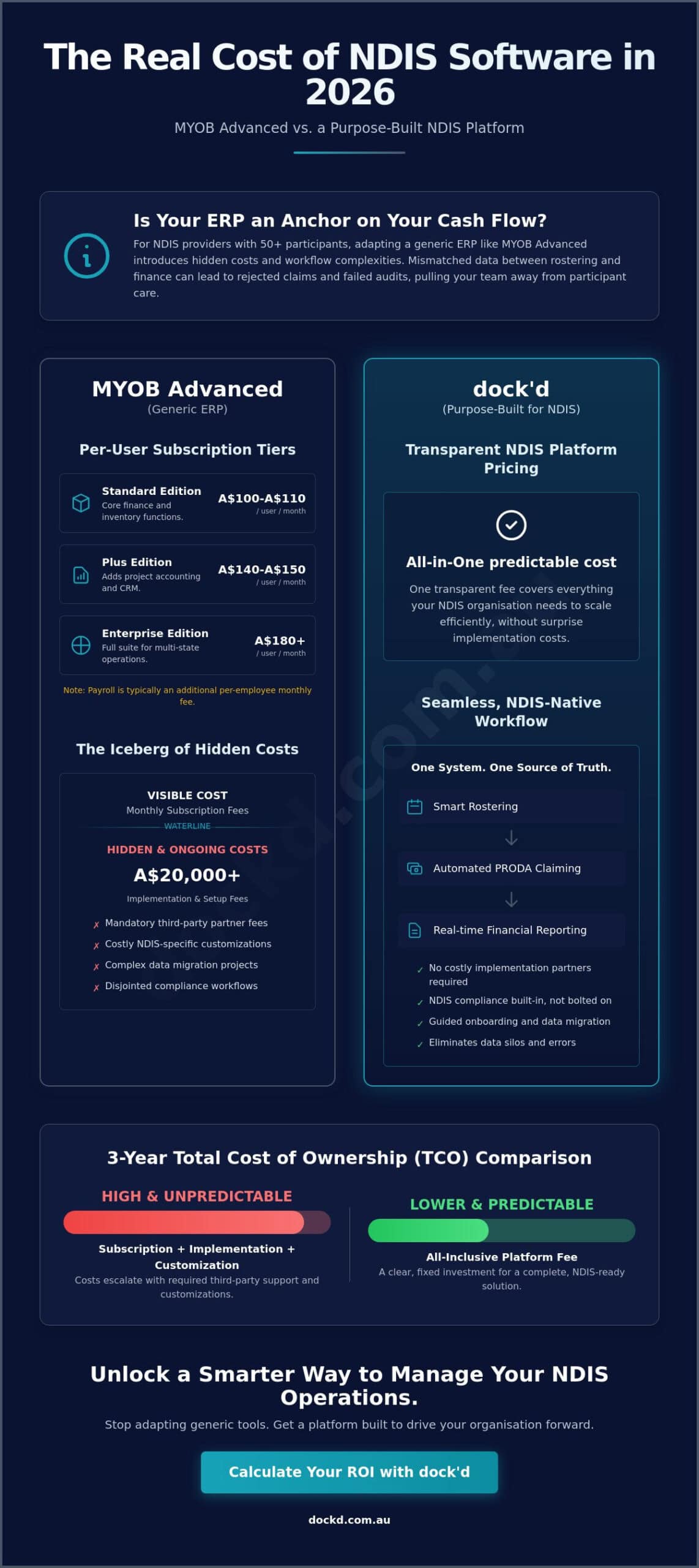
Unlock your organisation’s potential with a clear view of the investment required. MYOB Advanced, now often referred to under the MYOB Acumatica banner, operates on a per-user, per-month subscription model. This structure ensures you only pay for the access your team needs. It’s built for scale. Unlike basic accounting software, myob advanced pricing isn’t a one-size-fits-all sticker price. It’s a tailored solution delivered through certified partners. You won’t find these licenses on a retail shelf. Every quote reflects your specific operational complexity within the National Disability Insurance Scheme (NDIS) framework. This partner-led approach ensures the software fits your workflow, not the other way around.
The Three Main Pricing Tiers
Your journey starts with choosing the right edition. Each tier adds layers of functionality to match your growth phase. The right choice prevents over-investing in features you don’t yet require.
- Standard Edition: This tier handles core ERP functions. It’s ideal for growing teams managing foundational finance and inventory. Expect to pay approximately A$100 to A$110 per user, per month.
- Plus Edition: This edition introduces advanced project accounting and CRM tools. It’s perfect for providers managing complex participant plans and detailed reporting. Pricing typically sits between A$140 and A$150 per user, per month.
- Enterprise Edition: Built for multi-state operations and high-volume providers. It offers the full suite of automation and multi-currency capabilities. Costs generally start from A$180 per user, per month.
Payroll is typically an additional cost. Most NDIS providers pay a monthly fee per employee. This ensures your compliance with complex Fair Work awards remains seamless and automated.
Implementation and Hidden Setup Fees
The subscription is only one part of the financial equation. Implementation is where the real transformation happens. Partner fees for setup often range from A$20,000 for simple builds to over A$100,000 for complex, multi-entity configurations. You’re paying for technical expertise and system architecture. Data migration from legacy systems involves cleaning years of participant records. This process requires absolute precision to avoid service disruptions.
Ongoing costs include regular staff training and system customisation. These ensure the platform evolves alongside NDIS policy changes. To keep your operations moving as smoothly as a well-maintained vessel, simplify your logistics by choosing a partner who understands your specific niche. Budgeting for a 15% contingency on implementation costs is a savvy move for any provider in 2026. This covers unexpected workflow adjustments during the go-live phase.
The Hidden Costs of General ERPs for NDIS Compliance
A common myth suggests that a large-scale ERP can handle every business requirement out of the box. While MYOB Advanced is a robust platform, it’s designed for general commercial use, not the rigid regulatory environment of the NDIS. When you evaluate myob advanced pricing, the base subscription is only the starting point. The real expense lies in bridging the gap between standard accounting and NDIS compliance.
Building NDIS-specific workflows in a generic system is complex and slow. You aren’t just tracking sales; you’re managing participant goals, restrictive practices, and audit trails. Without native NDIS functionality, your team will likely resort to manual workarounds. These inefficiencies act as a silent tax on your operations, often consuming 15% to 20% of your administrative capacity. High-growth providers can’t afford this friction.
Customising a generic ERP to handle NDIS bulk claiming requires significant investment. You’ll need to hire specialised developers to build and maintain these connections. Understanding the True Cost of SaaS ERP involves looking beyond the monthly fee to the total cost of ownership. For NDIS providers, this includes the risk of compliance gaps that could lead to failed audits or clawed-back funds.
The Customisation Trap
ERPs are built for ‘business,’ but the NDIS runs on Practice Standards. Standard MYOB templates don’t include the specific language required for NDIS service agreements. Hiring developers to build these templates in MYOB can cost between A$180 and A$300 per hour. Even after a long rollout, many providers find that 40% of their staff still use external spreadsheets to manage NDIS scheduling. This duplication of data creates massive room for error and doubles your labour costs.
PRODA and NDIS Claiming Friction
Direct PRODA integration is the heartbeat of your cash flow. If your system doesn’t talk to the portal, your payments stall. Generic invoicing doesn’t account for support items, plan dates, or budget categories. You need specialised NDIS accounting and invoicing to ensure every claim is valid before it’s sent. Custom-built ‘bridges’ between MYOB and the NDIS portal often require constant API maintenance. These updates can cost your business A$5,000 to A$12,000 annually just to keep the lights on. It’s an expensive way to solve a problem that specialised software handles natively. When calculating myob advanced pricing, always factor in these recurring technical debts.
Calculating Your ROI: TCO for NDIS Providers
Total Cost of Ownership (TCO) is the only metric that matters when your organisation scales. Looking at a 3-year window reveals the true impact of your software choice. TCO includes your initial setup, monthly licensing, and the hidden cost of staff downtime. A general ERP often requires A$45,000 or more in custom coding just to handle NDIS bulk uploads and line-item tracking. Choosing a system where myob advanced pricing aligns with industry-specific needs eliminates these expensive workarounds. You get a platform that works on day one, not a project that requires months of billable developer hours.
Compliance peace of mind has a tangible dollar value. During a Quality and Safeguards Commission audit, the cost of manual evidence gathering can exceed A$15,000 in lost productivity. A native NDIS platform automates this trail. It turns a high-stress event into a simple report generation task. When your data is secure and accessible, you protect your registration and your revenue.
The Efficiency Dividend
Manual rostering is a drain on your bottom line. Automated scheduling and mobile timesheet capture can save support workers up to 5 hours per week. This isn’t just a convenience; it’s a massive recovery of billable time. Integrating NDIS plan management software features directly into your financial core ensures that no service goes unbilled. Faster claiming cycles via direct PRODA integration improve your cash flow instantly. This liquidity allows you to fund operations from your own revenue rather than relying on high-interest business loans to bridge payroll gaps.
Scaling Without the Bloat
Growth shouldn’t lead to a financial penalty. Many legacy platforms use per-user pricing models. This is a trap for NDIS providers with high support worker turnover or large casual pools. You end up paying for licenses that aren’t being used. Modern myob advanced pricing structures often favour resource-based or state-based models. This approach allows you to expand your footprint nationally without your software costs doubling every time you enter a new region. It keeps your overhead lean while your service delivery expands.
ROI for NDIS software is the total value of recovered billable hours plus the financial security of being 100 percent audit-ready at any moment.
Ready to simplify your digital operations? Explore the Dockd marketplace to find tools that help your NDIS business thrive.
Unlocking Simplicity: Why dock’d is the Smart Alternative
Heavyweight ERP systems often create more hurdles than they clear. While myob advanced pricing reflects a deep, enterprise-level feature set, many growing NDIS providers find themselves paying for complexity they simply don’t need. dock’d takes a different path. We built a tech-forward platform exclusively for the NDIS. It’s designed to remove friction, not add it. Your team spends less time on data entry and more time on participant outcomes.
The dock’d platform follows a rhythmic “Problem, Solution, Action” flow. Administrative backlog is the problem. Our automated workflow is the solution. Clicking “Claim” is the action. This efficiency is amplified by our seamless integration with Xero. You maintain total financial clarity without the overhead of a massive software suite. It’s professional, functional, and built for the Australian market.
Built-in NDIS Compliance
Keeping up with the NDIA is a full-time job. Manual updates lead to errors. dock’d automates the heavy lifting. Our system tracks changes to the NDIS Price Guide automatically, so your line items are always accurate. You won’t need expensive consultants for customisation. Everything from service agreements to incident reports is ready to go. Direct links to the PRODA log in ensure your claiming process remains secure and fast. It’s compliance without the headache.
Your support workers are the heartbeat of your business. They need tools that work in the field, not just in the office. The dock’d mobile app is a tool for adventurous care. It empowers your team to document progress, log hours, and manage schedules from any location. This real-time data flow eliminates the “Friday afternoon scramble” for timesheets and progress notes. Embedding person centred care principles into your daily workflows ensures every interaction is documented and aligned with each participant’s individual goals.
A Seamless Transition
High myob advanced pricing often comes with equally high implementation costs. dock’d offers a leaner, faster alternative. We start every journey with a detailed Business Evaluation. This process ensures our platform aligns with your specific operational goals before you commit. You’ll experience lower setup fees and a significantly faster go-live date compared to traditional ERP implementations. We act as your digital concierge, guiding you through every step of the setup.
- Fast Implementation: Get up and running in weeks, not months.
- Transparent Costs: No hidden fees for essential NDIS features.
- Local Support: Expert help that understands the Australian disability sector.
Ready to simplify? Unlock your business potential with dock’d today.
Chart Your Course Beyond Complex ERPs
Choosing the right platform is about more than just comparing myob advanced pricing for 2026. While high-tier ERPs offer massive scale, they often introduce friction through generalist features that don’t align with NDIS Practice Standards. You need a system that handles the heavy lifting of compliance without the bloat of a global corporate tool. Generalist software often leads to hidden implementation costs that can drain your A$ budget before you even go live. Stop fighting against tools that weren’t built for your specific sector.
dock’d is Australian owned and operated, specialised to navigate the unique regulatory waters of the NDIS. It delivers seamless Xero and PRODA integrations, ensuring your back-office stays agile and your claims remain accurate. Instead of getting lost in complex configurations, you can focus on delivering high-quality participant care. We’ve built this to be your digital concierge, removing the administrative anchors that hold your growth back. It’s time to simplify your operations and reclaim your time. Let’s get your business moving in the right direction today.
Book a Business Evaluation and find your perfect NDIS software fit
Frequently Asked Questions
Is MYOB Advanced the same as MYOB Acumatica?
Yes, MYOB Advanced was officially rebranded as MYOB Acumatica in July 2024. This change reflects the global technology partnership with Acumatica that powers the platform. You’ll find that myob advanced pricing and core functionalities remain the same under the new name. It’s the same enterprise-grade software designed to help Australian NDIS providers manage complex operations with greater agility.
How much does MYOB Advanced cost per user in Australia?
MYOB Acumatica doesn’t follow a traditional per-user pricing model; instead, it uses a resource-based subscription. This means your myob advanced pricing is based on the specific modules you use and your overall transaction volume. This approach allows you to add 5 or 50 new staff members without your costs increasing in a linear fashion. It’s a scalable solution that grows alongside your participant list.
Does MYOB Advanced have a built-in NDIS claiming module?
MYOB Advanced doesn’t include a native NDIS portal link as a standard feature. To automate your claims, you’ll need to use a third-party integration or a custom API to connect with the PRODA portal. This setup allows you to generate bulk upload files in minutes rather than hours. It eliminates the need for manual data entry, saving your finance team approximately 15 hours of administrative work every month.
What are the implementation costs for MYOB Acumatica?
Implementation costs for MYOB Acumatica depend on the complexity of your NDIS service delivery and existing data structures. These fees cover a multi-stage process including system architecture, data migration, and 40 hours of dedicated staff training. Most certified partners in Australia provide a fixed-scope quote after a discovery session. Investing in a professional setup ensures your NDIS compliance and payroll workflows are configured correctly from the start.
Can I integrate MYOB Advanced with Xero?
You can’t natively integrate the two platforms because they both serve as core accounting systems. MYOB Advanced is an ERP designed to replace Xero when a provider outgrows its limited reporting and payroll capabilities. Most organisations choose to migrate 100% of their financial data from Xero into MYOB to create a single source of truth. This transition simplifies your tech stack and removes the friction of managing two separate ledgers.
Is there a free trial for MYOB Advanced for NDIS providers?
There’s no self-service free trial for MYOB Acumatica due to its complex enterprise nature. Instead, you can book a 90 minute tailored demonstration that uses real-world NDIS scenarios. This walkthrough allows you to see how the software handles specific line items, participant plans, and support worker schedules. It’s a practical way to verify the system’s capabilities before you commit any capital to the project.
Why is NDIS-specific software usually cheaper than a general ERP?
NDIS-specific tools are often cheaper because they’re “point solutions” focusing solely on scheduling and basic billing. They don’t offer the 99.9% uptime or the deep financial customisation found in a general ERP like MYOB Acumatica. While a point solution might cost less upfront, it often lacks the power to handle multi-entity reporting or complex payroll for 100 plus employees. You’re paying for a robust platform that handles every facet of a large-scale business.
How long does it take to set up MYOB Advanced for a disability service?
A standard implementation for an NDIS provider typically takes between 12 and 24 weeks. This timeline includes a 4 week discovery phase to map your specific workflows and 3 weeks for user acceptance testing. Rushing this process can lead to errors in participant billing or payroll compliance. A measured rollout ensures your team is fully trained and your cash flow remains steady as you transition to the new system.