

A single coding error in your service agreement can trigger an NDIS audit that stalls your cash flow for 90 days. You already know that managing participant funding feels like steering through a storm without a reliable compass. The constant friction between flexible and non-flexible budgets creates a manual data entry nightmare that drains your team’s energy. Mastering the three NDIS categories of support is the only way to simplify your operations and reclaim your focus. Your NDIS management, simplified.
This 2026 reference guide helps you ensure compliant service delivery and seamless claims management. We provide the clarity you need to categorise services accurately, reducing administrative friction and securing your revenue stream. We’ll break down the Core, Capital, and Capacity Building buckets to help you unlock a more efficient, tech-forward workflow. Learn how to align your service agreements with the latest Australian NDIS standards and eliminate the manual errors that put your provider registration at risk. Let’s get your business moving with precision and confidence.
Key Takeaways
- Master the distinct functions of Core, Capacity Building, and Capital budgets to align your service delivery with participant goals.
- Identify the specific flexibilities within the ndis categories of support to maximise participant choice while maintaining strict compliance.
- Learn to structure multi-category service agreements that simplify claims management and protect your business from funding gaps.
- Discover how to train your staff to select the correct line items every time, ensuring your operations remain efficient and error-free.
- Unlock the power of real-time budget alerts and automated mapping to keep your service delivery as seamless as a day on the water.
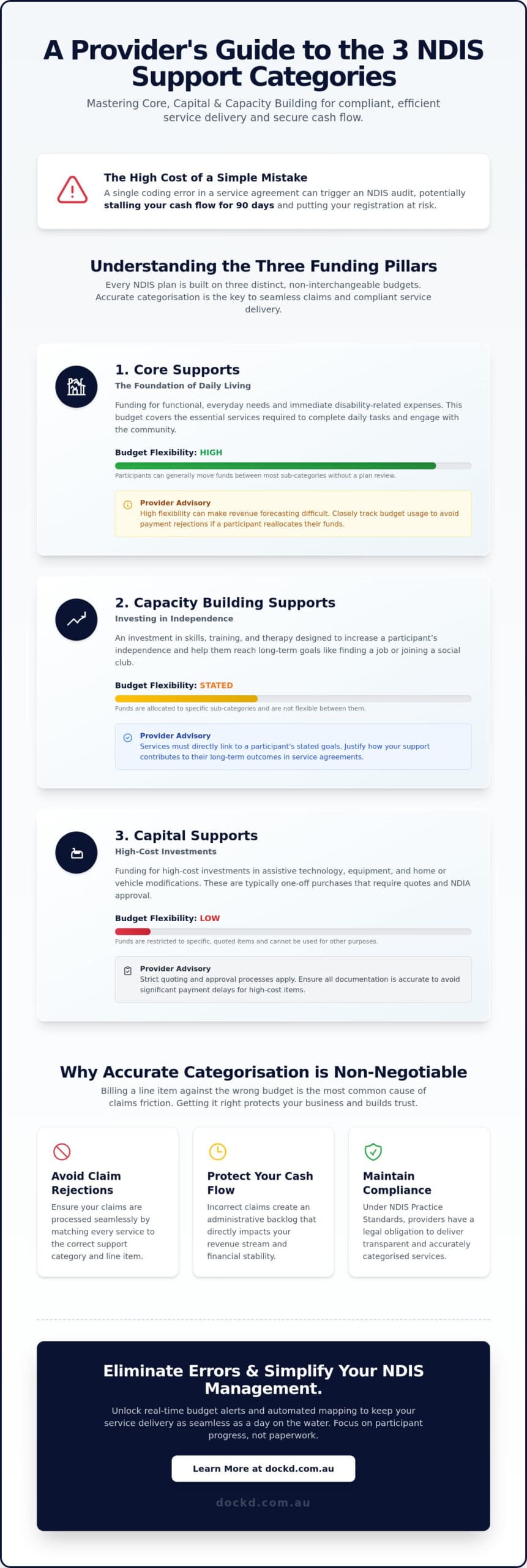
Understanding the Three NDIS Categories of Support
The National Disability Insurance Scheme (NDIS) functions through a structured funding model designed to give participants control over their lives. Planners divide every individual plan into three distinct budgets. These budgets aren’t interchangeable. As a provider, you must understand these distinctions to ensure your service agreements align with the participant’s available funding. Mismanaging these categories often leads to delayed payments and administrative friction. Your goal is to provide a seamless experience that keeps the focus on the participant’s progress rather than paperwork.
NDIS Categories of Support Definitions:
- Core Supports: Funding for functional, everyday needs and immediate disability-related expenses like transport or consumables.
- Capacity Building Supports: An investment in skills, training, and therapy designed to increase a participant’s independence and help them reach long-term goals.
- Capital Supports: Funding for high-cost investments, including assistive technology, equipment, and home or vehicle modifications.
The Relationship Between Goals and Support Categories
NDIS planners don’t allocate funds at random. They base every dollar on the participant’s stated outcomes. If a participant wants to join a local sports club, the planner might allocate Capacity Building funds for social skill development. You must link every service you provide to a specific support category. This isn’t just a suggestion; it’s a requirement for plan implementation. Impairment types heavily influence these allocations. For example, a participant with a physical disability may receive a larger Capital budget for mobility aids, while someone with a cognitive impairment might see more funding in Core for daily assistance. By 2026, the focus on “goal-linked funding” has become even more rigorous, requiring providers to justify how their ndis categories of support directly contribute to a participant’s stated life goals.
The Importance of Accurate Categorisation for Providers
Accuracy keeps your business healthy. Claim rejections occur most frequently when providers bill a line item against the wrong budget. This creates a backlog that hurts your cash flow. You also have a legal obligation to get this right. Under the NDIS Practice Standards, providers must deliver services that are transparent and accurately categorised. It’s about maintaining trust with the NDIA and the people you support. If you’re unsure how a participant’s specific condition affects their budget, check our guide on NDIS impairment categories. Proper categorisation ensures your ndis categories of support match the participant’s needs perfectly. It’s your job to simplify the process, removing the stress of the “how” so the participant can focus on the “why.”
Core Supports: The Foundation of Daily Living
Core Supports act as the functional engine of a participant’s plan. This budget covers the essential services required to complete daily tasks and engage with the community. It’s the most versatile of the ndis categories of support because it offers high levels of flexibility. Participants can generally move funds between three of the four sub-categories without needing a plan review from the NDIS. This allows for a responsive approach to care as a participant’s needs change throughout the year.
For providers, this flexibility is a double-edged sword. On one hand, it allows you to offer a broader range of services to a single client without administrative delays. On the other hand, it makes revenue forecasting difficult. If a participant decides to spend more on consumables, they might have less remaining for your scheduled support shifts. You must track budget usage closely to avoid payment rejections at the end of a plan cycle. Consult the official NDIS guidelines on funded supports to ensure your service delivery matches the latest compliance requirements.
Assistance with Daily Life and Social Participation
Assistance with Daily Life focuses on personal care and domestic tasks. You bill these shifts hourly according to the NDIS Pricing Arrangements. Social and Community Participation is about getting participants out of the house and into the world. Managing the balance between group and individual support is critical here. Group sessions often provide better margins for your business, but individual support allows for the intensive, tailored care many participants require. Many providers now bundle these services with NDIS respite care to offer comprehensive short-term accommodation options. This approach stabilises your roster and provides participants with a structured break from their routine.
Managing NDIS Transport and Consumables
The transport sub-category is distinct because it’s often paid directly to the participant as a periodic allowance. It’s divided into three levels based on the participant’s activity in the community, such as working or studying. Providers can claim for travel time and non-labour costs like tolls or parking, but the rules are strict. You should refer to the NDIS transport guide to ensure your claiming process is airtight. Consumables represent a low-cost, high-volume category. These include items like continence aids or basic PPE. For items under A$1,500, quotes aren’t typically required, making this a fast-moving revenue stream for providers with efficient supply chains.
Capacity Building and Capital Supports: Investing in the Future
Capacity Building and Capital Supports represent a strategic investment in a participant’s long-term independence. While Core supports handle the daily essentials, these categories focus on growth and structural changes. Providers must understand that Capacity Building funding is strictly goal-oriented. It’s rigid. You cannot move funds between these ndis categories of support to cover shortfalls in other areas. Success in these categories requires high-level evidence and meticulous reporting to ensure the NDIS continues to fund these vital pathways.
Capacity Building: Skill Development and Therapy
Capacity Building is the engine room for personal development. It’s divided into nine specific sub-categories, including Improved Daily Living, Improved Living Arrangements, and Increased Social and Community Participation. Support Coordination (COS) also sits within this budget, acting as the navigator for the participant’s journey. This funding is the backbone of early intervention NDIS strategies, where intensive therapy during key developmental windows creates the best long-term outcomes.
- Improved Daily Living: Covers assessment and training to build functional life skills.
- Improved Health and Wellbeing: Includes specialised exercise physiology and dietetics.
- Improved Life Choices: Funds plan management services to help participants oversee their budgets.
Don’t fall for the common misconception that all therapy belongs here. If a participant requires therapy to maintain current function rather than build new skills, it may be billed under Core. Check the 2026 NDIS Pricing Arrangements for the latest line-item distinctions. Precise billing prevents payment delays and keeps the participant’s progress on track.
Capital Supports: Assistive Technology and Home Mods
Capital Supports handle the “heavy lifting” of a participant’s plan. This category covers high-cost assistive technology (AT) and complex home modifications. These budgets are the most rigid in the NDIS ecosystem. Every purchase typically requires a specific quote and a professional assessment. For instance, any AT item costing over A$1,500 requires a formal quote and often a trial period to prove its suitability for the participant’s environment.
Providers play a vital role in facilitating these equipment trials and coordinating with tradespeople for home modifications. You must manage these as one-off payments rather than recurring service fees. Your documentation needs to prove that the technology or modification is the most cost-effective way to meet the participant’s goals. This tech-forward approach to disability support unlocks the world for participants, removing friction from their daily lives and providing a seamless path to autonomy.
Managing Multiple Support Categories: A Provider’s Operational Guide
Efficiency drives growth. When you manage various NDIS categories of support, manual tracking creates bottlenecks. You need a high-tech approach to keep your business moving. Streamline your operations with these four essential steps to ensure compliance and steady cash flow.
- Step 1: Create multi-category service agreements. Don’t leave budgets to chance. Draft agreements that clearly separate Core, Capital, and Capacity Building funds. Clearly define the A$ value allocated to each section to prevent accidental overspending.
- Step 2: Train staff on line item precision. Accuracy starts at the point of service. Ensure your team knows exactly which code to select for every shift. A wrong selection leads to immediate claim rejection.
- Step 3: Implement real-time budget tracking. Waiting for monthly reports is a risk. Use digital tools to monitor spend as it happens. This prevents over-servicing and protects the participant’s funding for the long term.
- Step 4: Automate the PRODA claiming process. Manual data entry is slow and prone to error. Automated systems can reduce claim rejection rates by up to 18% based on 2025 industry benchmarks. Speed up your payments by removing human touchpoints.
Service Agreement Best Practices
Structure your agreements for maximum flexibility. Core supports are often interchangeable, but Capacity Building funds are usually locked to specific outcomes. You must ensure participants understand how their budget utilisation impacts their goals. Clear communication builds trust. For complex plans, the NDIS plan manager acts as a vital partner in budget oversight, helping you stay within the defined NDIS categories of support without exhausting funds early.
Overcoming Common Invoicing Hurdles
Invoicing errors stall your momentum. When a claim is rejected, use the Problem, Solution, Action method. Problem: A claim for “Individual Social and Community Participation” is rejected due to budget exhaustion. Solution: Identify if there are flexible Core funds available that haven’t been tapped. Action: Correct the line item according to the 2026 NDIS Price Guide and resubmit within 48 hours. This proactive cycle keeps your revenue predictable and your administrative labour costs low. Your backend should feel as seamless as a digital marketplace.
Your provider operations, simplified. Optimise your NDIS business today.
Navigating NDIS Support Categories with dock’d
Managing the complex NDIS categories of support shouldn’t feel like navigating a vessel through a storm without a GPS. dock’d acts as your digital concierge, providing a high-tech marketplace experience tailored for the disability sector. The platform automatically maps your daily services to the specific ndis categories of support required for strict compliance. This removes the guesswork for your team and ensures every claim aligns with the latest 2026 price guide. Managers receive real-time budget alerts, preventing overspends before they happen. It’s about security and freedom. You get the reliability of a robust system while your participants get the focused care they deserve.
Seamless Rostering and Claiming
Stop wasting hours on manual data entry between different systems. dock’d bridges the gap between the field and the office. When a support worker finishes a shift, the data flows instantly from the timesheet to the invoice. We’ve built a direct Xero integration to give you a crystal-clear financial overview of your entire operation at any moment. This automation means your staff spend less time on administrative labour and more time on high-quality participant outcomes. It’s a faster, cleaner way to run your business without the friction of traditional paperwork.
Audit-Proofing Your Business
The NDIS Commission requires a precise digital paper trail for every claim made. dock’d creates this trail automatically as you work. Every interaction, service booking, and category allocation is logged, tracked, and timestamped. When audit season arrives, you won’t need to panic or search through dusty filing cabinets. Our automated reporting tools generate the necessary documentation in seconds. You’ll stay compliant with the latest 2026 regulations while maintaining the agility of a modern provider. It’s time to trade the paperwork for a platform that works as hard as you do.
Master Your NDIS Operations for 2026
Navigate the 2026 NDIS landscape with total confidence. Success starts with mastering the three distinct pillars of funding that drive participant outcomes. Core Supports provide the daily essentials, while Capacity Building and Capital Supports invest in long-term independence and infrastructure. With over 610,000 participants currently navigating the scheme, providers who accurately map their services to these NDIS categories of support stay compliant and ensure their clients reach their 2026 milestones without delay. Administrative friction shouldn’t slow your mission or your growth. Use a high-performance system to handle the heavy lifting of your back-office tasks. dock’d acts as your digital concierge, turning complex logistics into a streamlined, automated workflow. You get NDIS-compliant invoicing, built-in budget tracking, and a seamless Xero integration to keep your financials shipshape. It’s time to trade the manual paperwork for genuine progress. Focus on delivering quality care while we handle the technical details of the scheme. Your business deserves a clear path forward and a reliable partner to help you navigate the journey. Simplify your NDIS management with dock’d. Stay focused on the horizon and let your impact grow across the community.
Frequently Asked Questions
What are the 3 main NDIS categories of support?
The three main ndis categories of support are Core, Capacity Building, and Capital. These categories encompass the 15 support sub-categories defined by the NDIA to help participants achieve their goals. Core supports handle daily activities, while Capacity Building focuses on long-term skill development. Capital supports cover high-cost investments like home modifications or assistive technology. Master these categories to navigate the NDIS landscape with confidence.
Can I use Core Supports funding for Capacity Building services?
No, you can’t use Core Supports funding to pay for Capacity Building services. NDIS budgets are locked into these specific buckets to ensure funds meet their intended purpose. For example, you can’t swap consumable funding for a therapy session billed at the A$193.99 hourly rate. Verify the participant’s budget via the portal before starting work to keep your billing seamless.
How do NDIS support categories affect my service agreement?
NDIS support categories define the legal and financial boundaries of your service agreement. Under the NDIS Act 2013, your agreement must align with the participant’s goals and their specifically allocated budget. List the relevant category and line item clearly to ensure your claim is secure. This transparency builds trust and prevents payment delays, keeping your business moving forward.
What happens if a participant runs out of funds in a specific category?
When a category’s funds are exhausted, you must pause services or help the participant request a plan review. The NDIA doesn’t allow overspending in one category even if other categories have a surplus. Monitor the budget closely through the NDIS MyPlace portal to avoid hitting a dead end. Early action allows for a smoother transition to a new plan or a budget top-up.
Is transport always a separate category in an NDIS plan?
Transport isn’t always a standalone category; it often functions as a sub-section of Core Supports. Some participants receive these funds as a direct payment into their bank account, while others use them for provider-led travel. Check the plan’s Support Category 2 to see how the budget is structured. Knowing this detail helps you chart a clear course for community participation without funding friction.
How do I know which line item to use for my NDIS claim?
Find the correct line item by referencing the latest NDIS Support Catalogue. This document is your map for matching services to the right ndis categories of support. Filter the spreadsheet by the category name and look for the specific code that fits your activity. Using the wrong code leads to rejected claims and administrative headaches, so always double-check the current price guide.
Do all NDIS plans include Capital Supports?
No, Capital Supports are only included if a participant requires significant investments like wheelchairs or structural home changes. NDIA data shows that while most plans focus on daily living, only a specific percentage of participants receive funding for Specialist Disability Accommodation (SDA). Always confirm the Capital budget is active before discussing high-tech equipment with your client. Your equipment procurement, simplified.
Can a provider change a participant’s support category?
Providers can’t change a participant’s support category. Only the NDIA has the power to shift funds or alter the plan’s structure during a formal plan reassessment. You can support the process by providing detailed progress reports that highlight the need for different funding levels. Your role is to guide the participant through the administrative waters toward a better outcome.