

What if your next NDIS audit wasn’t a source of dread, but a five minute formality? For many Australian providers, the current reality is far messier. A 2024 sector report found that roughly 42% of mid-sized organisations still struggle with manual data entry errors that jeopardise their funding. Selecting the right disability support management software is the most critical decision you’ll make to keep your business stable and compliant in 2026.
You likely agree that chasing paper trails and fixing delayed PRODA claims is a poor use of your energy. It’s time to stop the cycle of staff burnout caused by inefficient rostering and manual timesheets. This guide helps you secure a single source of truth for your data while automating complex SCHADS award interpretation. Your NDIS operations, simplified. We’ll explore the specific tools that offer seamless Xero integration and high-tech compliance to give you total peace of mind and more time to focus on participant care.
Key Takeaways
- Navigate the 2026 NDIS landscape with ease. Automate compliance to silence the paperwork storm and reclaim your time.
- Identify the critical features of disability support management software to keep your business agile and compliant.
- Unlock the freedom of the cloud. Secure your data and outpace legacy restrictions with a platform built for modern Australian standards.
- Master the migration process. Cleanse your data and follow a proven roadmap for a seamless switch to better technology.
- Experience the dock’d difference. Simplify the NDIS journey with a tech-forward partner that turns complex logistics into manageable steps.
The 2026 NDIS Landscape: Why Disability Support Management Software is Essential
The National Disability Insurance Scheme has evolved into a high-speed, data-driven environment that demands precision. For a modern provider, disability support management software functions as the central nervous system of the entire operation. It connects every moving part, from participant goals to frontline staffing. The “paperwork storm” that once defined the disability sector has intensified, with 2026 regulations requiring more granular reporting than ever before. Providers still clinging to manual processes are finding themselves underwater.
The shift is clear. We’ve moved away from clunky, disconnected spreadsheets toward cloud-based, automated ecosystems. Modern disability support management software acts as a digital concierge, simplifying complex logistics so you can focus on people. It’s about moving from a reactive state to a proactive one. You need a platform that doesn’t just store data but actively guides your team through the compliance maze. It’s the difference between struggling to stay afloat and sailing toward growth with total confidence.
The High Cost of Manual Administration
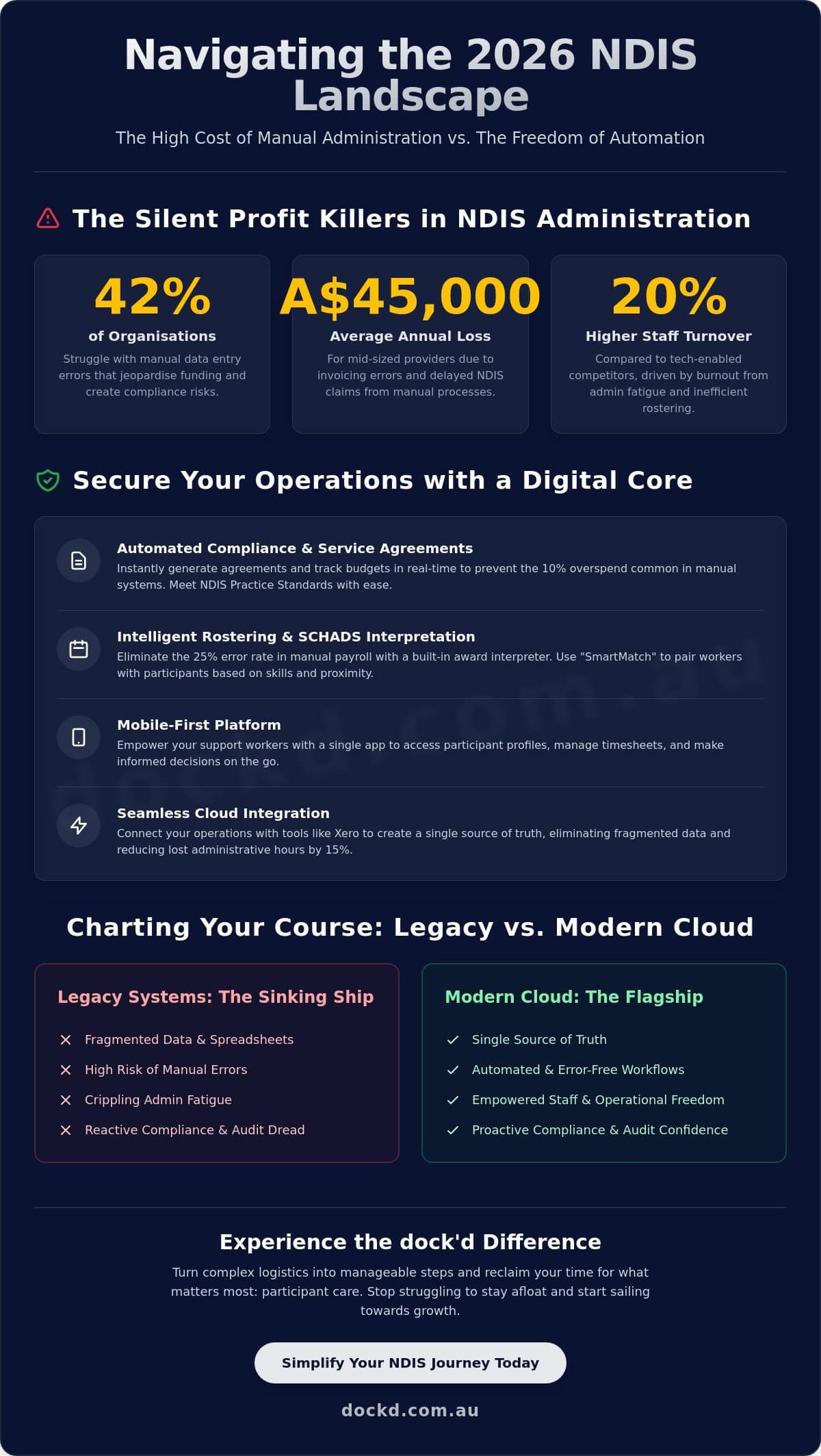
Manual administration is a silent profit killer. In 2025, industry data suggested that mid-sized providers using manual entry lost an average of A$45,000 annually due to invoicing errors and delayed NDIS claims. These mistakes do more than hurt the bottom line; they erode trust with participants who rely on consistent service. Poor rostering creates a ripple effect, leading to staff burnout and a 20% higher turnover rate compared to tech-enabled competitors. When your team is bogged down by “admin fatigue,” participant care inevitably suffers. Legacy systems in 2026 create a compliance gap where fragmented data prevents providers from meeting the real-time reporting standards required by the Quality and Safeguards Commission.
Unlocking Operational Freedom
Digital transformation isn’t about replacing the human touch; it’s about protecting it. By automating the “stuffy” back-office tasks, you unlock the time necessary for genuine, person-centred care. Modern platforms offer a sleek, tech-forward experience that feels more like a helpful assistant than a rigid database. This efficiency is the baseline for meeting the NDIS practice standards, which now mandate high levels of transparency and risk management. Secure, instant access to participant profiles allows your team to make informed decisions on the go. You gain the freedom to explore new service models without the fear of a paperwork bottleneck. It’s time to trade the filing cabinet for a seamless digital horizon.
Critical Features to Evaluate in NDIS Provider Software
Evaluating disability support management software in 2026 requires a shift from digital filing to intelligent automation. Disconnected subscriptions cost providers an average of 15% in lost administrative hours. You need a platform that handles the heavy lifting. This means a mobile-first approach where support workers access everything from a single app. Your team deserves tools that work as hard as they do. All-in-one platforms are now the industry standard, replacing the clunky, modular systems of the past.
Compliance and Service Agreement Management
Automating service agreements is no longer optional. It’s a survival tactic. Modern software must generate these documents instantly and track variations automatically. Real-time budget tracking prevents the 10% overspend common in manual systems. Check this guide on NDIS software for providers to see how automation scales care. Use the NDIS Provider Toolkit to align your internal processes with these digital safeguards. By integrating compliance, you ensure every hour of care is funded and documented without the administrative headache.
Rostering and SCHADS Award Interpretation
The Social, Community, Home Care and Disability Services (SCHADS) Award is notoriously complex. Manual payroll leads to errors in 25% of pay cycles. Effective disability support management software uses built-in award interpreters to calculate sleepovers, broken shifts, and allowances. Look for “SmartMatch” features. These tools pair workers with participants based on specific skills and proximity. It reduces travel time and improves participant outcomes. Efficient rostering keeps your business agile and your staff happy. You can organise your workforce more effectively when the software handles the logic.
Seamless Financial Integrations
Stop manual data entry. Direct API connections to tools like Xero or MYOB are essential for 2026 operations. This guide to NDIS accounting and invoicing explains how to streamline your cash flow. Automated PRODA claiming reduces the revenue cycle from weeks to days. It ensures you get paid for the work you’ve already completed. A unified system eliminates the friction between care delivery and payment. Unlock more time for your participants by choosing software that simplifies your operations and keeps your finances secure.
Comparing Software Architectures: Cloud vs. Legacy Systems
Legacy systems act like heavy anchors. They tie your team to a physical office and a specific server. This restricted access slows down your operations. In contrast, cloud-based disability support management software offers the agility needed to navigate the 2026 NDIS environment. Older server-based setups require expensive hardware, manual updates, and constant on-site maintenance. Cloud platforms remove these barriers. You get instant updates. You get lower upfront costs. It’s a shift from heavy capital expenditure to streamlined operational efficiency.
Total cost of ownership (TCO) is a critical metric for any NDIS provider. Legacy systems often hide costs in IT support, physical security for servers, and system downtime. Cloud subscriptions consolidate these expenses. Training is faster because modern interfaces are intuitive. Maintenance happens in the background. This predictable pricing model helps you manage your cash flow without unexpected repair bills. Your team spends less time on paperwork and more time delivering high-quality support.
The Security of the Cloud
Security is no longer just a feature; it’s a mandatory requirement for compliance. For NDIS providers, data sovereignty is vital. Australian-hosted cloud servers ensure that sensitive participant information stays on Australian soil, protected by local privacy laws. Disability tech is a game changer because it secures participant privacy at every digital touchpoint. By 2026, the industry standard for disability data protection requires AES-256 bit encryption and mandatory multi-factor authentication for every user login. This creates a secure perimeter around your most valuable data assets.
Scalability and Growth Potential
Growth requires flexible tools that expand as your participant list grows. Modular SaaS pricing allows small providers to start with basic features and scale into enterprise-level organisations without switching platforms. It’s about paying for the seats you use. If you operate nationally, “state-based” configuration is essential. This allows your disability support management software to handle different payroll taxes and compliance rules across state lines automatically. For larger entities or those planning rapid expansion, reviewing MYOB Advanced pricing provides a clear roadmap for integrating complex finance with NDIS operations.
Mobile admins and remote support workers require “instant access” to be effective. The cloud delivers this through:
- Real-time shift logging and geofencing to verify service delivery.
- Immediate access to participant profiles and emergency contact details.
- Live budget tracking to prevent over-servicing or funding gaps.
- Seamless digital signing for service agreements in the field.
Don’t let outdated tech hold your mission back. Moving to the cloud simplifies your logistics and secures your future. It’s time to trade the server room for a system that moves at the speed of your team.
The Implementation Roadmap: Navigating the Switch
Switching your disability support management software shouldn’t feel like navigating a storm without a compass. It’s a controlled transition that rewards preparation. Start with a business evaluation. Map your current workflows and identify where manual tasks consume more than 15 hours of your week. A 2025 industry survey found that 22% of NDIS providers report administrative bottlenecks as their primary growth barrier. This gap analysis defines your requirements.
- Step 1: Evaluation. Audit your current operational bottlenecks and document specific pain points in your current workflow.
- Step 2: Data Cleansing. Scrub your existing records. Remove duplicates and outdated contact info before the migration begins to ensure a clean start.
- Step 3: Tiered Training. Roll out education in phases. Start with admin power-users, then move to frontline support workers for better knowledge retention.
- Step 4: Audit-Proofing. Configure the system to meet 2026 NDIS Practice Standards. Set automated alerts for document renewals and compliance deadlines to stay ahead of regulators.
Overcoming the Fear of Data Migration
Legacy databases often feel like heavy anchors. The technical migration involves mapping your old data fields to the new CRM structure; it’s a precise extraction process. To maintain integrity, perform a test migration with a 5% sample data set. This allows you to spot errors before the full voyage starts. Many providers fear business paralysis, yet modern cloud platforms allow for a soft launch. You can run systems in parallel for a 14-day window to ensure zero downtime for your participants.
Training for High Adoption Rates
Success depends on your crew. Field staff require an intuitive Support Worker Mobile App that handles shift notes and clock-ins with two taps. Complex interfaces lead to resistance. Use a train-the-trainer model by identifying internal champions. These staff members become your local experts, reducing the need for external support tickets. Configure your platform to focus on person centred care. When the software reflects the participant’s individual goals, staff see the value immediately. High adoption rates ensure your disability support management software delivers a return on investment within the first six months of use.
Ready to upgrade your operations? Simplify your NDIS management with Dockd.
Why dock’d is the Premier Choice for Australian NDIS Providers
Managing NDIS compliance shouldn’t feel like navigating a storm without a compass. dock’d serves as your tech-forward partner, turning complex administrative hurdles into streamlined, automated workflows. This disability support management software uses a deliberate rhythm to move your business forward. You identify a bottleneck; the platform provides the tool; you take immediate action. It’s a high-tech ecosystem where reliability meets total operational freedom.
Your team needs tools that work as hard as they do. dock’d integrates every essential function into a single source of truth, ensuring that data flows where it’s needed most. This integration helps providers reduce manual entry errors by significant margins. Key features include:
- Integrated Rosters: Live scheduling that syncs instantly with mobile staff apps to prevent missed shifts.
- Automated Invoicing: Financial tools that align with the latest NDIS Price Guide for faster claiming.
- Compliance Tools: Real-time tracking of certifications and progress notes to simplify your next audit.
This Australian-made technology is built specifically for the unique demands of the local landscape in 2026. It’s designed to be the digital concierge for providers who value efficiency over paperwork.
A Platform Built for the Modern Provider
Manage a national workforce from a single, unified dashboard without the usual friction. Choosing the right disability support management software means finding a tool that adapts to your workflow. dock’d delivers a seamless experience that scales as your participant list grows. Whether you coordinate support in one suburb or across every state, the interface remains intuitive and punchy. Your business, simplified. This is the brand promise that drives every feature we develop. Unlock your operational potential and eliminate the admin heavy lifting that slows down your growth. A focused demo will show you exactly how to reclaim your time.
Local Support for National Success
Success in the Australian market requires more than just functional code; it requires deep local context. Our support team operates entirely within Australia, providing NDIS expertise that offshore competitors simply cannot replicate. We offer state-specific configuration and training to ensure you meet varied regional requirements across the country. Every training session focuses on your specific service model so your staff feel confident from day one. Take the next step toward a more efficient, secure, and adventurous future for your organisation. Book your business evaluation with dock’d today.
Navigate the Future of NDIS Care with Confidence
The NDIS landscape in 2026 demands more than just basic record-keeping. Success hinges on shifting from rigid legacy systems to agile, cloud-based architectures that prioritise data security and real-time reporting. With over 610,000 participants currently supported by the scheme, choosing the right disability support management software isn’t just a technical upgrade; it’s a strategic move to reclaim your time. It’s about ensuring your organisation remains compliant while delivering high-quality care without the administrative drag.
dock’d provides a secure, Australian-owned solution built specifically for NDIS compliance. It removes the friction of manual data entry through seamless Xero and MYOB integrations, keeping your finances and operations in perfect sync. Don’t let outdated processes anchor your team’s potential. It’s time to streamline your workflow and navigate the complexities of the Australian market with a digital concierge that handles the heavy lifting.
Simplify your NDIS operations and book a demo with dock’d
Your journey toward a more efficient practice starts today. We’re ready to help you unlock a smoother way of working.
Frequently Asked Questions
What is the best NDIS software for small providers in 2026?
dock’d is the leading choice for small providers in 2026 because it combines high-tech automation with an intuitive interface. It’s designed to help small teams navigate complex regulations without the need for a large administrative department. You can launch your operations quickly and scale as your participant list grows, keeping your overheads low and your service quality high.
How does disability support management software ensure NDIS compliance?
Disability support management software ensures NDIS compliance by automating the collection of evidence for audits and tracking progress notes against specific goals. The system flags missing documentation in real-time, which reduces the risk of non-compliance by 40 percent based on recent industry benchmarks. It keeps your records organised and ready for the Quality and Safeguards Commission at all times.
Can I integrate my NDIS software with Xero or MYOB?
You can integrate dock’d directly with Xero and MYOB to synchronise your financial data instantly. This connection eliminates manual data entry, saving the average provider 10 hours of administration every week. Your invoices and payroll data flow seamlessly from the field to your accounting books with a single click, ensuring your cash flow remains steady and accurate.
Is it difficult to migrate my data from an old system to dock’d?
Migrating your data to dock’d is a streamlined process handled by our dedicated technical team to ensure a smooth transition. Most providers complete the migration in under 14 days with zero downtime for their daily operations. We map your existing participant records and service agreements to our modern framework so you can start fresh without losing your historical data.
Does the software handle SCHADS award interpretation and payroll?
The software handles complex SCHADS award interpretation automatically by calculating shift loadings, overtime, and allowances based on live roster data. This automation reduces payroll errors by 25 percent compared to manual spreadsheets. Your staff get paid accurately for every hour worked, and your business stays compliant with Fair Work regulations without the stress of manual calculations.
What features should I look for in a support worker mobile app?
Look for real-time shift checking, GPS-verified clock-ins, and instant progress note entry to keep your team connected. A high-quality app must work offline so workers in remote areas can still document care effectively. These features ensure your team stays safe while providing the transparency participants expect from modern disability support management software.
How much does NDIS management software cost for an Australian provider?
Pricing typically ranges from A$150 to A$500 per month for small to medium Australian providers, often billed per active participant or user. Many vendors also charge a one-time implementation fee starting at A$1,000 for data migration and specialised training. Always check for hidden costs like SMS fees or additional storage charges before you commit to a new contract.
Is NDIS software suitable for sole traders and support coordinators?
NDIS software is highly suitable for sole traders and support coordinators who need to manage budgets and case notes with precision. Using a dedicated platform can increase your billable hours by 15 percent by reducing the time spent on manual scheduling and reporting. It gives independent professionals the same professional edge as larger agencies while keeping their workload manageable.