

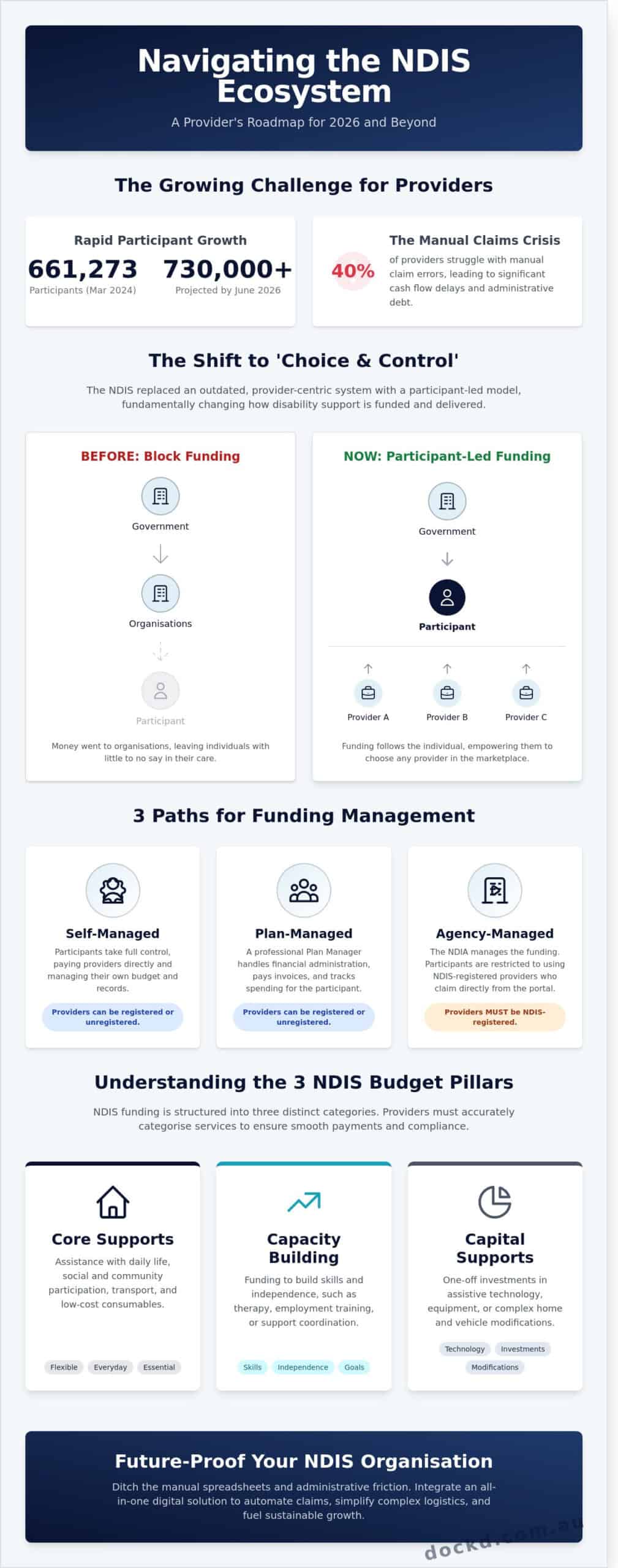
By June 2026, the NDIS will support over 730,000 participants, yet 40% of registered providers still struggle with manual claim errors that delay their cash flow. You likely feel the weight of this rapid growth. Managing bureaucratic complexity and the constant fear of a failed audit can make your mission feel like a mountain of paperwork. It’s frustrating when your passion for providing care is buried under administrative debt and inefficient systems.
Your provider journey, simplified. This guide helps you unlock the full potential of the NDIS ecosystem by providing a clear, actionable roadmap for registration and compliance. We’ll show you how to move from manual chaos to a secure, tech-forward operation that prioritises participants over paperwork. Discover how to master NDIS claims and reporting with total confidence in the 2026 market. We’ll start by breaking down the current regulatory framework before diving into the essential steps for building a modern, audit-ready disability support business.
Key Takeaways
- Master the shift to participant-led funding and learn to navigate the three primary budget categories with total precision.
- Secure your business by aligning with the latest NDIS Practice Standards and understanding your specific compliance obligations.
- Ditch the manual spreadsheets and integrate PRODA to automate your claiming process and eliminate administrative friction.
- Future-proof your organisation with an all-in-one digital solution designed to simplify complex logistics and fuel sustainable growth.
What is the NDIS? Defining Australia’s Disability Support System
The National Disability Insurance Scheme (NDIS) represents Australia’s most significant social reform since the introduction of Medicare in 1984. It launched in July 2013 to replace an outdated, “lottery-based” system of disability support. Before this reform, disability services relied on block funding. This meant the government gave money directly to organisations, leaving individuals with very little say in the care they received. The NDIS flipped this model completely. It introduced individualised, participant-led funding where the money follows the person, not the provider. This transition ensures that support is personal, flexible, and tailored to specific needs.
The core philosophy of the scheme is “Choice and Control.” This isn’t just a tagline; it’s a functional mandate that gives people with disability the power to decide who supports them and how those supports are delivered. It treats participants as consumers in a competitive marketplace rather than passive recipients of welfare. Managing this complex ecosystem is the National Disability Insurance Agency (NDIA). As the scheme manager, the NDIA oversees the A$44 billion annual budget allocated in the 2024-25 federal budget, ensuring the system remains financially viable while delivering essential services to those who need them most.
The Core Purpose of the NDIS
The NDIS focuses on unlocking the potential of every individual by increasing social and economic participation. As of March 2024, the scheme supports 661,273 participants, helping them engage with their communities and enter the workforce. By providing long-term, sustainable funding for essential supports, the scheme removes the financial friction that once prevented people with disability from living independently. It provides a secure foundation for participants to pursue their goals without the fear of support suddenly disappearing. The NDIS is a lifetime insurance approach for all Australians that guarantees support for anyone who acquires a permanent and significant disability.
Who is Involved? Key Stakeholders in 2026
- The Participant: The individual at the centre of the NDIS plan who directs their own journey and chooses their own destination.
- The Provider: Businesses and specialists who deliver the services, equipment, and therapy required to meet participant goals.
- The NDIS Quality and Safeguards Commission: The national regulator that ensures safety, handles complaints, and maintains high standards across the entire industry.
This structure creates a secure, transparent marketplace. It simplifies the logistics of disability support, moving away from old-fashioned bureaucracy toward a tech-forward, efficient model. For providers, understanding this landscape is the first step in delivering high-quality, impactful support. The ndis isn’t just a funding body; it’s a catalyst for a more inclusive Australian society.
How the NDIS Ecosystem Operates: Plans, Budgets, and Categories
The participant journey starts with a formal access request and moves quickly into the planning phase. Once the National Disability Insurance Agency confirms eligibility, participants meet with a representative to define their personal goals. By 2026, the planning process has shifted toward a more rigorous assessment of evidence-based supports. This ensures every A$ allocated produces a clear, functional benefit. It’s no longer enough for a service to be a general preference; it must be necessary and reasonable under the updated October 2024 legislative framework.
Participants choose how to manage their funding based on their desired level of control. Self-managed participants take full responsibility for their budget, paying providers directly and keeping records for five years. Plan-managed participants use a dedicated professional to handle the financial administration. Agency-managed plans require participants to use registered providers who claim directly through the digital portal. Each path requires different levels of documentation and reporting from the service provider to ensure transparency.
Understanding NDIS Support Categories
Scheme budgets consist of three distinct pillars designed to address different aspects of a participant’s life. Core Supports are the most flexible, covering daily activities, transport, and low-cost consumables. Capacity Building focuses on long-term goals, funding items like occupational therapy, employment training, or support coordination. Capital Supports involve one-off investments in assistive technology or complex home modifications. Providers must accurately categorise services to avoid payment delays or potential audit flags from the agency.
- Core: Assistance with daily life, social community participation, and basic consumables.
- Capacity Building: Improved living arrangements, finding and keeping a job, and therapeutic supports.
- Capital: Specialist Disability Accommodation (SDA) and high-tech equipment.
The Role of the Price Guide and Support Lists
The Pricing Arrangements and Price Limits set the maximum rates providers can charge for specific services. These limits are reviewed annually on 1 July to keep pace with the Australian economy and labour costs. The 2026 support lists define exactly what items are claimable, leaving less room for ambiguity than in previous years. Providers must align their service agreements with these lists to ensure participants aren’t left with out-of-pocket expenses.
Maintaining a high standard of service while staying within these price ceilings is the primary challenge for modern providers. Aligning your business operations with NDIS Practice Standards & Compliance Requirements is non-negotiable for maintaining your registration and building trust with participants. It’s about delivering high-quality care while respecting the financial boundaries of the scheme. Your provider operations, simplified, depends on staying ahead of these regulatory shifts and ensuring every claim is backed by solid evidence.
Navigating NDIS Practice Standards & Compliance Requirements
Compliance keeps your business afloat. The NDIS Practice Standards act as the ultimate benchmark for quality and safety, ensuring participants receive consistent support across Australia. Whether you’re a solo provider or a large agency, these standards dictate how you manage risks and deliver care. They aren’t just suggestions; they’re the rules of the sea for disability services.
Providers generally fall into two categories: Registered and Unregistered. Registered providers can deliver high-risk supports, such as specialist disability accommodation or behaviour support. They face rigorous oversight from the NDIS Quality and Safeguards Commission. Unregistered providers have more flexibility but cannot provide certain services or access agency-managed funding. Both must adhere to the NDIS Code of Conduct regardless of their registration status.
Registration requires a formal audit. For low-risk services, you’ll undergo Verification. This is a desktop review of your policies and procedures. High-risk services require Certification. This involves on-site audits and interviews with staff and participants to verify your operational excellence. Every staff member in a risk-assessed role must also clear the NDIS Worker Screening Check before they start. This national check ensures that workers don’t pose an unacceptable risk to people with disability, creating a safer environment for everyone.
Essential Compliance for Every Provider
Clear documentation simplifies your operations. You must develop robust NDIS Service Agreements that outline exactly what supports you’ll provide and the costs involved. These documents protect your revenue and the participant’s rights. Effective incident reports and feedback systems are also mandatory. You must track every slip-up or complaint to drive continuous improvement. For a deeper dive into these requirements, read our NDIS Practice Standards guide to stay ahead of the curve.
The NDIS Code of Conduct
The Code of Conduct is the moral compass of the NDIS. It contains seven key elements that all providers and workers must follow:
- Act with respect for individual rights to freedom of expression, self-determination, and decision-making.
- Respect the privacy of people with disability.
- Provide supports and services in a safe and competent manner with care and skill.
- Act with integrity, honesty, and transparency.
- Promptly take steps to raise and act on concerns about matters that might impact the quality and safety of supports.
- Take all reasonable steps to prevent and respond to all forms of violence, exploitation, neglect, and abuse.
- Take all reasonable steps to prevent and respond to sexual misconduct.
The NDIS Commission has the power to issue fines or ban providers who fail these tests. Compliance is a continuous process, not a one-off event. Your compliance, simplified, means more time spent delivering life-changing support and less time worrying about red tape.
Operational Excellence: Managing Your NDIS Business Effectively
Running an NDIS business is a high-stakes voyage. You face constant hurdles with rostering, claiming, and reporting. These logistics sink approximately 30% of administrative time when handled manually. You need a clear map to stay afloat. Integrate your systems with PRODA immediately. Automated claiming removes the manual friction of the NDIS portal. It ensures you get paid on time. This digital bridge turns a complex government requirement into a seamless background process.
The 2026 landscape demands person centred care. This isn’t just a buzzword; it’s an operational mandate. Shift your focus from filling shifts to matching lives. Transparency is your anchor. Use Xero integration to keep your books clean and accessible. Real-time financial data builds trust with participants and the NDIA. It proves your business is grounded and reliable. When your finances are transparent, your growth becomes predictable.
Streamlining NDIS Rostering and Invoicing
Don’t just assign a body to a shift. Match support worker skills with specific participant goals. A worker with specialized mental health training shouldn’t be doing general domestic assistance if a complex care participant needs their expertise. This precision prevents staff burnout and improves participant outcomes. Automated NDIS accounting and invoicing is your lifeline for cash flow. When invoices trigger the moment a shift ends, your business sustainability improves. Explore NDIS software for providers to automate these complex logistics and secure your revenue stream.
Simplifying Support Coordination (COS)
Support Coordinators act as the navigators of the NDIS. They help participants unlock the full potential of their plans. Tracking billable hours is often where revenue leaks occur in COS. Use digital tools to capture progress notes and billable time instantly. This ensures every minute of advocacy is accounted for and compliant with the latest NDIA price guide. Check out the Comm Care guide for specific operational tactics that reduce your paperwork load.
Ready to streamline your operations and reclaim your time? Simplify your NDIS management today.
Future-Proofing Your NDIS Organisation with dock’d
Manual spreadsheets are the single greatest risk to your NDIS business growth. Research from 2024 indicates that providers relying on manual entry spend roughly 30% more time on administrative tasks compared to those using automated systems. By 2026, the NDIS Quality and Safeguards Commission will demand even more rigorous digital evidence for every service claim. Fragmented Excel files create silos, increase the risk of underpayment, and make audits a stressful ordeal. Relying on outdated methods is a gamble with your registration. Stop managing files. Start managing care.
dock’d provides the high-tech solution for the modern Australian provider. Our all-in-one platform replaces chaos with a streamlined, secure hub. We provide the real-time data you need for NDIS audits and business evaluations. You can see your operational health at a glance. Simplify your journey. Reclaim your time.
Why dock’d is the Tech-Forward Choice
We built dock’d specifically for the Australian NDIS market. It is not a generic management tool; it is a localised engine designed for compliance. Our platform offers a seamless integration of rosters, timesheets, and NDIS invoicing. This creates a rhythmic flow from service delivery to payment. Because the system is cloud-based, you can manage remote support workers with total precision from any location. You gain instant visibility into shift completions and incident reporting. It’s your NDIS operations, simplified. If you’re currently evaluating your existing platform against newer options, our Visualcare vs modern NDIS software alternatives checklist provides a practical framework for making that comparison.
- Localised Compliance: Built-in features that align with the latest NDIS Practice Standards.
- Instant Integration: Connect your rosters directly to your billing cycle to eliminate manual errors.
- Cloud Accessibility: Empower your team with mobile tools that work wherever they are.
Getting Started: Your Digital Transformation
Moving away from legacy systems is the first step toward a secure future. Many providers hesitate because they fear data loss, but dock’d assists with every stage of migration. We ensure your client records and staff data move safely into our secure environment. We prioritise expert setup support and staff training to ensure your team is confident from day one. This transformation is about more than software; it’s about unlocking your business potential. Our team acts as a digital concierge to guide you through the transition. Once you’re live, you’ll have the transparency needed for any NDIS audit. Take the lead in a digital-first industry. Book a demo with dock’d today.
Chart Your Course for 2026 and Beyond
Success in the NDIS ecosystem requires more than just passion. It demands a robust framework for compliance and operational precision. By 2026, providers must master the Practice Standards to remain competitive while managing complex budgets and diverse support categories. Efficiency isn’t just a luxury; it’s the engine that drives your organisation forward. You need systems that work as hard as your team to support the community.
Stop letting manual paperwork anchor your growth. Since 2016, dock’d has provided an Australian-owned and operated solution designed to remove friction from your daily workflow. You can automate PRODA claiming and sync seamlessly with Xero integration to ensure your cash flow remains steady. Our platform simplifies NDIS-compliant accounting and invoicing so you can focus on delivering person centred care instead of chasing signatures. Before committing to a complex ERP platform, growing providers should also review MYOB Advanced pricing for NDIS providers in 2026 to understand how those costs compare against purpose-built management software. It’s about working smarter and staying secure in a digital-first landscape.
Ready to simplify your NDIS operations? Discover how dock’d can help you scale.
The future of disability support is bright for providers who choose the right tools to navigate the journey. You have the vision, and we have the tech to help you reach it.
Frequently Asked Questions
What does NDIS stand for and what is its main goal?
NDIS stands for the National Disability Insurance Scheme. Its primary goal is to provide individualised support to Australians with permanent and significant disabilities, along with their families and carers. As of March 2024, the scheme supports 646,449 participants across the country. It focuses on early intervention and providing necessary resources to improve a person’s independence and community involvement over time.
Do I need to be a Registered NDIS Provider to start a business?
You don’t need to be a registered provider to start your business, but it limits who you can serve. Unregistered providers can only work with participants who self-manage their funds or use a plan manager. If you want to provide specialist disability accommodation or use restrictive practices, registration is mandatory. Evaluate your target market first to decide which pathway suits your business model best.
What are the three main NDIS funding categories?
The three main funding categories are Core Supports, Capital Supports, and Capacity Building Supports. Core Supports cover daily activities like cleaning or transport, while Capital Supports fund expensive investments like assistive technology or home modifications. Capacity Building Supports focus on activities that help participants learn new skills. Each category ensures that funding is used effectively to meet the specific goals outlined in a participant’s plan.
How much does it cost to get an NDIS audit?
Audit costs depend on your registration pathway and the complexity of your services. A simple Verification audit for low-risk services usually costs between A$900 and A$1,500. If you provide high-risk services, you’ll need a Certification audit. These start at A$3,000 and can exceed A$10,000 for large organisations with multiple sites. Get quotes from several approved quality auditors to find the best rate for your business.
Can I use standard accounting software like Xero for NDIS invoicing?
Yes, you can use Xero for NDIS invoicing to keep your finances organised and transparent. It handles ABN requirements and the GST-free status for most disability services effectively. Many providers integrate Xero with NDIS-specific CRM tools to automate bulk claims and reduce manual data entry. This tech-forward approach simplifies your administrative tasks, allowing you to focus more on delivering high-quality care to your participants.
What is the NDIS Worker Screening Check and is it mandatory?
The NDIS Worker Screening Check is a national assessment that determines if a person poses a risk to people with disability. It’s mandatory for all workers in “risk-assessed roles” at registered provider organisations. Unregistered providers aren’t legally required to ensure workers have this check, but many do so to build trust and ensure safety. Apply through your state or territory agency to clear your staff before they start work.
How often do NDIS plans get reviewed for participants?
Plans are typically reviewed every 12 to 24 months to ensure the funding still meets the participant’s needs. However, a participant can request a “change of circumstances” review at any time if their situation shifts significantly. Stay proactive by documenting all progress and challenges. This data helps the participant secure the right level of support during their next scheduled meeting with the agency.
What happens if an NDIS provider is found non-compliant?
Non-compliant providers face serious penalties from the NDIS Quality and Safeguards Commission. These range from formal compliance notices and heavy fines to the total revocation of your registration. During the 2022-23 financial year, the Commission issued 87 infringement notices and 35 banning orders to protect the community. Maintain strict records and follow the Practice Standards to keep your business secure and your reputation intact.